Confusion Continues The bad news is markets tend to get jittery when the Fed is preparing for a new interest rate cycle. The good news is the primary reason the Fed is contemplating raising interest rates is a strengthening U.S. economy. The question in the short run is: Will the economy be strong enough to offset the negative impact of higher rates? The odds of the answer being “yes” increased Thursday. From Reuters: Gross domestic product expanded at a 4.2 percent annual rate instead of the previously reported 4.0 percent pace, the Commerce Department said on Thursday. Both business spending and exports were revised higher, while a buildup in business inventories was smaller than … [Read more...]
How Low Inflation in Europe Could Affect Your Investments in the U.S.
Last December, we explained why central bankers are terrified of economies that slip into a very difficult to stop deflationary spiral. European policymakers are not yet terrified, but it is fair to say they are concerned about what has been persistent low inflation. From Reuters: Euro zone price inflation fell unexpectedly in May, increasing the risks of deflation in the currency area and all-but sealing the case for the European Central Bank to act this week. Annual consumer inflation in the 18 countries sharing the euro fell to 0.5 percent in May from 0.7 percent in April, the EU’s statistics office Eurostat said on Tuesday. Fed Casts A Wider Economic Net Unlike the … [Read more...]
Inflation Expectations and the FED
As inflation expectations rise the FED has less and less "wiggle room" to stimulate the economy. But how do you measure "inflation expectations"? In today's article, Chris Ciovacco will show us. ~Tim McMahon, editor Low Inflation Leaves Fed’s No Taper Door Open Fed Lost Control In 2008 In early December, we used Japan as an extreme example of why central banks are terrified of allowing their respective economies to slip into a deflationary spiral. Do the same concepts apply to the United States? They do. The federal government offers standard Treasury bonds (IEF) and Treasuries that provide some protection against inflation (TIP). The law of supply and demand tells us that when demand … [Read more...]
FED Looks for New Ways to Crank Up Money Supply
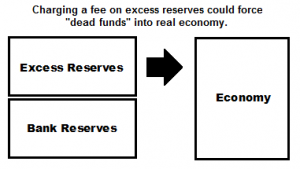
With all the talk about "Tapering" you'd think the FED was actually considering reducing it's money pumping. But in actuality that is not it at all. The FED is afraid that it is creating a a bubble in the stock market so it is looking for ways to continue its pumping but shift it enough so that the money goes somewhere besides just to the stock market. In other words, it is still worried about the economy and realizes that it is doing more harm than good but feels trapped, so it is looking for new ways that might work better. If the FED can figure out how to free up the log jam of "excess reserves" held by the banks, liquidity could be sloshing around the economy before you know it and … [Read more...]
“No QE3″, Retracement Level Stalls Financials
Since financial stocks make up 14% of the S&P 500 Index, it is difficult to sustain a rally without strength in banks and financial services firms. With the Fed and ECB opening up the liquidity fire hydrant in late December 2011, bank stocks experienced another in a series of monster bailout rallies. As outlined below, the Financials Select Sector ETF (XLF) may be poised to give back some gains over the coming sessions based on numerous factors including reduced odds of QE3. Unfortunately in the debt-saddled world we live in, central banks may be the most important driver of asset prices. Dallas Fed President Richard Fisher told reporters after a speech Wednesday: There will be no … [Read more...]
Fed To ‘Hold Off’ On QE 3
We noted extreme levels of optimism earlier today. What could possibly trigger a correction in stocks and commodities? If the Fed fails to signal and/or announce another round of quantitative easing (QE), it would undoubtedly leave the markets disappointed. The Fed uses the Wall Street Journal (WSJ) as a medium to communicate with the markets. It is possible someone at the Fed picked up the phone and said, “We need to temper short-term expectations for another round of QE. Can you help us out?” Friday’s WSJ has an article titled “Fed Holds Off For Now on Bond Buys”. Notice the word “may” is not included. Here is the first paragraph of the article: Federal Reserve officials are waiting … [Read more...]
Markets Fear Deflation
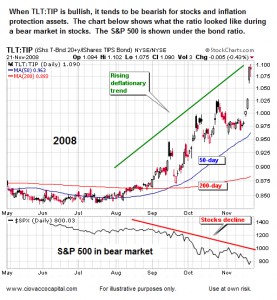
The best way to know the future is to survey millions of people and analyze their responses. That is exactly what the market does every day. And even better Mr. Market knows not only what people say they believe but where they are putting their money as well. In the following article Chris Ciovacco, the Chief Investment Officer for Ciovacco Capital Management shows us how the markets view the current possibility of deflation. Chris has an amazingly simple chart that shows us exactly what the market is thinking right now. That chart is the ratio of Treasuries to Treasury Inflation-Protected Securities (TIPS). Currently the ratio is indicating a deflationary bias in the market. When you think … [Read more...]
How The FED Prints Money- Part 4
This is part 4 in the video series on the effects of Quantitative Easing by Chris Ciovacco the Chief Investment Officer for Ciovacco Capital Management. To see the other parts How the FED Prints Money, How the FED Prints Money – Part 2, How The FED Prints Money- Part 3 … [Read more...]
How The FED Prints Money- Part 3
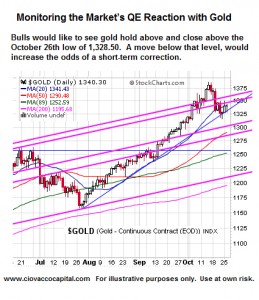
Last week we looked at who gets all the money the FED prints and before that we looked at the process the FED uses to get the money "Out of Thin Air" and into the hands of people who can spend it. Today we are going to look at what is "Quantitative Easing" well it sounds cool anyway... ~editor What is Quantitative Easing? Fed’s Perspective & Writings Part 3 in a 6 Part Video Series on Quantitative Easing A Wall Street Journal article (10/27/10) on quantitative easing (QE) hints the Fed will take a middle of the road approach in terms of the size and duration of QE2. As we would expect, the stock and commodity markets’ initial reaction is negative. A middle of the road … [Read more...]
How the FED Prints Money – Part 2
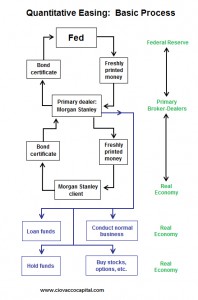
Yesterday we looked at the process the FED uses to get the money "Out of Thin Air" and into the hands of people who can spend it. In other words the "how" they do this magic. Basically, that route is through special dealers and then it goes into a few select hands. Today we are not going to look at the "how" but instead we will look at "Who" gets the money and where it is likely to go from there. Because if we know where it is likely to go we can get there first and profit from the incoming cash flow. ~Tim McMahon, editor Quantitative Easing (QE2): Who Gets the Fed’s Printed Money? Part 2 of a 6 Part Video Series on Quantitative Easing: In Part 1: How the FED Prints Money, we … [Read more...]

