• Home
  • Related Sites
    • Financial Trend Forecaster
      • Moore Inflation Predictor
      • NYSE Rate of Change (ROC)
      • NASDAQ Rate of Change (ROC)
      • Crypto ROC- BTC & ETH
    • Unemployment Data
      • Historical Employment Data
      • Unemployment Rate Chart
      • Labor Force Participation Rate
    • Optio Money
    • Elliott Wave University
    • More Resources
  • Definitions
    • What is Inflation?
    • What is Core Inflation?
    • Inflation vs CPI
    • What is Deflation?
    • What is Disinflation?
    • What is Agflation?
    • What is Stagflation?
    • What is Hyperinflation?
    • What is Quantitative Easing?
    • What is Quantitative Tightening?
    • What is Velocity of Money?
    • What is Fiat Currency?
    • How Do I Calculate Inflation?
    • What are “Sticky Prices” and Why Do They Matter?
  • Featured Content
  • About Us
  • Feedback
    • Sitemap
  • Subscribe Now

InflationData.com

Your Place in Cyber Space for Inflation Data

CPI Index

CPIWidgetSept25
  • Numerical Inflation Data
    • Current Inflation Rate
    • Monthly Inflation Rate
    • Historical U.S. Inflation Rates
    • Historical CPI
  • Inflation Charts
    • Ann. Inf. Rate Chart
    • Long Term Inflation >
      • Ave. Inf. by Decade
      • Total Inf. by Decade
      • Inflation 1913-1919
      • Inflation 1920-1929
      • Inflation 1930-1939
      • Inflation 1940-1949
      • Inflation 1950-1959
      • Inflation 1960-1969
      • Inflation 1970-1979
    • Cumulative Inflation
    • FED Monetary Policy and Inflation
    • Inflation and Recession
    • Confederate Inflation (1861 – 1865)
    • Misery Index
    • The 3 Stages of Inflation
    • 15-Yr Inflation Trends Chart
  • Inflation Calculators
    • Cumulative Inf. Calc.
    • How Much Would it Cost
    • Salary Inf. Calc.
    • Cost of Living Calc.
    • U.K. Inf. Calc.
    • Cost of Gas Calc.
    • Net Worth Calc.
    • Lifetime Earnings Calc.
    • Savings Goal Calc.
    • Financial Calculators
  • Inf. Adjusted Prices
    • Energy >
      • Inflation Adj. Gas Prices
      • Historical Oil Prices Chart
      • Crude Oil Price (Table)
      • Natural Gas Prices
      • Electricity Prices
      • Oil vs Gold
    • Gold >
      • Inflation Adjusted Annual Average Gold Prices
      • Gold is a “Crisis Hedge” not an  “Inflation Hedge”
      • Comparing Oil vs. Gold
    • Corn Prices
    • Education Inflation
    • Housing Prices
    • Mortgage Rates
    • NYSE Index
    • Inf. Indexed Bonds
    • Movie Revenues
    • Inflation-Adjusted Wages
  • Cost of Living
    • Calculate Cost of Living
    • Cost-of-living Adj. (COLA)
    • Consumer Price Index CPI
      • Historical CPI
      • Current CPI
      • CPI Release Dates
    • Gas Prices >
      • Cost of Gas
      • Cost of Gas Per Month
      • Gas vs. Oil Price Chart
    • Food Prices 1913 vs 2013
    • Health Insurance
  • Blog
    • Key Inflation Articles
    • International Inflation
    • Historical Inflation Rates for Japan (1971 to 2014)
You are here: Home » Blog » Government » The Federal Reserve » How The FED Prints Money- Part 3

How The FED Prints Money- Part 3

Published on November 11, 2010 Updated on March 30, 2014 by Chris Ciovacco Leave a Comment

Last week we looked at who gets all the money the FED prints and before that we looked at the process the FED uses to get the money “Out of Thin Air” and into the hands of people who can spend it. Today we are going to look at what is “Quantitative Easing” well it sounds cool anyway… ~editor


What is Quantitative Easing? Fed’s Perspective & Writings

Part 3 in a 6 Part Video Series on Quantitative Easing

A Wall Street Journal article (10/27/10) on quantitative easing (QE) hints the Fed will take a middle of the road approach in terms of the size and duration of QE2. As we would expect, the stock and commodity markets’ initial reaction is negative. A middle of the road approach to QE seems counter intuitive to the Fed’s own historical analysis of why quantitative easing was ineffective in Japan. In CCM’s July 2010 review of James Bullard’s Seven Faces of “The Peril”, our read between the lines interpretation of Bullard’s take on QE included:

In order for quantitative easing to sufficiently increase future inflation expectations, market participants must believe the Fed will do “whatever it takes for as long as necessary” to obtain the objective of sufficiently positive inflation. This means the Fed must be willing to leave balance sheet expansion in place for as long as necessary to create expectations of higher future inflation by market participants (consumers, investors, companies, etc.). This reminds us of past “bazooka-like” policy moves, where policymakers would say, “You think we can’t create positive inflation? Just watch.”

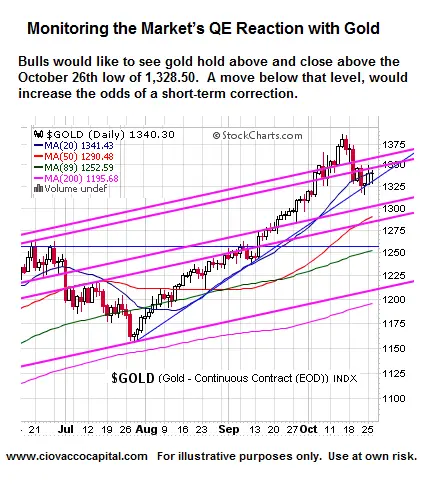
The key to next week’s Fed statement on QE will be how they address the concept of “whatever it takes for as long as necessary”. We can use gold and the U.S. dollar to monitor the market’s reaction to QE2. On October 11th in U.S. Dollar Could Rally In Coming Weeks, we hypothesized QE2 could be a “buy the rumor, sell the news event” relative to risk assets. Since October 11th, the dollar index has moved from 77.18 as high as 78.36; a move above 78.36 would increase the odds of the U.S. dollar having a multi-week countertrend rally. On October 13th with the S&P trading at 1,169, we listed 1,196 as a possible short-term upside target. The S&P 500’s intraday high on October 25th was 1,196, which means we have entered a zone where the odds of a short-to-intermediate-term reversal have increased (emphasis on odds). Stock market breadth on October 26th was weak, adding to the list of concerns over the next few days. We recently mentioned some yellow flags in the gold market. Thus far, gold is holding up well enough that a push to new highs still could be in the cards. From a short-term bearish perspective, a break of the thin blue trendline below would increase our concerns about a correction in gold. The long-term fundamentals for gold remain sound.
 

What is quantitative easing? – Video: In part three of our six part series on quantitative easing, we examine Fed statements, writings, and publications related to the objectives of, and rationale behind, QE2. The analysis of some key Fed commentary on quantitative easing allows us to better understand the Fed’s perspective relative to QE’s possible impact on the financial markets, investing, the economy, interest rates, asset prices, and the wealth effect. Today’s quantitative easing video also touches on the following:

* Duration of QE program

* Consumption

* Investment

* Ben Bernanke’s “printing press” speech

* U.S. dollar devaluation

* Fiat / paper money system

* Spending

* Inflation

* Dividend-paying securities (video player below)


About Chris Ciovacco

  • Web
  • |
  • More Posts(12)

Filed Under: Printing Money, The Federal Reserve Tagged With: government, government spending, inflation, macro economics, money supply, printing money, quantitative easing, The Federal Reserve

Leave a Reply Cancel reply

Your email address will not be published. Required fields are marked *

This site uses Akismet to reduce spam. Learn how your comment data is processed.

Latest Posts

  • How Deflation Created the Middle Class
  • October Inflation Numbers Delayed
  • Why the 2.8% COLA May Fall Short of Real Inflation
  • Delayed BLS September Inflation Data Released
  • September CPI Data Delay Causes Social Security COLA Concerns
  • August 2025 Inflation Report
  • Is the FED Getting Soft on Inflation?
  • July Inflation Report

Sponsored:

As a Seasoned Investor I thought I'd seen everything... But recently I discovered TradingView which has really improved the information I have at my fingertips.~ Tim McMahon, editor

TradingView gives me an edge... including powerful charting tools, real-time market data, and a global community of traders—all in one easy to use platform. It has hundreds of indicators, and even custom scripts for more advanced users, and you don't need to change Brokers just use its seamless brokerage integration... TradingView isn't just a charting tool—it's your full trading command center.

Trade smarter. Trade faster. Check Out TradingView for free.

----------

The Best Place to Buy Your Crypto

Coinbase is the largest Crypto Trading platform in the U.S. and the easiest to use. ~Tim McMahon, editor

Check out Coinbase here

Subscribe Now

eTrends Signup Form

Elliott Wave Resources

Free Elliott Wave Resources

What is Waveopedia?

Waveopedia is EWI’s free, comprehensive index of Elliott wave patterns and terms. Everyone from beginners to experts can benefit from it. It’s a great place to send your followers if they’re new to Elliott waves.

  • Deflation Hits China is the U.S. Next?

  • Why You Must Avoid the Herding Trap

  • Chasing Trends Can Cost You

  • More Education Resources

Post Archives

Home | Articles | Sitemap | Terms of Service | Privacy | Disclaimer | Advertise With Us

Copyright © 1996-2025 · Capital Professional Services, LLC · Maintained by Design Synergy Studio · Admin

Do Not Sell My Personal Information
