

Inflation Adjusted PricesWhat is the inflation adjusted price of common commodities?
|
Inflation-
Money Supply- |
Traditionally, war films, musicals and historical dramas have been the most popular genres and Gone With the Wind held the record of highest-grossing film for 25 years but doesn’t even make it into the top fifty in the modern market. But purchasing power varies widely over the time period since Gone With the Wind was first released in 1939. But the true key to determining how revenues really compare is when you adjust them for inflation.
Highest-grossing films (Nominal)
First we will look at nominal gross box office revenues. That is the actual number of dollars (not adjusted for inflaiton) earned strictly in the box office. Modern films have an advantage because in addition to box office revenues there are home video sales, pay-per-view sales, and merchandising sales. These revenues can dwarf box office revenues such was the case with Pixar’s movie Cars which was only moderately successful in the theater grossing $461 million but it generated almost $10 Billion in merchandise sales. In addition, box office receipts are [click to continue…]
In the following article Bill Bonner makes some excellent points about the problem with the current monetary policy. The first is that it is totally ludacris to try to buy real goods with fake money. It has to cause distortions in the overall economy. “People make different decisions when they can borrow for practically nothing… “ Secondly, once it gets started, without some form of real recovery it will be impossible to stop. Kind of like a drug addict. The withdrawal will be painful and won’t happen until something forces the FED’s hand. And thirdly also just like drug addicts and unsuccessful people the world over the FED is taking a short term view. It is a proven fact that the most successful people take a long term view. Doctors are willing to spend many years studying before they ever earn a penny but eventually they are well rewarded for their forbearance. And looking at the other side of the long term view… just because penalties have not yet been assessed doesn’t mean they don’t exist. When conditions change the FED will have to find buyers for all this debt they are creating and where will they come from? ~Tim McMahon,editor
Between Improbable and Impossible
by Bill Bonner
“Buying Real things with Fake Money…”Stock market investors don’t seem to know or care that the main thing propping up their investments is the same thing that will ultimately destroy them. And that the longer the situation continues the bigger the mess will be when it finally blows up.
We’re talking, of course, about Fed, Bank of England, Bank of Japan and People’s Bank of China monetary policy. It is “experimental.” It is “bold.” It is also reckless and potentially catastrophic.
Lending money at negative real interest rates creates grotesque distortions in the market.
Savers get nothing for their trouble. In fact, they lose money in real (inflation-adjusted) terms. So they shift to speculating on stocks. The stock market goes higher… but it is not a market you can trust.
It is being driven by the [click to continue…]
Summary:
Lacy Hunt and Van Hoisington launch into their first-quarter “Review and Outlook,” this week with a statement that some may find eye-opening: “The Federal Reserve (Fed) is not, and has not been, ‘printing money’…”
But given the facts of life about how money is really created (and destroyed), they are of course right: it’s all about the acceleration – or deceleration – in the M2 money supply.
Van and Lacy say, “A review of post-war economic history would lead to a logical assumption that the money supply (M2) would respond upward to [the Fed's] massive infusion of reserves into the banking system.
Mystery Math- Monetary Base up 350%, M2 Up 35%?
And yet, the Fed’s 3.5x expansion of the monetary base over the past five years has only grown M2 by 35%, and year-over-year growth through March, 2013, was less than 7%. “In other words,” say our authors, “there is no evidence that the massive security purchases by the Fed have resulted in a sustained acceleration in monetary growth; nor is there evidence that economic conditions have improved.”
So what is wrong with this picture?
Well, it turns out that not only can’t the FED control the money supply, it can’t control the velocity of money either. And that means the Fed can’t create rising aggregate demand.
As in, Ben is shooting blanks.
To help us get our heads around this fundamental realization, Van and Lacy lead us deeper into the gooey cytoplasm of Federal Reserve genetics; but the bottom line, as Prof. Irving Fisher taught us, is that GDP = MV. That is, nominal GDP equals money times its turnover (velocity). And don’t look now, but velocity is [click to continue…]
We have updated the charts on long Term Inflation, including Average Annual Inflation by decade, Cumulative Inflation by Decade and Cumulative Inflation since 1913.
The Chart below shows the Annual Inflation Rates for each decade. Each bar represents the average Annual Inflation for that decade (not the total cumulative inflation for that 10 year period but how much it increased each year on average during that decade).

Do you know:
1) Average Annual Inflation since 1913:
2) That deflation in the “Roaring 20′s” was almost as bad as in the “Great Depression” of the 1930′s?
3) How Crop Subsidies affected farm prices in the 1920′s and 30′s?
4) How the proliferation of tractors in the 1920′s affected Wheat prices?
5) How the price of a Ford Automobile compares in price from 1913 to 2012?
6) How much total cumulative Inflation since 1913?
Inflation like everything else it seems has cycles. It trends up for years and then for almost no reason begins falling again. After a while it rises again.
Unfortunately, while it is doing its long term dance it is bouncing up and down creating so much “noise” that it is difficult to see the longer term trend.
The chart below shows this trend by adding a 5 year moving average to the inflation rate. This smooths out the noise so we can see the underlying trend. And surprisingly it is actually quite regular.
Inflation Cycles Approx. Every 15 Years
From the chart we can see that beginning in 1917 we had 15 years of declining inflation until the bottom in 1932. From there inflation increased for 15 years until 1947. Read More
Many people believe the fallacy that wars and disasters are good for the economy, perhaps because some people like defense contractors and home-builders benefit. But it is important to understand how wealth works. If you build a house from raw materials you are richer. For instance suppose you take $50,000 worth of raw materials and add $50,000 worth of labor and come out with a house worth $150,000. in that case you created $50,000 worth of wealth out of thin air. But if someone comes along and knocks your house down and you rebuild it. 1) Are you better off? 2) Worse off? 3) The Same? ~ Tim McMahon, editor
In this article Kerk Phillips looks at the economics of disaster.
Even Economically, Disasters like Hurricane Sandy are Bad Things
By Kerk Phillips
Every time there is a significant natural disaster, I eventually — and unfortunately — hear from someone that there is at least one upside: the disaster will be good for the economy. And every time I respond, “Wrong!”
Inevitably, this supposed economic stimulus is called a silver lining. To quote one of my favorite demotivational thoughts from Despair.com, “Pessimism: Every dark cloud has a silver lining, but lightning kills hundreds of people each year who are trying to find it.”
Natural disasters are bad. They destroy lives and wealth, and that has no upside. After the disaster is over, people are unambiguously worse off than before, and while their quality of life inevitably recovers, on average they are not better off in the long run for having lived through the disaster.
On an individual basis, it is possible for [click to continue…]
Last week, we went to São Paulo, Brazil. There, too, we found taxi drivers who knew a lot more about monetary crises than the typical US economist. Said one:
I remember. I was just a kid. But my father would call and tell us to run to the grocery store. He had just been paid. We’d dash for the grocery story, meet him there and buy everything we could. We spent every cent in just a few minutes.
Our friend was recalling what it was like in the late 1980s in Brazil. The government had caused inflation… then hyperinflation. Prices rose so fast that as soon as people got some cash they ran to the grocery store to spend it.
Later, there was no point. In 1990, hyperinflation in Brazil reached 30,000%. What cost 1 real (the Brazilian currency) in 1980 cost 1 trillion in 1997. The hyperinflation wiped out the middle class… and wiped the shelves clean.
“It’s hard to run a business when [click to continue…]
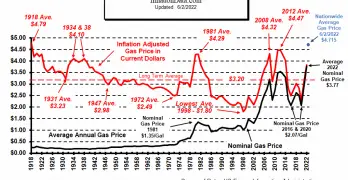
Doug S. Says I’m full of It- Regarding Gas Inflation
I just got the following comment from Doug S.
I saw the chart on how gas prices haven’t really risen when considered with inflation. I am 61 years old, and when I was working in the mid- to late-60s as a high school student, I made $1.60 an hour as minimum wage. Gas was only .25-.35 per gallon (with ‘gas wars’, much of the time cheaper) so with one hour of work I could purchase 5-6 gallons of gas. Now, with a minimum wage of $7.50 or so, you can only purchase a bit more than 2 gallons of gas, depending on the day of the week. Minimum wage has gone up, what, 4.6-5 times or so, but gas prices have gone up 10 times or more. Where am I missing the point???
Based on what I have read, a loaf of bread might have gone up 5-6 times. I do know that you can use figures to make any point you want, but I am not convinced that gas is matching inflation and is ‘less or about the same’ inflated price as it was 40 or 50 years ago. This is garbage. Doug S.

My response:
Doug,
I don’t recall saying that gas is currently cheap or that it is less or about the same as 50 years ago. Although it is about the same as 1918.
If you look at the chart [click to continue…]
Since the beginning of 2012, health insurance costs have skyrocketed significantly above the rate of overall inflation. As you can see from the chart below, health insurance inflation peaked at almost 15% per year in 2012 and at 12% in 2007 while overall inflation hovered around 2%. When people focus in on one single item, this is why many people don’t believe the overall inflation rate. They say, “Oh, my health insurance went up 15% how can inflation be only 2%?”. But what they fail to take into consideration is that in September of 2008 when the overall inflation rate was 5% health insurance was falling 2%. Yes, according to the U.S. Bureau of Labor Statistics, health insurance costs actually decreased 2% from year earlier prices. And continued to fall at between 3% and 4% all of 2009, 201o and 2011 while prices in general briefly fell to a deflationary -2.0% in 2009 but then bumped along between 1% and 4% for the next couple of years.
At the beginning of 2012, health insurance costs shot up in an effort to make up for lost ground.
Click for Larger Image
With that in mind let’s look at the actual prices of health insurance. From the following chart [click to continue…]
In