 In times of uncertainty, investors turn to Gold as a hedge against unforeseen disasters since physical gold is one of the few investments that is not simultaneously an asset and someone else’s liability. In other words, it is a real asset, not just an IOU. If an asset is also someone else’s debt there is the risk of default. So as the overall probability of default rises, people want to protect against that risk and thus bid up the price of gold.
With inflation-adjusted prices reaching levels we haven’t seen since the 1980 peak, there is talk once again of Gold as an “Inflation Hedge”. But how well does it really work?
For those who argue that Gold is an inflation hedge, all they have to do is look at the chart at the right and they will see that it is not a perfect (or even imperfect) inflation hedge.
Simply put if Gold were truly a perfect inflation hedge the red line in the chart would be perfectly flat. But instead, there are significant spikes.
If gold were an inflation barometer why did the inflation-adjusted price of gold fall from over $2400 in 1980 to $364 in 2001? Over that 21-year time period, it lost over 80% of its value. At the same time, the CPI index went from 82.4 to 177.07, i.e., prices more than doubled.
Historically, gold and money have been pretty much synonymous so pure Gold was immune to inflation. But that didn’t stop currency inflation. In the early days, kings discovered that they could “extend” their money supply by adding just a bit of lead to the melting pot. Unfortunately, as the percentage of lead increased the value of the coins decreased causing the first cases of inflation. (And also creating the habit of biting coins to see how soft they were and thus how much lead they contained).
Need a few more Gold coins? Just throw a little lead in the melting pot… no one will notice…
Egyptian Pharaohs issued the earliest gold coins, around 2700 B.C. But they were primarily as gifts for friends and not for commerce (i.e. more like medals or commemorative coins).
It wasn’t until (560-546 B.C.), that King Croesus of ancient Lydia began issuing Gold coins for general circulation. (Incidentally, after 2500 years, the saying “rich as King Croesus” is still occasionally used.
Incidentally, every country that has employed fair Gold coinage has prospered while those that inflated their coinage with “base” metals failed.
One example is Spain. During the time when Spain was issuing their famous “pieces of eight” it was a world “superpower” but lost that status as it debased its currency.
Gold in the U.S.
The Coinage Act of 1792, established official U. S. monetary units based on a world Gold price of $19.39 per Troy ounce. Congress changed the gold specification of money in 1834 and again in 1837 when it was set at $20.67 per ounce.
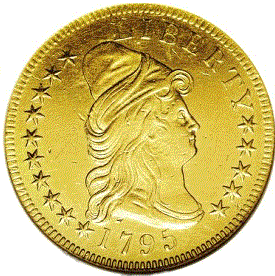
From 1805- 1837 no $10 Gold coins were minted.
The U.S. had periods of high inflation during both the Revolutionary and Civil Wars because they were not on a “gold standard” and issued “Greenbacks” instead.
In an effort to curtail inflation at the end of the civil war in 1879, the U.S. government made the “greenbacks” that they had issued during the Civil War convertible into gold putting us on a de facto gold standard.
Finally, in 1900 the government officially adopted the gold standard once again.
By 1914 most countries in the world were on a Gold standard.
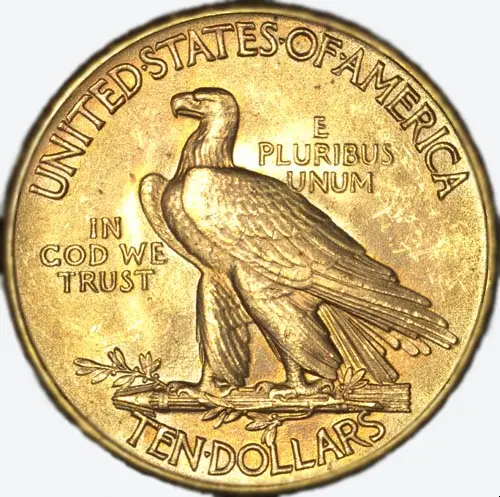
This Gold exchange rate was maintained by a complex system of transferring Gold from New York to London. Thus creating a system of checks and balances that should have prevented the onset of inflation.
This worked fairly well until other countries began abandoning their Gold standard to finance the First World War. The U. S. entered the war late and was able to maintain its gold standard.
However because other country’s currencies “floated” against the dollar the true value of the dollar also floated and inflation still occurred (basically other countries were able to export their inflation to the U.S.).
Remember at that time people spent gold and silver coins. Even though the price of Gold was fixed other prices weren’t fixed, and so the amount of goods people could buy with their Gold could still fluctuate.
Note: Now we are exporting some of our inflation to China as they send us goods and buy our debt.
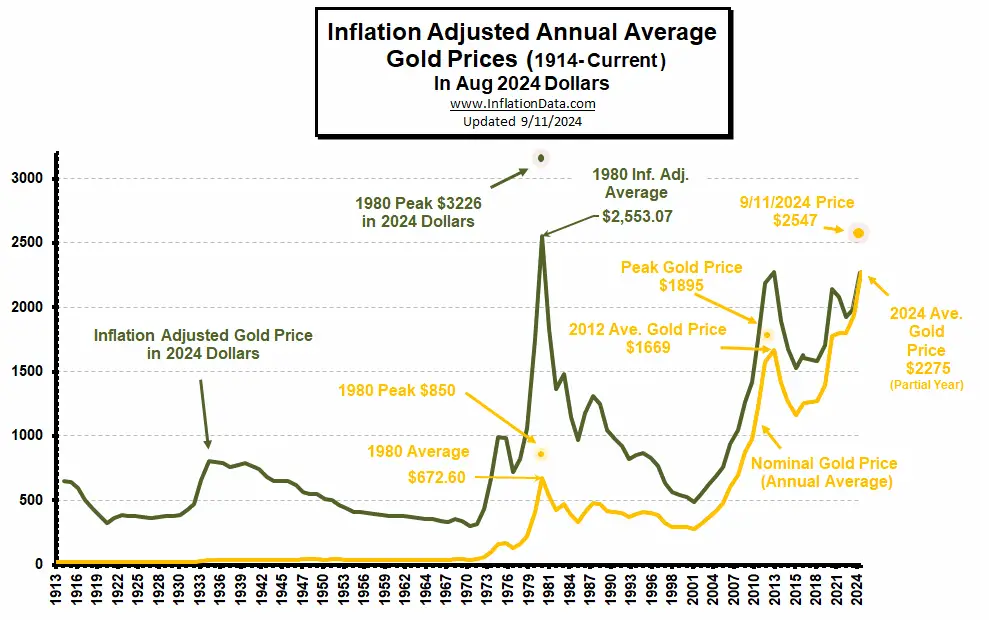
See that in the following chart the nominal price of Gold from 1913-1931 is flat but the inflation-adjusted price is not. This is because the price of gold was fixed by the government. Once gold was allowed to float freely in the 1970’s, if Gold perfectly hedged inflation the inflation-adjusted price of gold would be flat.
Notice in the chart “Total Inflation by decade“ below that from 1913 through 1920 inflation (as measured by the CPI) had increased by almost 98% (in other words in 7 years consumer prices had almost doubled) but the price of Gold remained flat (by Government decree).
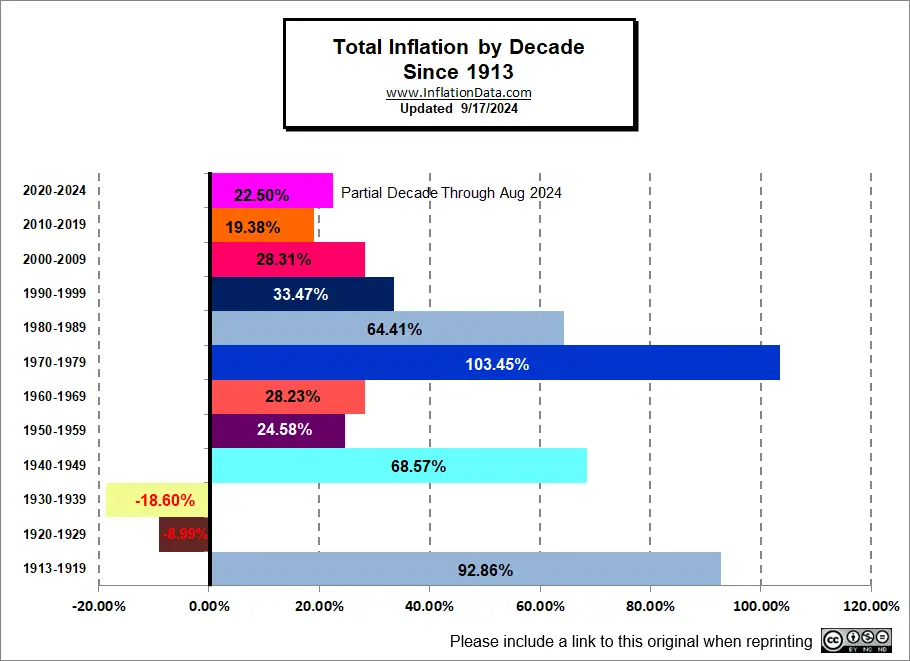
Over the next 10 years deflation set in as the roaring 20’s unfolded and the US economy boomed and Europe suffered the after-effects of WWI.
Finally, in 1929 the system could not stand the internal stresses and the stock market crashed ushering in the Great depression.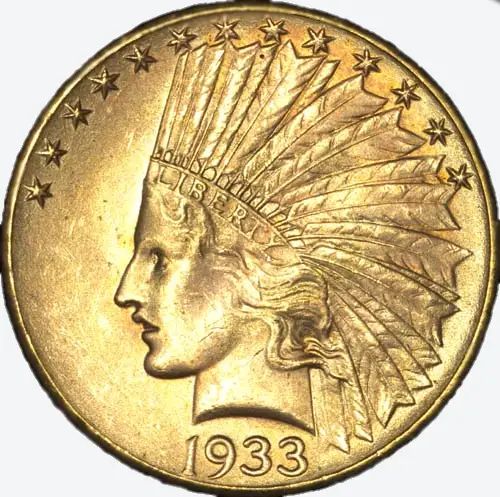
In 1933, President Franklin Roosevelt realized that the U.S. could not maintain the pretense that Gold was still worth only $20.67 per ounce (because at that price Foreign governments would have bought all our gold). So he perpetrated one of the greatest frauds ever on the American public.
Rather than simply repricing Gold at it’s real price and allowing the citizens to be richer, he forced U.S. citizens to sell their Gold at the official price of $20.67 and once he had collected all the Gold into government coffers. Once the government owned all the gold, he adjusted the price to its real price of $35 per Troy ounce. Thus the government made a handsome 69.33% profit in a few months (equivalent to a 69% tax on Gold owners). Imagine paying a 69% tax sometime! And not on income but assets.
This effectively, increased the money supply and “legitimized” the inflation that had silently been occurring behind the scenes as prices increased but gold values did not. In hindsight, this increase in the money supply may have been the key factor in the emergence from the Depression.
Notice that inflation from 1913 to 1930 was up about 64% … is it any coincidence that FDR raised the Gold price 69%?
NO! That one-time adjustment just brought the gold price in line with inflation (plus a 5% bonus for the government). But that didn’t solve the problem permanently. It just postponed it. By 1970 inflation was up 306% and gold was still officially $35 an ounce. Once again the price of gold needed adjusting.
But this time there was no gold in the hands of private citizens for the government to steal. This put the government in a bind because although US citizens could not own gold, foreign governments could continue to present their foreign exchange tickets at the “gold window” and the US was obligated to pay up in Gold! And that is exactly what France decided to do.
So in 1971, President Nixon ended the US gold standard pretense. At that point, the price of gold bullion was allowed to float freely and find its own level.
This time rather than take all the Gold from the people (since they had none) the Government raised money by allowing the people to buy Gold back at the new higher free market prices. Thus the government profited once again from the gold FDR stole from its citizens.
Government gold sales had a tempering effect on gold prices for a while as the government liquidated its “excess” gold bullion. But by the late 1970’s the government had stopped its gold sales and the price really took off.
Many felt that this rise in gold prices was in response to inflation fears (and partly it was) but partially it was pent-up demand and fear, as we will see in a moment inflation doesn’t necessarily translate into higher gold prices. But fear of any sort usually does translate into higher gold prices.
In 1980 the price of Gold peaked and the annual inflation rate declined but cumulative inflation climbed steadily upward. As we can see from the chart above, in 1980, cumulative inflation since 1913 was 780% and by the year 2000 cumulative inflation was 1675%.
If gold were a true inflation hedge, gold would have climbed with it. But rather than keeping up with inflation the price of Gold fell from the peak of $850 per ounce down to under $300 in 2001 losing 65% of its value.
But in inflation-adjusted dollars the scene is even worse. The 1980 peak in current inflation adjusted dollars was over $2337 and by 2001 it fell to $351 losing a whopping 85% of its inflation adjusted value!
So even though inflation rose… gold fell… because the fear level was low (and possibly because governments worldwide manipulated the price).
Inflation was slow and steady but not enough to cause fear. So Gold was not a very good inflation hedge!
So why did Gold rise in the new millennium?
Partially because it is a commodity like all other commodities and demand has picked up from China (perhaps they got tired of the gold manipulation game).
But mostly because fear reentered the market. And the more fear there is over defaults, inflation, etc. the higher the gold price climbs. So although Gold isn’t a perfect inflation hedge in the short run it is a very good crisis hedge. When paper can’t be trusted, Gold will always retain some value.
What type of fear triggers gold to rise?
- Fear of inflation or that paper assets will return to their intrinsic value (i.e. zero)
- Fear that governments like Greece, Ireland, Iceland, Portugal and yes even the United States will not be able to pay their debts.
- Fear that the EU will disband
- Fear of stock market collapse or instability.
- Fear that the housing market will collapse.
- Fear of War or Terrorism
- Fear of Banking Collapse or Corporate Bankruptcy
- Fear of almost anything
Yes, there is plenty of fear in the market these days to fuel the price of gold.
In addition to Fear… Chinese demand may be driving up the price of Gold. See: Why (and How) China is Boosting the Price of Gold for more information. Another way to measure prices is in terms of another commodity. See Oil vs. Gold to get an idea of how much gold is worth in terms of barrels of oil or how much oil is worth in terms of gold.
- Comparing Oil vs. Gold
- Where is Gold Headed?
- Is There a Correlation Between Inflation and the Stock Market?
- What is the Real Inflation Adjusted Stock Price?
- Stock Market vs. Gold
- Why Buy Gold?
- The Case of the Disappearing Gold
- 2 Types of Money
- What are “Foreign Exchange Reserves”?
- Why Gold is a Good Investment for Inflationary Times
- Gold and the Federal Reserve
- Civil Liberties Rest Upon Sound Money

