• Home
  • Related Sites
    • Financial Trend Forecaster
      • Moore Inflation Predictor
      • NYSE Rate of Change (ROC)
      • NASDAQ Rate of Change (ROC)
      • Crypto ROC- BTC & ETH
    • Unemployment Data
      • Historical Employment Data
      • Unemployment Rate Chart
      • Labor Force Participation Rate
    • Optio Money
    • Elliott Wave University
    • More Resources
  • Definitions
    • What is Inflation?
    • What is Core Inflation?
    • Inflation vs CPI
    • What is Deflation?
    • What is Disinflation?
    • What is Agflation?
    • What is Stagflation?
    • What is Hyperinflation?
    • What is Quantitative Easing?
    • What is Quantitative Tightening?
    • What is Velocity of Money?
    • What is Fiat Currency?
    • How Do I Calculate Inflation?
    • What are “Sticky Prices” and Why Do They Matter?
  • Featured Content
  • About Us
  • Feedback
    • Sitemap
  • Subscribe Now

InflationData.com

Your Place in Cyber Space for Inflation Data

CPI Index

CPIWidgetSept25
  • Numerical Inflation Data
    • Current Inflation Rate
    • Monthly Inflation Rate
    • Historical U.S. Inflation Rates
    • Historical CPI
  • Inflation Charts
    • Ann. Inf. Rate Chart
    • Long Term Inflation >
      • Ave. Inf. by Decade
      • Total Inf. by Decade
      • Inflation 1913-1919
      • Inflation 1920-1929
      • Inflation 1930-1939
      • Inflation 1940-1949
      • Inflation 1950-1959
      • Inflation 1960-1969
      • Inflation 1970-1979
    • Cumulative Inflation
    • FED Monetary Policy and Inflation
    • Inflation and Recession
    • Confederate Inflation (1861 – 1865)
    • Misery Index
    • The 3 Stages of Inflation
    • 15-Yr Inflation Trends Chart
  • Inflation Calculators
    • Cumulative Inf. Calc.
    • How Much Would it Cost
    • Salary Inf. Calc.
    • Cost of Living Calc.
    • U.K. Inf. Calc.
    • Cost of Gas Calc.
    • Net Worth Calc.
    • Lifetime Earnings Calc.
    • Savings Goal Calc.
    • Financial Calculators
  • Inf. Adjusted Prices
    • Energy >
      • Inflation Adj. Gas Prices
      • Historical Oil Prices Chart
      • Crude Oil Price (Table)
      • Natural Gas Prices
      • Electricity Prices
      • Oil vs Gold
    • Gold >
      • Inflation Adjusted Annual Average Gold Prices
      • Gold is a “Crisis Hedge” not an  “Inflation Hedge”
      • Comparing Oil vs. Gold
    • Corn Prices
    • Education Inflation
    • Housing Prices
    • Mortgage Rates
    • NYSE Index
    • Inf. Indexed Bonds
    • Movie Revenues
    • Inflation-Adjusted Wages
  • Cost of Living
    • Calculate Cost of Living
    • Cost-of-living Adj. (COLA)
    • Consumer Price Index CPI
      • Historical CPI
      • Current CPI
      • CPI Release Dates
    • Gas Prices >
      • Cost of Gas
      • Cost of Gas Per Month
      • Gas vs. Oil Price Chart
    • Food Prices 1913 vs 2013
    • Health Insurance
  • Blog
    • Key Inflation Articles
    • International Inflation
    • Historical Inflation Rates for Japan (1971 to 2014)
You are here: Home » Blog » Government » The Federal Reserve » How Low Inflation in Europe Could Affect Your Investments in the U.S.

How Low Inflation in Europe Could Affect Your Investments in the U.S.

Published on June 3, 2014 Updated on June 2, 2021 by Chris Ciovacco Leave a Comment

Last December, we explained why central bankers are terrified of economies that slip into a very difficult to stop deflationary spiral. European policymakers are not yet terrified, but it is fair to say they are concerned about what has been persistent low inflation. From Reuters:

Euro zone price inflation fell unexpectedly in May, increasing the risks of deflation in the currency area and all-but sealing the case for the European Central Bank to act this week. Annual consumer inflation in the 18 countries sharing the euro fell to 0.5 percent in May from 0.7 percent in April, the EU’s statistics office Eurostat said on Tuesday.


Fed Casts A Wider Economic Net

Unlike the European Central Bank (ECB), the Federal Reserve has a “maximum employment goal”, which was added to The Federal Reserve Act in 1997 via the “dual mandate” clause:
“The Board of Governors of the Federal Reserve System and the Federal Open Market Committee shall maintain long run growth of the monetary and credit aggregates commensurate with the economy’s long run potential to increase production, so as to promote effectively the goals of maximum employment, stable prices and moderate long-term interest rates.”


ECB To Become More Like Fed?

With low inflation and somewhat stagnant employment opportunities, some in the eurozone are calling for a more Fed-like approach to European central banking. From Euronews:

Antonio Tajani, the European Commissioner for industry, has said the value of the euro against the dollar is currently too high, and there should be a rethink of the European Central Bank’s role so it focuses more on stimulating job creation. Tajani told a conference in Milan that the euro at just under $1.40 is hurting “the economies of Spain, Italy, France and, in the long run, Germany”. He wants the ECB to be more like the Federal Reserve in the US, focused not just on inflation but also on stimulus to reverse low unemployment.

ECB Set To Join Currency Wars

Since the ECB has to deal with input from 18 countries, they tend to move slowly when it comes to a major shift in policy. From The Wall Street Journal:

The European Central Bank is poised to join the currency wars. But investors shouldn’t expect a shock-and-awe campaign. The central bank is widely expected to further loosen monetary policy Thursday. This is likely to take the form of charging banks to hold money with the ECB and emphasizing that the central bank expects to keep borrowing rates near zero for a long time yet. It may also try measures to boost bank lending to companies.

A Weaker Euro Impacts The U.S. Dollar

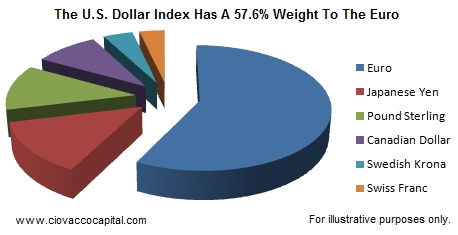
Currencies are valued in relative terms, which means if one country wants a weaker currency, it can put upward pressure on the currencies of other nations. For example, the U.S. Dollar Index (UUP) is valued via the following inputs:
Dollar vs Euro

The 57.6% weight to the euro tells us if the ECB is successful in its quest for a weaker euro, it will impact the value of the dollar.

A Stronger Dollar Impacts Our Portfolios

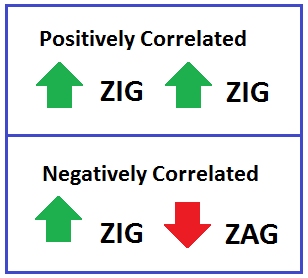
A weaker euro and stronger U.S. Dollar would impact numerous asset classes and commonly traded ETFs, which speaks to investment/ETF correlations. In the simplest form, if two ETFs are positively correlated, they tend to zig and zag together. If they are negatively correlated, when one zigs the other one tends to zag.
ZigZag

Bonds Tend To Zig, Emerging Markets Tend To Zag

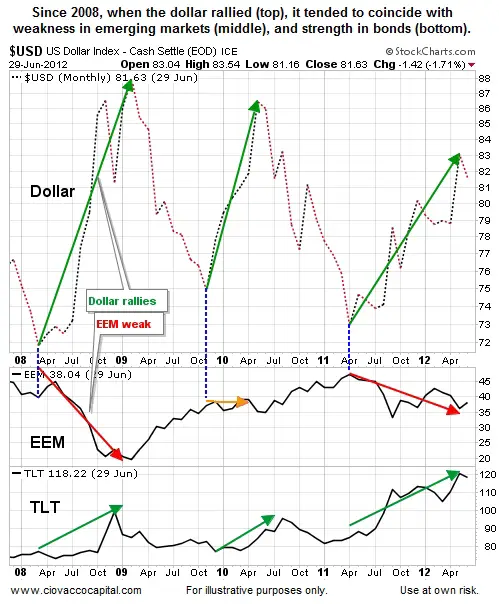
Correlations can change over time, so it is not safe to assume anything. However, rallies in the U.S. Dollar (see top portion of chart below) have recently been associated with weakness in emerging markets (EEM) and strength in long-dated U.S. Treasury bonds (TLT).
Dollar-vs-EEM-TLT

Investment Implications – Understand vs. Anticipate

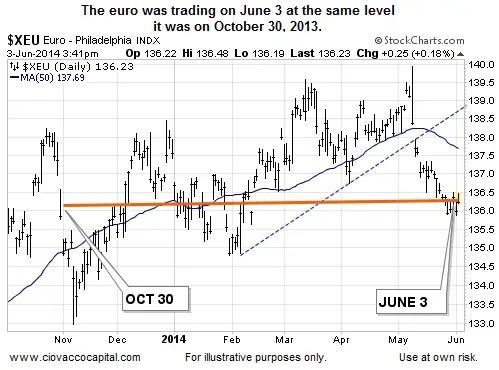
Given the ECB’s desire for a weaker euro, should we load up on Treasuries and avoid emerging markets? No, but we should understand how a weaker euro could impact the broader investment landscape and have contingency plans in place. As shown in the chart below, while the euro has been dropping in recent weeks, it has made little-to-no progress, up or down, over the past seven months.
XEU

The big events of the week are still ahead of us; the ECB’s policy announcement is due Thursday and the U.S. monthly labor report before the bell Friday. Depending on the market’s reaction, it is possible we will cut back on our bond exposure (TLT), and make another incremental bump to the equity (SPY) side of the portfolio. If the ECB and the labor report convert some back to the fear trade, we are happy to keep our bond allocation as is. We will observe with a flexible mind and adjust as needed.

This article originally appeared on Ciovaccocapital.com and was reprinted by permission.

See Also:

  • FED Looks for New Ways to Crank Up Money Supply
  • Deflationary Forces Overpower FED
  • How The Federal Reserve is Making Us Poorer
  • Gold and the Federal Reserve


About Chris Ciovacco

  • Web
  • |
  • More Posts(12)

Filed Under: The Federal Reserve

Leave a Reply Cancel reply

Your email address will not be published. Required fields are marked *

This site uses Akismet to reduce spam. Learn how your comment data is processed.

Latest Posts

  • How Deflation Created the Middle Class
  • October Inflation Numbers Delayed
  • Why the 2.8% COLA May Fall Short of Real Inflation
  • Delayed BLS September Inflation Data Released
  • September CPI Data Delay Causes Social Security COLA Concerns
  • August 2025 Inflation Report
  • Is the FED Getting Soft on Inflation?
  • July Inflation Report

Sponsored:

As a Seasoned Investor I thought I'd seen everything... But recently I discovered TradingView which has really improved the information I have at my fingertips.~ Tim McMahon, editor

TradingView gives me an edge... including powerful charting tools, real-time market data, and a global community of traders—all in one easy to use platform. It has hundreds of indicators, and even custom scripts for more advanced users, and you don't need to change Brokers just use its seamless brokerage integration... TradingView isn't just a charting tool—it's your full trading command center.

Trade smarter. Trade faster. Check Out TradingView for free.

----------

The Best Place to Buy Your Crypto

Coinbase is the largest Crypto Trading platform in the U.S. and the easiest to use. ~Tim McMahon, editor

Check out Coinbase here

Subscribe Now

eTrends Signup Form

Elliott Wave Resources

Free Elliott Wave Resources

What is Waveopedia?

Waveopedia is EWI’s free, comprehensive index of Elliott wave patterns and terms. Everyone from beginners to experts can benefit from it. It’s a great place to send your followers if they’re new to Elliott waves.

  • Deflation Hits China is the U.S. Next?

  • Why You Must Avoid the Herding Trap

  • Chasing Trends Can Cost You

  • More Education Resources

Post Archives

Home | Articles | Sitemap | Terms of Service | Privacy | Disclaimer | Advertise With Us

Copyright © 1996-2025 · Capital Professional Services, LLC · Maintained by Design Synergy Studio · Admin

Do Not Sell My Personal Information
