• Home
  • Related Sites
    • Financial Trend Forecaster
      • Moore Inflation Predictor
      • NYSE Rate of Change (ROC)
      • NASDAQ Rate of Change (ROC)
      • Crypto ROC- BTC & ETH
    • Unemployment Data
      • Historical Employment Data
      • Unemployment Rate Chart
      • Labor Force Participation Rate
    • Optio Money
    • Elliott Wave University
    • More Resources
  • Definitions
    • What is Inflation?
    • What is Core Inflation?
    • Inflation vs CPI
    • What is Deflation?
    • What is Disinflation?
    • What is Agflation?
    • What is Stagflation?
    • What is Hyperinflation?
    • What is Quantitative Easing?
    • What is Quantitative Tightening?
    • What is Velocity of Money?
    • What is Fiat Currency?
    • How Do I Calculate Inflation?
    • What are “Sticky Prices” and Why Do They Matter?
  • Featured Content
  • About Us
  • Feedback
    • Sitemap
  • Subscribe Now

InflationData.com

Your Place in Cyber Space for Inflation Data

CPIWidget-Jan26
  • Numerical Inflation Data
    • Current Inflation Rate
    • Monthly Inflation Rate (Moved)
    • Historical U.S. Inflation Rates
    • Historical CPI
  • Inflation Charts
    • Ann. Inf. Rate Chart
    • Long Term Inflation >
      • Ave. Inf. by Decade
      • Total Inf. by Decade
      • Inflation 1913-1919
      • Inflation 1920-1929
      • Inflation 1930-1939
      • Inflation 1940-1949
      • Inflation 1950-1959
      • Inflation 1960-1969
      • Inflation 1970-1979
    • Cumulative Inflation
    • FED Monetary Policy and Inflation
    • Inflation and Recession
    • Confederate Inflation (1861 – 1865)
    • Misery Index
    • The 3 Stages of Inflation
    • 15-Yr Inflation Trends Chart
  • Inflation Calculators
    • Cumulative Inf. Calc.
    • How Much Would it Cost
    • Salary Inf. Calc.
    • Cost of Living Calc.
    • U.K. Inf. Calc.
    • Cost of Gas Calc.
    • Net Worth Calc.
    • Lifetime Earnings Calc.
    • Savings Goal Calc.
    • Financial Calculators
  • Inf. Adjusted Prices
    • Energy >
      • Inflation Adj. Gas Prices
      • Historical Oil Prices Chart
      • Crude Oil Price (Table)
      • Natural Gas Prices
      • Electricity Prices
      • Oil vs Gold
    • Gold >
      • Inflation Adjusted Annual Average Gold Prices
      • Gold is a “Crisis Hedge” not an  “Inflation Hedge”
      • Comparing Oil vs. Gold
    • Corn Prices
    • Education Inflation
    • Housing Prices
    • Mortgage Rates
    • NYSE Index
    • Inf. Indexed Bonds
    • Movie Revenues
    • Inflation-Adjusted Wages
  • Cost of Living
    • Calculate Cost of Living
    • Cost-of-living Adj. (COLA)
    • Consumer Price Index CPI
      • Historical CPI
      • Current CPI
      • CPI Release Dates
    • Gas Prices >
      • Cost of Gas
      • Cost of Gas Per Month
      • Gas vs. Oil Price Chart
    • Food Prices 1913 vs 2013
    • Health Insurance
  • Blog
    • Key Inflation Articles
    • International Inflation
    • Historical Inflation Rates for Japan (1971 to 2014)
You are here: Home » Blog » Uncategorized » What are “Sticky Prices” and Why Do They Matter?

What are “Sticky Prices” and Why Do They Matter?

Published on April 20, 2023 by Tim McMahon Leave a Comment

What Is Price Stickiness?

Price stickiness, aka. “Sticky prices” are prices that tend not to change very quickly.  So, despite costs (or demand) going up, a business with “sticky prices” may not raise its prices for an extended period of time. In other words, sticky prices tend to change slowly despite changing underlying factors. Sticky prices are a key component of Macroeconomic theory.

Why wouldn’t a business raise prices if its costs are going up?

You would think that most products and services would respond to the laws of supply and demand, i.e., when demand goes up, prices quickly follow. Or, when underlying costs rise a business would automatically raise its own prices to maintain profitability. However, with certain goods and services, this does not always happen immediately.

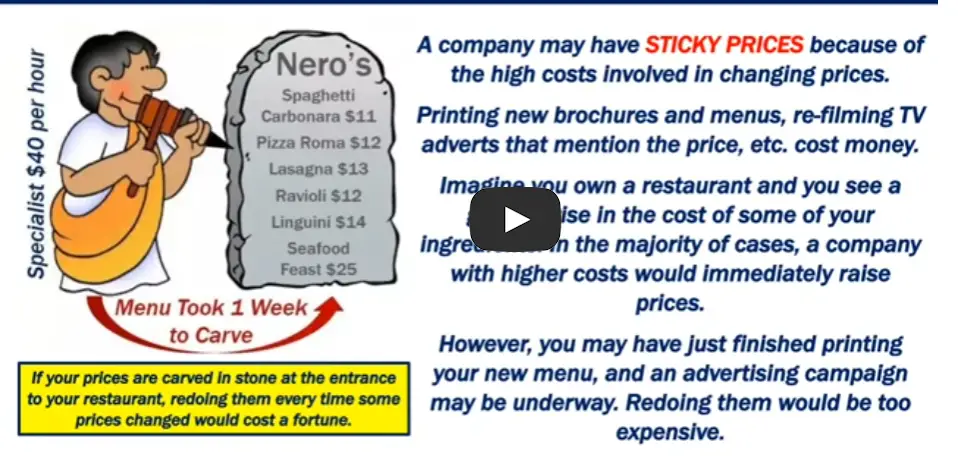
The reason a business wouldn’t raise prices quickly is that they have certain costs associated with raising prices. These costs are called “menu costs”.  The term originates from the cost of restaurants literally having to print new menus. Businesses with high ‘menu costs’ tend to have sticky prices.

Other examples of “menu costs” include changing advertising that mentions a price, printing new brochures, etc.

Another factor contributing to price stickiness can be imperfect information in the markets or irrational decision-making by company executives. For instance, some companies may try to keep prices constant as a business strategy, even though it isn’t sustainable on a long-term basis. Other factors in stickiness could be long-term contracts where a purchaser has locked in prices for the longer term.

Some prices are more “sticky” than others.

Back in 2010, the Federal Reserve Bank of Cleveland published a chart of the relative stickiness of different categories of prices, with motor fuel the least sticky, i.e., they change the quickest at 0.7 months. In other words, it takes about 3 weeks for gas stations to change their prices based on underlying costs. Slightly more sticky are car rental costs, and fresh fruit and vegetable costs. These are called “flexible prices”.

At the other end of the spectrum (i.e., the stickiest prices), are Education costs which take around 11 months to change, Medical Care costs, which take 14 months to change, and Personal Care Services which take about 2 years to change.

Flexible and Sticky Prices in the CPI Market Basket

The following chart shows the most flexible prices in months and their relative importance in the CPI basket.
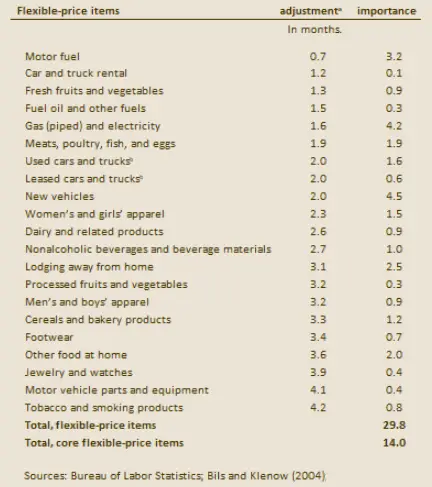
Flexible Prices

Sticky Prices Example

This chart shows the stickiest prices in months and their relative importance in the CPI basket.
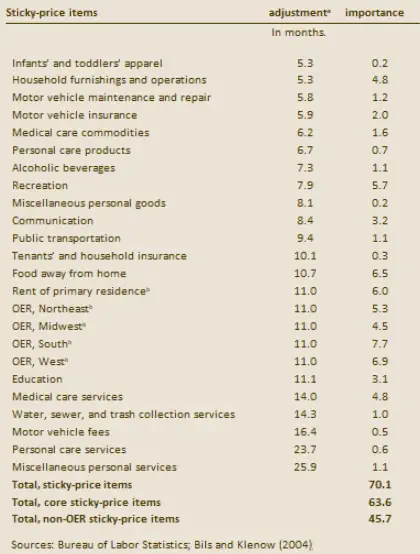
Sticky Prices

The Stickiest Price Ever

The early days of Coca Cola provide an example of the stickiest price. From its invention in 1886 to the late 1950s, the price of a bottle of Coke held at a nickel — even as most other product’s prices rose dramatically through 70 years of inflation.

The main reason? Vending machines.

Most vending machines that sold Coca Cola only took nickels, and if the company wanted to overhaul those machines to take dimes, they’d have to double the price of their product.

Fearing customer frustration and the loss of business that would come with it, Coke opted to keep charging five cents for their product for the better part of a century.

Stickiness in Just One Direction

In some circumstances, prices can be sticky in just one direction. People tend to believe that “prices go up but never go down”, which may have some basis in reality. This is partially because once people get used to paying a higher price they are less likely to object to paying that price, so without some compelling reason (like added competition), sellers find no reason to lower their prices even if their cost decreases. This is called being “sticky-down”.

The opposite would be “sticky-up” if it can move down rather easily but will only move up with pronounced effort.

Wage Stickiness

The idea of price stickiness can also be applied to wages or salaries. As workers become accustomed to earning a certain wage, they are highly resistant to taking a pay cut, and so wages tend to be sticky. In his book The General Theory of Employment, Interest and Money, John Maynard Keynes argued that nominal wages display downward stickiness, because workers are reluctant to accept cuts in nominal wages.

In periods of recession, when a company needs to cut costs, typically, the company won’t resort to cutting wages. Instead, companies prefer to lay off less productive employees rather than cut pay across the board. This has two benefits: it actually increases overall productivity, and it is less destructive to overall morale. Union and civil service wage contracts may also strongly contribute to the downward stickiness of wages in the same way as other types of long-term contracts.

Sticky Prices Video

Sticky Prices Video

For a more in-depth study on whether sticky prices matter, here is an article by the Minneapolis FED.

About Tim McMahon

Connect with Tim on Google+.

  • Web
  • |
  • Twitter
  • |
  • Facebook
  • |
  • LinkedIn
  • |
  • More Posts(408)

Filed Under: Uncategorized Tagged With: flexible prices, Price, stickiness, sticky

Leave a Reply Cancel reply

Your email address will not be published. Required fields are marked *

This site uses Akismet to reduce spam. Learn how your comment data is processed.

Latest Posts

  • Updated Cumulative Inflation Calculator
  • Inflation-Adjusted Silver Prices
  • December Inflation Down Slightly, Not Flat
  • December 2025 Inflation Report for November
  • How Deflation Created the Middle Class
  • October Inflation Numbers Delayed
  • Why the 2.8% COLA May Fall Short of Real Inflation
  • Delayed BLS September Inflation Data Released

Sponsored:

As a Seasoned Investor I thought I'd seen everything... But recently I discovered TradingView which has really improved the information I have at my fingertips.~ Tim McMahon, editor

TradingView gives me an edge... including powerful charting tools, real-time market data, and a global community of traders—all in one easy to use platform. It has hundreds of indicators, and even custom scripts for more advanced users, and you don't need to change Brokers just use its seamless brokerage integration... TradingView isn't just a charting tool—it's your full trading command center.

Trade smarter. Trade faster. Check Out TradingView for free.

----------

The Best Place to Buy Your Crypto

Coinbase is the largest Crypto Trading platform in the U.S. and the easiest to use. ~Tim McMahon, editor

Check out Coinbase here

Subscribe Now

eTrends Signup Form

Elliott Wave Resources

Free Elliott Wave Resources

What is Waveopedia?

Waveopedia is EWI’s free, comprehensive index of Elliott wave patterns and terms. Everyone from beginners to experts can benefit from it. It’s a great place to send your followers if they’re new to Elliott waves.

  • Deflation Hits China is the U.S. Next?

  • Why You Must Avoid the Herding Trap

  • Chasing Trends Can Cost You

  • More Education Resources

Post Archives

Home | Articles | Sitemap | Terms of Service | Privacy | Disclaimer | Advertise With Us

Copyright © 1996-2026 · Capital Professional Services, LLC · Maintained by Design Synergy Studio · Admin

Do Not Sell My Personal Information