• Home
  • Related Sites
    • Financial Trend Forecaster
      • Moore Inflation Predictor
      • NYSE Rate of Change (ROC)
      • NASDAQ Rate of Change (ROC)
      • Crypto ROC- BTC & ETH
    • Unemployment Data
      • Historical Employment Data
      • Unemployment Rate Chart
      • Labor Force Participation Rate
    • Optio Money
    • Elliott Wave University
    • More Resources
  • Definitions
    • What is Inflation?
    • What is Core Inflation?
    • Inflation vs CPI
    • What is Deflation?
    • What is Disinflation?
    • What is Agflation?
    • What is Stagflation?
    • What is Hyperinflation?
    • What is Quantitative Easing?
    • What is Quantitative Tightening?
    • What is Velocity of Money?
    • What is Fiat Currency?
    • How Do I Calculate Inflation?
    • What are “Sticky Prices” and Why Do They Matter?
  • Featured Content
  • About Us
  • Feedback
    • Sitemap
  • Subscribe Now

InflationData.com

Your Place in Cyber Space for Inflation Data

CPI Index

CPIWidgetSept25
  • Numerical Inflation Data
    • Current Inflation Rate
    • Monthly Inflation Rate
    • Historical U.S. Inflation Rates
    • Historical CPI
  • Inflation Charts
    • Ann. Inf. Rate Chart
    • Long Term Inflation >
      • Ave. Inf. by Decade
      • Total Inf. by Decade
      • Inflation 1913-1919
      • Inflation 1920-1929
      • Inflation 1930-1939
      • Inflation 1940-1949
      • Inflation 1950-1959
      • Inflation 1960-1969
      • Inflation 1970-1979
    • Cumulative Inflation
    • FED Monetary Policy and Inflation
    • Inflation and Recession
    • Confederate Inflation (1861 – 1865)
    • Misery Index
    • The 3 Stages of Inflation
    • 15-Yr Inflation Trends Chart
  • Inflation Calculators
    • Cumulative Inf. Calc.
    • How Much Would it Cost
    • Salary Inf. Calc.
    • Cost of Living Calc.
    • U.K. Inf. Calc.
    • Cost of Gas Calc.
    • Net Worth Calc.
    • Lifetime Earnings Calc.
    • Savings Goal Calc.
    • Financial Calculators
  • Inf. Adjusted Prices
    • Energy >
      • Inflation Adj. Gas Prices
      • Historical Oil Prices Chart
      • Crude Oil Price (Table)
      • Natural Gas Prices
      • Electricity Prices
      • Oil vs Gold
    • Gold >
      • Inflation Adjusted Annual Average Gold Prices
      • Gold is a “Crisis Hedge” not an  “Inflation Hedge”
      • Comparing Oil vs. Gold
    • Corn Prices
    • Education Inflation
    • Housing Prices
    • Mortgage Rates
    • NYSE Index
    • Inf. Indexed Bonds
    • Movie Revenues
    • Inflation-Adjusted Wages
  • Cost of Living
    • Calculate Cost of Living
    • Cost-of-living Adj. (COLA)
    • Consumer Price Index CPI
      • Historical CPI
      • Current CPI
      • CPI Release Dates
    • Gas Prices >
      • Cost of Gas
      • Cost of Gas Per Month
      • Gas vs. Oil Price Chart
    • Food Prices 1913 vs 2013
    • Health Insurance
  • Blog
    • Key Inflation Articles
    • International Inflation
    • Historical Inflation Rates for Japan (1971 to 2014)
You are here: Home » Blog » Government » The Federal Reserve » How the FED Prints Money – Part 2

How the FED Prints Money – Part 2

Published on October 26, 2010 Updated on June 2, 2021 by Chris Ciovacco Leave a Comment

Yesterday we looked at the process the FED uses to get the money “Out of Thin Air” and into the hands of people who can spend it. In other words the “how” they do this magic. Basically, that route is through special dealers and then it goes into a few select hands. Today we are not going to look at the “how” but instead we will look at “Who” gets the money and where it is likely to go from there. Because if we know where it is likely to go we can get there first and profit from the incoming cash flow. ~Tim McMahon, editor


Quantitative Easing (QE2): Who Gets the Fed’s Printed Money?

Part 2 of a 6 Part Video Series on Quantitative Easing: In Part 1: How the FED Prints Money, we discussed how Mr. Bernanke’s quantitative easing program is implemented via the Fed’s eighteen primary dealers, not traditional banks.

We do not know the size of the Fed’s program, nor do we know how the markets will react in the short-term. However, one thing we know with near certainty – a large quantity of newly printed money is going to flow from the Fed to the eighteen primary dealers. We also know a significant amount of the electronic greenbacks will flow from the primary dealers into the accounts of their clients.

Since the Fed encourages the primary dealers to offer client bonds in the QE competitive bidding process, it is helpful for investors to know more about the clients of the primary bond dealers. Sovereign wealth funds, who do business with numerous primary dealers, will be one of the most influential groups who may participate in QE2. A sovereign wealth fund is a state-owned investment fund, which holds a wide variety of financial assets, including stocks, bonds, commodities, currencies, precious metals, and real estate.

One of the largest sovereign wealth funds is the Norway Global Government Pension Fund, which holds somewhere in the neighborhood of $400 billion in assets. Others include the China Investment Corporation ($300 billion), Singapore Investment Corporation ($250 billion), Hong Kong Monetary Authority ($225 billion), the Russia National Welfare Fund ($140 billion), and the Australian Future Fund ($60 billion).


(FED money creation Video Loading… Please be patient)


�

To give a hypothetical example of how the Fed’s newly printed money can make its way around the globe, assume the following: (a) concerned about the currency risk associated with holding too many U.S. Treasuries, the Singapore Investment Corporation (SIC) decides to sell some bonds to the Fed via the QE2 program, (b) the Fed takes the Treasuries and the SIC gets newly printed U.S. dollars in return, (c) since holding U.S. dollars also entails currency risk, the SIC decides to diversify into gold, global stocks, and emerging market bonds. This hypothetical example shows how the Fed’s printing press can, in theory, create demand for other assets and thus, help drive asset prices higher. Higher asset prices can help improve strained balanced sheets which can, in theory, spark more spending, investing, borrowing, and hiring (emphasis on in theory).

Understanding the global footprints of the primary dealers and their clients allows us to visualize the broad geographic reach of the Fed’s printing press. Understanding the buying power and investment influence of large clients of the primary dealers, like sovereign funds, helps us understand how QE2 may potentially impact a wide range of markets from currencies to commodities.

The flow chart below shows how the Fed’s newly printed cash can flow from the Fed to the primary dealer, then to the primary dealer’s clients.
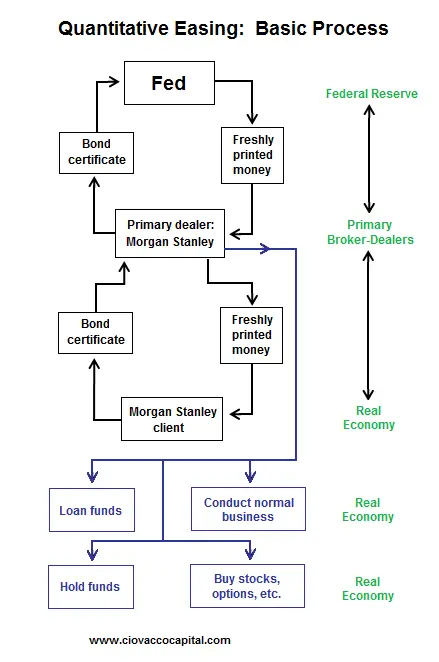
 

How the FED Prints Money

The Money Printing Process


With the million dollar question relative to QE2 being the magnitude of the Fed’s planned bond purchases, we can expect some volatile trading sessions for the next week or so. According to a Forbes/CNN article:

Economists at Goldman Sachs estimate the Federal Reserve may need to buy a staggering $4 trillion worth of assets such as Treasury securities to get the economy rolling again. The Goldman economists, Jan Hatzius and Sven Jari Stehn, don’t expect the Federal Reserve to go nearly that far when it resumes its asset-purchasing quantitative easing policy. Citing many officials’ unease with the prospect of adding significantly to the Fed’s already bloated balance sheet, Goldman expects the Fed to end up buying around $2 trillion worth of assets over the next few years.

Traders, money managers, and active investors may want to get some extra rest this weekend; with mid-terms and a Fed announcement coming early next week, both stress levels and market volatility will most likely be elevated.


About Chris Ciovacco

  • Web
  • |
  • More Posts(12)

Filed Under: Government, Printing Money, The Federal Reserve Tagged With: economy, government, macro economics, out of thin air, printing money, quantitative easing, The Federal Reserve

Leave a Reply Cancel reply

Your email address will not be published. Required fields are marked *

This site uses Akismet to reduce spam. Learn how your comment data is processed.

Latest Posts

  • How Deflation Created the Middle Class
  • October Inflation Numbers Delayed
  • Why the 2.8% COLA May Fall Short of Real Inflation
  • Delayed BLS September Inflation Data Released
  • September CPI Data Delay Causes Social Security COLA Concerns
  • August 2025 Inflation Report
  • Is the FED Getting Soft on Inflation?
  • July Inflation Report

Sponsored:

As a Seasoned Investor I thought I'd seen everything... But recently I discovered TradingView which has really improved the information I have at my fingertips.~ Tim McMahon, editor

TradingView gives me an edge... including powerful charting tools, real-time market data, and a global community of traders—all in one easy to use platform. It has hundreds of indicators, and even custom scripts for more advanced users, and you don't need to change Brokers just use its seamless brokerage integration... TradingView isn't just a charting tool—it's your full trading command center.

Trade smarter. Trade faster. Check Out TradingView for free.

----------

The Best Place to Buy Your Crypto

Coinbase is the largest Crypto Trading platform in the U.S. and the easiest to use. ~Tim McMahon, editor

Check out Coinbase here

Subscribe Now

eTrends Signup Form

Elliott Wave Resources

Free Elliott Wave Resources

What is Waveopedia?

Waveopedia is EWI’s free, comprehensive index of Elliott wave patterns and terms. Everyone from beginners to experts can benefit from it. It’s a great place to send your followers if they’re new to Elliott waves.

  • Deflation Hits China is the U.S. Next?

  • Why You Must Avoid the Herding Trap

  • Chasing Trends Can Cost You

  • More Education Resources

Post Archives

Home | Articles | Sitemap | Terms of Service | Privacy | Disclaimer | Advertise With Us

Copyright © 1996-2025 · Capital Professional Services, LLC · Maintained by Design Synergy Studio · Admin

Do Not Sell My Personal Information