With all the talk about “Tapering” you’d think the FED was actually considering reducing it’s money pumping. But in actuality that is not it at all. The FED is afraid that it is creating a a bubble in the stock market so it is looking for ways to continue its pumping but shift it enough so that the money goes somewhere besides just to the stock market. In other words, it is still worried about the economy and realizes that it is doing more harm than good but feels trapped, so it is looking for new ways that might work better. If the FED can figure out how to free up the log jam of “excess reserves” held by the banks, liquidity could be sloshing around the economy before you know it and inflation could be back big time. This is a result of the money multiplier (a function of bank reserves) so even though the FED increased the monetary base M2 actually fell in 2013. See Is Bernanke Shooting Blanks. In today’s article Chris Ciovacco looks at what the FED is thinking now. ~Tim McMahon, editor.
Fed Considering Even More Stimulus For Economy
Minutes Show Another Stimulative Tool Being Considered
We made the case on July 30 the Fed’s desire to taper is about bubble management rather than confidence in the economy. Hard evidence aligning with a “the Fed is still concerned about the economy” stance was included in the most recently released Fed minutes:
Participants also discussed a range of possible actions that could be considered if the Committee wished to signal its intention to keep short-term rates low or reinforce the forward guidance on the federal funds rate. For example, most participants thought that a reduction by the Board of Governors in the interest rate paid on excess reserves could be worth considering at some stage.

According to an op-ed penned by former Fed governor Alan Binder, the text above from the October Fed minutes could be significant. From The Wall Street Journal:
I can assure you that those buried words were momentous. The Fed is famously given to understatement. So when it says that “most” members of its policy committee think a change “could be worth considering,” that’s almost like saying they love the idea. That’s news because they haven’t loved it before.
Why Should We Care About Excess Reserves?
Banks are required to keep a minimum amount of cash close at hand (reserves) so they can fulfill withdrawal requests from their customers. Any reserves held over and above these requirements are called excess reserves. During strong economic periods, banks tend to hold the minimum required reserves, since they prefer to use the capital in more profitable ways. Prior to the collapse of Lehman Brothers in September 2008, excess reserves were not substantial. Binder describes the current state of reserves as follows:
Today banks hold a whopping $2.5 trillion in excess reserves, on which the Fed pays them an interest rate of 25 basis points—for an annual total of about $6.25 billion. That 25 basis points, what the Fed calls the IOER (interest on excess reserves), is the issue. Unlike the Fed’s main policy tool, the federal-funds rate, the IOER is not market-determined. It’s completely controlled by the Fed. So instead of paying banks to hold all those excess reserves, it could charge banks a small fee, i.e., a negative interest rate, for the privilege.
Change Could Spark More Stimulative Lending
The quantitative easing (QE) process injects freshly printed money into the global financial system. The $2.5 trillion in excess reserves being held at the Fed tells us a lot of cash is not making its way into the real economy. Binder on the possible impact of charging a fee on excess reserves:
Excess reserves sitting idle in banks’ accounts at the Fed do nothing to boost the economy. We want banks to use the money. If the Fed turned the IOER negative, banks would hold fewer excess reserves, maybe a lot fewer. They’d find other uses for the money. One such use would be buying short-term securities. Another would probably be lending more, which is what we want.
An Alternative To QE
Fed governors are not sleeping well knowing they cannot continue to grow the central bank’s balance sheet indefinitely. According to Binder, charging interest on reserves could assist in this area as well:
A second reason for cutting the IOER answers some of the criticisms the Fed has taken for its asset-buying programs called quantitative-easing: Doing so would stimulate the economy without increasing the size of the Fed’s balance sheet. In fact, the Fed could probably shrink its balance sheet.
Reserve Chatter Says Aggressive Taper Unlikely
If Fed governors were confident about the economy and on the cusp of announcing a sharp reduction in their monthly bond purchases, why were they talking about additional ways to stimulate the economy in the minutes released on November 20? The answer is they are not confident about the economy, and therefore are unlikely to aggressively taper. The previous statement does not rule out a December taper by any means, but it does tell us to keep an open mind about how long QE will last.
Investment Implications – Observable Deterioration
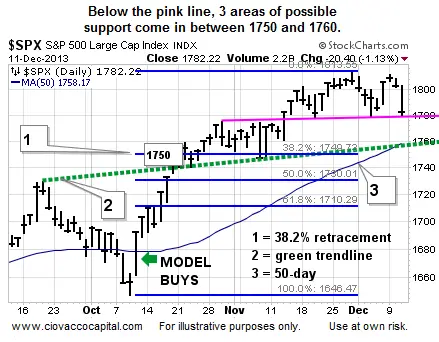
Our market model started redeploying cash on October 10 (see green arrow in chart below). The S&P 500 has made very little progress since mid-November, which speaks to slowing bullish momentum (see pink line). The observable evidence has deteriorated enough to warrant an incremental reduction in our exposure to stocks; a move that was made Wednesday. If the S&P 500 fails to hold the pink line near 1780, there are three areas of possible support not too far below, telling us buyers may surface in the days ahead. Therefore, we will continue to hold our positions in U.S. stocks (SPY), technology (QQQ), financials (XLF), energy (XLE), China (FXI), and Europe (FEZ). With a Fed meeting next week, volatility may continue short-term.
Fed governors are also concerned a tapering announcement will cause investors to run for the stock and bond exits, similar to 1994. While an announcement of charging banks a fee on excess reserves may not be imminent, it is important for us to know it is being considered and why it is being considered.
This article is © Ciovacco Capital Management, LLC. All Rights Reserved and was originally published here and has been reprinted by permission.
You might also like:
- Deflationary Forces Overpower FED
- Pushing on a String, Velocity of Money and Money Multiplier Conspire Against the FED
- How The Federal Reserve is Making Us Poorer
- No Way Out
- Is Bernanke Shooting Blanks?



Leave a Reply