Hyperinflation
Hyperinflation is an extremely rapid period of inflation, usually caused by a rapid increase in the money supply. Usually due to unrestrained printing of fiat currency.See How Does Gold Fare During Hyperinflation?
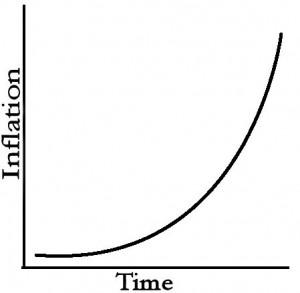
Unfortunately, there is no exact percentage where inflation turns from “ordinary Inflation” to “Hyperinflation”. So you can’t say for instance that 9.9% inflation is ordinary but 10% inflation is hyperinflation. Typically in hyperinflation it just gets progressively worse. Every month the inflation rate just gets higher and higher until the curve goes hyperbolic.
 Classic Hyperinflation

Classic examples are the Hyperinflation of Weimar Germany and the more recent Zimbabwean Hyperinflation which reached 2.2 Million Percent.
For instance in Germany prices doubled in only 5 years between 1914 and 1919, but then things got really bad…
So the doubling in 5 years was only the beginning and if it had ended there might not have even been considered hyperinflation.
But as it went on, things got worse, dentists and doctors stopped asking for currency, seeking payment in butter or eggs instead. Prices rose not just by the day, but by the hour — or even the minute. If you had your morning coffee in a café, and you preferred drinking two cups rather than one, it was cheaper to order both cups at the same time.
The flight from currency that had begun with the buying of diamonds, gold, country houses, and antiques now extended to minor and almost useless items — bric-a-brac, soap, hairpins. From: Hyperinflation of Weimar Germany
During times of Hyperinflation people know the money will be worth less tomorrow so they exchange any cash they have for any physical good they can get their hands on (whether they need it or not). After all, a bar of soap will still be a bar of soap tomorrow but it may take twice as many dollars to buy it. This has the effect of further stoking the fires of inflation by increasing the Velocity of money. See: What is the Velocity of Money? and Velocity of Money and the Money Multiplier.
In Zimbabwe, by 2008 the (hyper)inflation rate had reached 2.2 million percent. Eggs sold for a million dollars each. And things were just physically extremely difficult because of the lack of a stable medium of exchange. See: Zimbabwean Hyperinflation
Hyperinflation Leads to Lawlessness
In most cases of hyperinflation the lack of a reliable system of exchange leads to a breakdown in society and a “wild-west” sort of atmosphere.
In Germany,
The law-abiding country crumbled into petty thievery. Copper pipes and brass armatures weren’t safe. Gasoline was siphoned from cars. People bought things they didn’t need and used them to barter — a pair of shoes for a shirt, some crockery for coffee. Berlin had a “witches’ Sabbath” atmosphere. Prostitutes of both sexes roamed the streets. Cocaine was the fashionable drug.
In Zimbabwe,
Inflation is making it impossible for families to afford basic commodities they need to live day by day. A Chivhu resident who asked to be identified only as Innocent, said inflation is obliging many Zimbabweans to make a living by means that are sometimes “less than reputable”.
Examples of Hyperinflation:

click for larger image
Hyperinflation is not as uncommon as you think
- Egypt 276 AD – 334 AD 1 million percent inflation in 58 years. A measure of wheat which sold for 200 drachmae in 276 AD increased to more than 2,000,000 drachmae in 334 AD
- France 1789-1803 Assignats were created as notes by the French government based on the value of confiscated church property. But they were printed with no relation to the underlying value and eventually became totally worthless (no exchange value).
- United States 1779 47% inflation per month
- United States 1861-1865 Total hyperinflation of 1,200 to 1. Confederate Civil War Inflation Rates
- Austria 1914- 1923 Inflation in one year (1922) reached 1426% and overall the consumer price index rose by a factor of 11,836.
- Germany 1914-1923 Total hyperinflation 1,000,000,000,000 to 1. Hyperinflation in Weimar Germany
- Hungary 1919-1924 Inflation reached 98% per month in 1922
- Poland 1918-1924 Hyperinflation 800,000 to 1
- Philippines 1942-1944 Conquering Japanese army issued fiat currency which rapidly became worthless.
- Greece 1942-1953 Total hyperinflation 50,000,000,000,000 to 1
- Hungary 1945-1946 Total hyperinflation 400,000,000,000,000,000,000,000,000,000 to 1. Some historians believe this hyperinflation was actually an act of war as Russian Marxists tried to destroy the Hungarian middle and upper classes.
- China 1947-1949 Total hyperinflation 15,000,000,000,000,000,000 to 1
- Brazil 1967-1994 Total hyperinflation of 2,750,000,000,000,000,000 to 1.
- Mexico 1982-1993 Total hyperinflation of 10,000%
- Bolivia 1984-1987 New currency replaced the old currency at a rate of 1 Million to one.
- Iraq 1987-1995 Total hyperinflation of 10,000 to 1.
- Nicaragua 1988-1991 Total hyperinflation of 50,000,000,000 to 1.
- Argentina 1975-1993 By the end the hyperinflation currency exchanged at 100 Billion to one.
- Peru 1986-1991 Total hyperinflation of 1,000,000,000 to 1.
- Yugoslavia 1989-1994 By the end the hyperinflation currency exchanged at 1027 to one.
- Poland 1989-1994 By the end the hyperinflation currency exchanged at 10,000 to one.
- Zaire 1989-1996 By the end the hyperinflation currency exchanged at 300,000,000,000 to one.
- Angola 1991-1999 By the end the hyperinflation currency exchanged at 1 Billion to one.
- Bosnia and Herzegovina 1992-1993 Hyperinflation at the rate of 100,000 to 1.
- Belarus 1994-2002 By the end the hyperinflation currency exchanged at 1 Million to one.
- Zimbabwe 1998-2008 The overall impact of hyperinflation was 1 = 1025 The final result was a total elimination of the currency and only foreign currencies traded. Zimbabwe Hyperinflation and Zimbabwe Hyperinflation and the U.S. Dollar.
- North Korea December 2009 to mid-January 2011.
See Also:
- How Does Gold Fare During Hyperinflation?
- Hyperinflation of Weimar Germany
- What is the Velocity of Money?
- Confederate Hyperinflation Rates
- Surviving a Hyperinflation
See Wikipedia Hyperinflation for more information.

