
• Home
  • Related Sites
    • Financial Trend Forecaster
      • Moore Inflation Predictor
      • NYSE Rate of Change (ROC)
      • NASDAQ Rate of Change (ROC)
      • Crypto ROC- BTC & ETH
    • Unemployment Data
      • Historical Employment Data
      • Unemployment Rate Chart
      • Labor Force Participation Rate
    • Optio Money
    • Elliott Wave University
    • More Resources
  • Definitions
    • What is Inflation?
    • What is Core Inflation?
    • Inflation vs CPI
    • What is Deflation?
    • What is Disinflation?
    • What is Agflation?
    • What is Stagflation?
    • What is Hyperinflation?
    • What is Quantitative Easing?
    • What is Quantitative Tightening?
    • What is Velocity of Money?
    • What is Fiat Currency?
    • How Do I Calculate Inflation?
    • What are “Sticky Prices” and Why Do They Matter?
  • Featured Content
  • About Us
  • Feedback
    • Sitemap
  • Subscribe Now

InflationData.com

Your Place in Cyber Space for Inflation Data

CPI Index

CPIWidgetSept25
  • Numerical Inflation Data
    • Current Inflation Rate
    • Monthly Inflation Rate
    • Historical U.S. Inflation Rates
    • Historical CPI
  • Inflation Charts
    • Ann. Inf. Rate Chart
    • Long Term Inflation >
      • Ave. Inf. by Decade
      • Total Inf. by Decade
      • Inflation 1913-1919
      • Inflation 1920-1929
      • Inflation 1930-1939
      • Inflation 1940-1949
      • Inflation 1950-1959
      • Inflation 1960-1969
      • Inflation 1970-1979
    • Cumulative Inflation
    • FED Monetary Policy and Inflation
    • Inflation and Recession
    • Confederate Inflation (1861 – 1865)
    • Misery Index
    • The 3 Stages of Inflation
    • 15-Yr Inflation Trends Chart
  • Inflation Calculators
    • Cumulative Inf. Calc.
    • How Much Would it Cost
    • Salary Inf. Calc.
    • Cost of Living Calc.
    • U.K. Inf. Calc.
    • Cost of Gas Calc.
    • Net Worth Calc.
    • Lifetime Earnings Calc.
    • Savings Goal Calc.
    • Financial Calculators
  • Inf. Adjusted Prices
    • Energy >
      • Inflation Adj. Gas Prices
      • Historical Oil Prices Chart
      • Crude Oil Price (Table)
      • Natural Gas Prices
      • Electricity Prices
      • Oil vs Gold
    • Gold >
      • Inflation Adjusted Annual Average Gold Prices
      • Gold is a “Crisis Hedge” not an  “Inflation Hedge”
      • Comparing Oil vs. Gold
    • Corn Prices
    • Education Inflation
    • Housing Prices
    • Mortgage Rates
    • NYSE Index
    • Inf. Indexed Bonds
    • Movie Revenues
    • Inflation-Adjusted Wages
  • Cost of Living
    • Calculate Cost of Living
    • Cost-of-living Adj. (COLA)
    • Consumer Price Index CPI
      • Historical CPI
      • Current CPI
      • CPI Release Dates
    • Gas Prices >
      • Cost of Gas
      • Cost of Gas Per Month
      • Gas vs. Oil Price Chart
    • Food Prices 1913 vs 2013
    • Health Insurance
  • Blog
    • Key Inflation Articles
    • International Inflation
    • Historical Inflation Rates for Japan (1971 to 2014)
You are here: Home » velocity of money

How Inflation Can Effect Rising Prices

Published on April 5, 2021 by Guest Author Leave a Comment

UK Money House

In the field of economics, many experts agree that the long-term effects of inflation are dependent on the money supply in a country. Alternatively, the price levels are directly proportional to the money supply in the long run. Therefore, the money supply or the currency in circulation can directly affect the prices of goods and services. The confusion arises because both monetary inflation (an increase in the money supply) and price inflation (an increase in consumer prices) are both commonly referred to as "inflation". Even though many people consider money printing to be the cause of more money in circulation, physical paper in circulation is actually only a small percentage of the … [Read more...]

Filed Under: Inflation Tagged With: Assets, Hedges, inflation, Loan, mortgage, Purchasing Power, velocity of money

The Effects of Inflation and Interest Rates on Commodity Prices
Published on March 29, 2018 Updated on August 24, 2021 by Tim McMahon Leave a Comment

In common usage, inflation refers to steadily rising prices of goods and services over time, while "deflation" relates to falling prices. Inflation is both a boon and a bane to the economy and the rate of inflation is affected by a variety of factors including FED monetary policy, interest rates, supply vs. demand, and the Velocity of money. However, strictly speaking, rising prices are "price inflation" which is generally caused by "monetary inflation" i.e. the expansion of the money supply, among other things. See What is Inflation? for more info. Many Keynesian Economists believe that Inflation is a prerequisite for economic growth and prosperity and Keynesians believe Monetary … [Read more...]

Filed Under: Inflation Tagged With: FED, interest rates, monetary policy, supply vs. demand, velocity of money

The Quantity Theory of Money

Published on October 21, 2017 by Elliott Wave International Leave a Comment

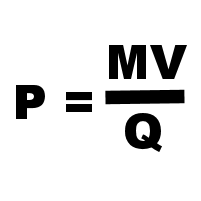
P equals MV over Q

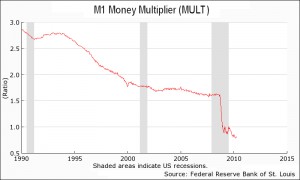
We have written quite extensively on the cause of inflation in articles like: How does the Money Supply affect our Inflation Rate? in What is Inflation? and Inflation Cause and Effects. One of the keys to understanding inflation is the Money Multiplier.  Because of the "Fractional Reserve system banks are only required to keep a small fraction of the money on deposit as "reserves" against potential withdrawals the bank can loan out the majority of the money on deposit to earn interest. This results in a multiplication effect increasing the money supply by vast multiples. This "leverage" can work in either direction. In April 2010, I wrote an article explaining how this can result in … [Read more...]

Filed Under: Money Supply Tagged With: deflation, inflation, Quantity Theory of Money, velocity of money

Inflation or Deflation? – Yes

Published on October 22, 2014 Updated on June 2, 2021 by John Mauldin Leave a Comment

Velocity of Money Trap

Over the years we've published a variety of articles on the inherent "tug-of-war" between inflationary and deflationary forces in the world including How can we have Inflation and Deflation at the same time? and Battle of the 'Flations both from back in 2008 and Deflation or Inflation - Which is it? in 2009 and Which is Stronger- Inflation or Deflation? in 2010. Another recurring theme has been Velocity of Money and Money Multiplier- Why Deflation is Possible and today John Mauldin will take a stab at each these critical topics once again. Understanding their interrelationships will greatly help you understand the monetary forces at work.~ Tim McMahon, editor The Flat Debt Society By … [Read more...]

Filed Under: Inflation Tagged With: deflation, inflation, velocity of money

Pushing on a String, Velocity of Money and Money Multiplier Conspire Against the FED

Published on October 22, 2013 Updated on September 20, 2017 by Casey Research Leave a Comment

Federal Reserve Bank Chicago

Under certain circumstances such as high national indebtedness, fear of bad economic times or when interest rates approach zero, monetary policy becomes ineffective in enticing consumers into spending more money.  Economists refer to this as "Pushing on a String" because if the basic demand doesn't exist to induce people to spend money, it can't be forced through monetary policy. Prime examples of this are during the Great Depression in the United States and in Japan since the 1990s. And as Lacy Hunt explains we are once again facing this problem in the United States since 2008. ~Tim McMahon, editor Federal Reserve Policy Failures Are Mounting By Lacy H. Hunt, Ph.D., Economist The Fed's … [Read more...]

Filed Under: The Federal Reserve Tagged With: economy, money multiplier, Pushing on a string, The Federal Reserve, velocity of money

Is Ben Bernanke “Shooting Blanks”?

Published on April 29, 2013 Updated on February 17, 2014 by Guest Author 2 Comments

M2 Money Supply

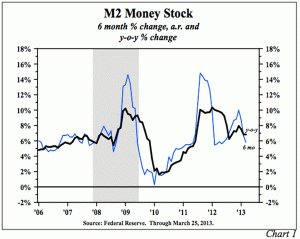
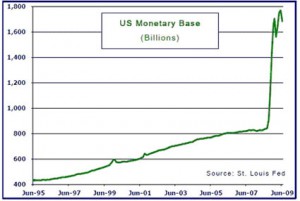
Summary: Lacy Hunt and Van Hoisington launch into their first-quarter "Review and Outlook," this week with a statement that some may find eye-opening: "The Federal Reserve (Fed) is not, and has not been, 'printing money'…" But given the facts of life about how money is really created (and destroyed), they are of course right: it's all about the acceleration – or deceleration – in the M2 money supply. Van and Lacy say, "A review of post-war economic history would lead to a logical assumption that the money supply (M2) would respond upward to [the Fed's] massive infusion of reserves into the banking system. Mystery Math- Monetary Base up 350%, M2 Up 35%? And yet, the Fed's 3.5x … [Read more...]

Filed Under: Inflation, Money Supply Tagged With: inflation, money supply, velocity of money

Velocity of Money

Published on September 17, 2011 Updated on July 26, 2022 by Tim McMahon 7 Comments

Velocity of Money

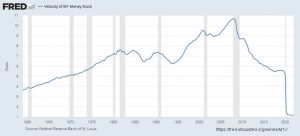
What is the velocity of money? Simply defined, the velocity of money is the turnover in the money supply. A shop owner can measure how fast his inventory is selling by calculating "inventory turnover." To do that, he simply calculates Total Sales ÷ Average Inventory for the period in question. See: Inventory TurnOver for more information. But if you expand the idea of turnover to the entire country, you get the "Velocity of Money". Strictly speaking all the velocity of money tells us is how long people hold onto their money. But from that we can infer their motives and perceptions of the economy in general... The Velocity of Money Calculation To Calculate the Velocity of Money, you … [Read more...]

Filed Under: Definitions, Economy Tagged With: money velocity, velocity, velocity of money

Inflation and Velocity of Money

Published on December 29, 2010 Updated on July 26, 2022 by Guest Author 2 Comments

How do you define inflation? In some ways it's a slippery thing, like trying to nail Jell-O to a tree. One common definition amounts to "a general and sustained rise in the price of goods and services." Another is "a persistent decline in the purchasing power of money." Others argue that inflation is directly tied to the money supply. That is to say, they believe a substantial rise in the money supply is the same thing as inflation. (This is one small step removed from Milton Friedman’s old assertion: "Inflation is always and everywhere a monetary phenomenon.") Why is the debate important? Because of the infamous chart you see below (courtesy of hedge fund QB Partners and the St. Louis … [Read more...]

Filed Under: Definitions, Inflation Tagged With: debt, inflation, money supply, printing money, quantitative easing, velocity of money

Velocity of Money and Money Multiplier- Why Deflation is Possible
Published on April 12, 2010 Updated on March 30, 2014 by Tim McMahon 4 Comments

By Tim McMahon Back in 1924, John Maynard Keynes called gold a barbarous relic. There is a thought prevalent these days that deflation is the new barbarous relic. In a speech in November of 2002, Federal Reserve chairman Ben Bernanke said,  “I believe that the chance of significant deflation in the United States in the foreseeable future is extremely small… I am confident that the Fed would take whatever means necessary to prevent significant deflation… the effectiveness of anti-deflation policy could be significantly enhanced by cooperation between the monetary and fiscal authorities.”  He went on to say, “the U.S. government has a technology, called a printing press (or, today, its … [Read more...]

Filed Under: Money Supply Tagged With: deflation, money multiplier, velocity of money

Latest Posts

  • How Deflation Created the Middle Class
  • October Inflation Numbers Delayed
  • Why the 2.8% COLA May Fall Short of Real Inflation
  • Delayed BLS September Inflation Data Released
  • September CPI Data Delay Causes Social Security COLA Concerns
  • August 2025 Inflation Report
  • Is the FED Getting Soft on Inflation?
  • July Inflation Report

Sponsored:

As a Seasoned Investor I thought I'd seen everything... But recently I discovered TradingView which has really improved the information I have at my fingertips.~ Tim McMahon, editor

TradingView gives me an edge... including powerful charting tools, real-time market data, and a global community of traders—all in one easy to use platform. It has hundreds of indicators, and even custom scripts for more advanced users, and you don't need to change Brokers just use its seamless brokerage integration... TradingView isn't just a charting tool—it's your full trading command center.

Trade smarter. Trade faster. Check Out TradingView for free.

----------

The Best Place to Buy Your Crypto

Coinbase is the largest Crypto Trading platform in the U.S. and the easiest to use. ~Tim McMahon, editor

Check out Coinbase here

Subscribe Now

eTrends Signup Form

Elliott Wave Resources

Free Elliott Wave Resources

What is Waveopedia?

Waveopedia is EWI’s free, comprehensive index of Elliott wave patterns and terms. Everyone from beginners to experts can benefit from it. It’s a great place to send your followers if they’re new to Elliott waves.

  • Deflation Hits China is the U.S. Next?

  • Why You Must Avoid the Herding Trap

  • Chasing Trends Can Cost You

  • More Education Resources

Post Archives

Home | Articles | Sitemap | Terms of Service | Privacy | Disclaimer | Advertise With Us

Copyright © 1996-2025 · Capital Professional Services, LLC · Maintained by Design Synergy Studio · Admin

Do Not Sell My Personal Information