Annual Inflation Increases to 1.31%
- Annual Inflation rose from 0.12% in May to 1.31% in August.
- CPI Index rose to 259.918 in August.
- Monthly Inflation for August was 0.32%, July was 0.51%, June was 0.55%, May was 0.002%, April was -0.67%, March was -0.22%, February was 0.27%.
- The FED holds pretty steady on Assets and FED Funds Rates.
- Next release October 13th
Annual inflation for the 12 months ending in August was 1.31%, up from July’s 0.99%. Inflation is still moderate but may be picking up.
The CPI index itself was up from 259.101 in July to 259.918 in August. Resulting in a monthly inflation rate of 0.32%.
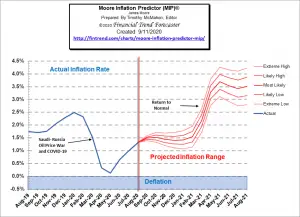 The Moore Inflation Predictor once again indicates an increase in inflation for the next few months. There is also the possibility that the recent massive FED money printing will kick us into much higher inflation. But current projections are that inflation could spike to over 4%.
Currently, the inflation rate is still below the FED’s target 2% rate, the FED had been concerned with a market meltdown due to falling Oil prices and the Coronavirus. Over the months since the Coronavirus shutdown, the FED embarked on a massive money creation scheme of Quantitative Easing (QE4). But June saw a significant reduction in FED Assets. July-August saw them hold assets steady. So QE4 may be ending.
Monthly Inflation:
According to the BLS commissioner’s report, “The Consumer Price Index for All Urban Consumers (CPI-U) increased 0.4 percent in August on a seasonally adjusted basis after rising 0.6 percent in July, the U.S. Bureau of Labor Statistics reported today. Over the last 12 months, the all items index increased 1.3 percent before seasonal adjustment.
The monthly increase in the seasonally adjusted all items index was broad-based; a sharp rise in the used cars and trucks index was the largest factor, but the indexes for gasoline, shelter, recreation, and household furnishings and operations also contributed. The energy index rose 0.9 percent in August as the gasoline index rose 2.0 percent. The food index rose 0.1 percent in August after falling in July; an increase in the food away from home index more than offset a slight decline in the food at home index.
The index for all items less food and energy rose 0.4 percent in August after increasing 0.6 percent in July. The sharp rise in the index for used cars and trucks accounted for over 40 percent of the increase; the indexes for shelter, recreation, household furnishings and operations, apparel, motor vehicle insurance, and airline fares also rose. The indexes for education and personal care were among the few to decline.”
Seasonally Adjusted Inflation Table
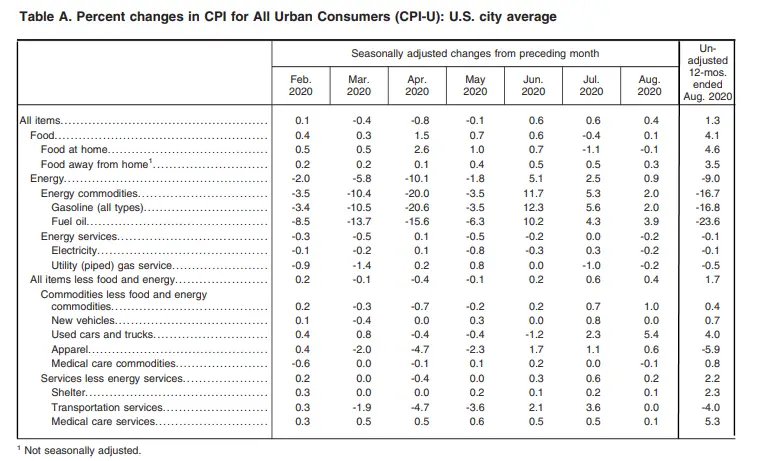 On the chart above, we can see that on an unadjusted basis inflation is up 1.3% for the year. We can also see that Energy is up 0.9% in August. But Energy is still down -9.0% for the entire year.
Current Inflation Situation
Inflation bottomed at 0.12% in May before climbing to 1.31% in August.
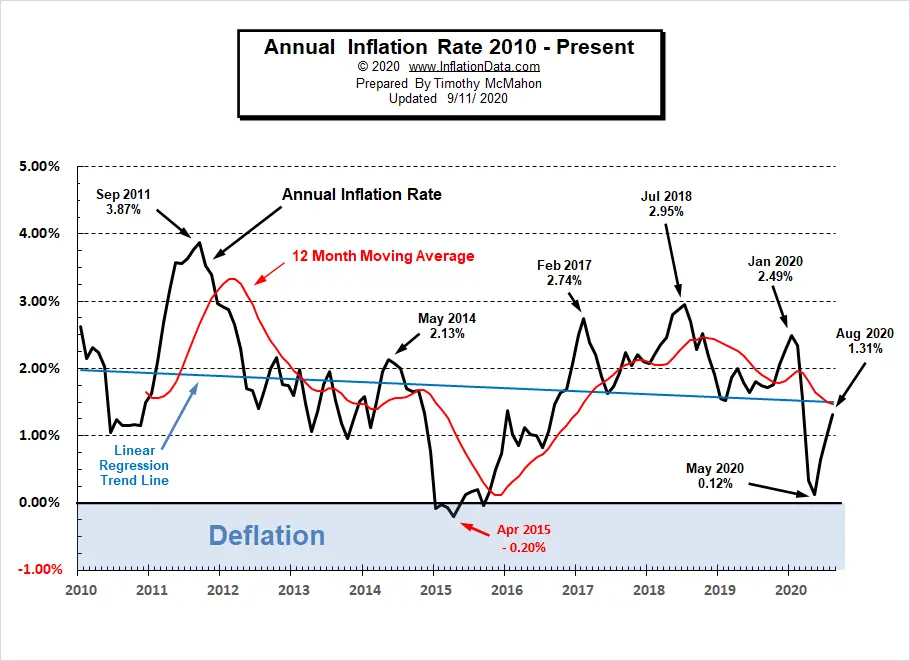 See Current Inflation Rate for more information.
Not Seasonally Adjusted Monthly Inflation Rates
Monthly inflation for June was 0.55% comprising the majority of the annual inflation since March and April’s deflation canceled out most of the rest of the year’s inflation.
| Jan | Feb | Mar | Apr | May | Jun | Jul | Aug | Sep | Oct | Nov | Dec | |
| 2016 | 0.17% | 0.08% | 0.43% | 0.47% | 0.41% | 0.33% | (0.16%) | 0.09% | 0.24% | 0.12% | (0.16%) | 0.03% |
| 2017 | 0.58% | 0.31% | 0.08% | 0.30% | 0.09% | 0.09% | (0.07%) | 0.30% | 0.53% | (0.06%) | 0.002% | (0.06%) |
| 2018 | 0.54% | 0.45% | 0.23% | 0.40% | 0.42% | 0.16% | 0.01% | 0.06% | 0.12% | 0.18% | (0.33%) | (0.32%) |
| 2019 | 0.19% | 0.42% | 0.56% | 0.53% | 0.21% | 0.02% | 0.17% | (0.01%) | 0.08% | 0.23% | (0.05%) | (0.09%) |
| 2020 | 0.39% | 0.27% | (0.22%) | (0.67%) | 0.002% | 0.55% | 0.51% | 0.32% |
See: Monthly Inflation Rate for more information and a complete table of Unadjusted Monthly Rates.
For more information See Annual Inflation.
Federal Reserve Actions
In the following chart, we see the Federal Reserve Total Assets. The market peaked almost exactly when the FED started tightening in early 2018. Throughout 2019 the FED claimed to have taken a more “dovish” stance but through the first half of 2019, it lowered interest rates but didn’t change its approach to QT. Throughout all of 2018 and the first 3/4 of 2019, the FED eliminated roughly 1/3rd of QE3 but in the last three months of 2019, it realized it had over-done it a bit and ticked back up. Then in response to the recent Coronavirus crash, it has implemented QE4 equal in speed to QE1 and greater in magnitude than QE1, QE2, and QE3 combined. This is a MASSIVE increase in the money supply. Many believe that this will create massive inflation in the days to come. See Inflation Expectations and the Massive Fed Stimulus and Will the $2 Trillion Covid-19 Stimulus Cause Inflation? for more information.
From June 10th through July 8th 2020 the FED had QT2 where FED assets shrunk and since then it has held fairly steady. According to the National Bureau of Economic Research (NBER) the U.S. has been in a recession since February (shaded area) after the longest boom in economic history. According to NBER the peak occurred in February 2020. Often their peaks will take a long time before people realize that things are not going well. It is, however, possible that the “recession” will be short-lived if the economy can get back on track especially in light of all the FED money pumping going on.
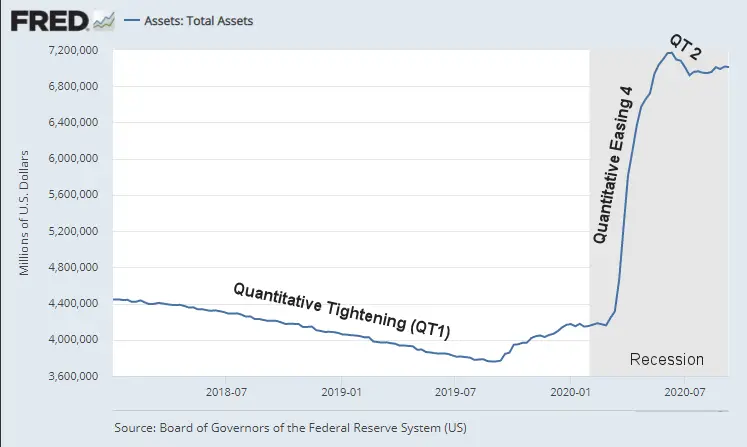
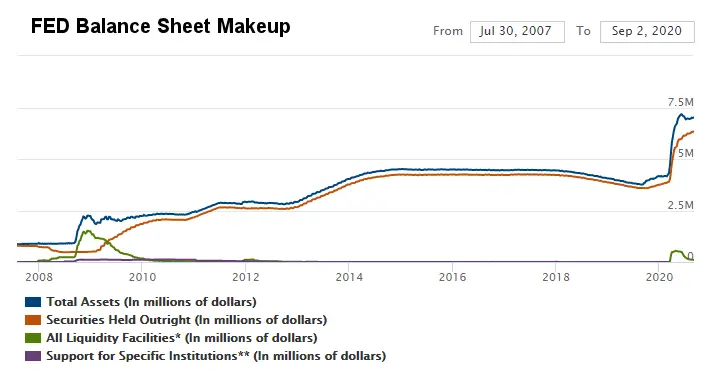
At first glance, that decrease is worrying for the stock market. But if we look at the breakdown of the FED assets in the chart below we see that the entire decrease comes from “Liquidity Facilities” and not “Securities”. Liquidity facilities typically are near zero so they are simply returning to normal. For more information see Is the FED tightening?
FED Funds Rate
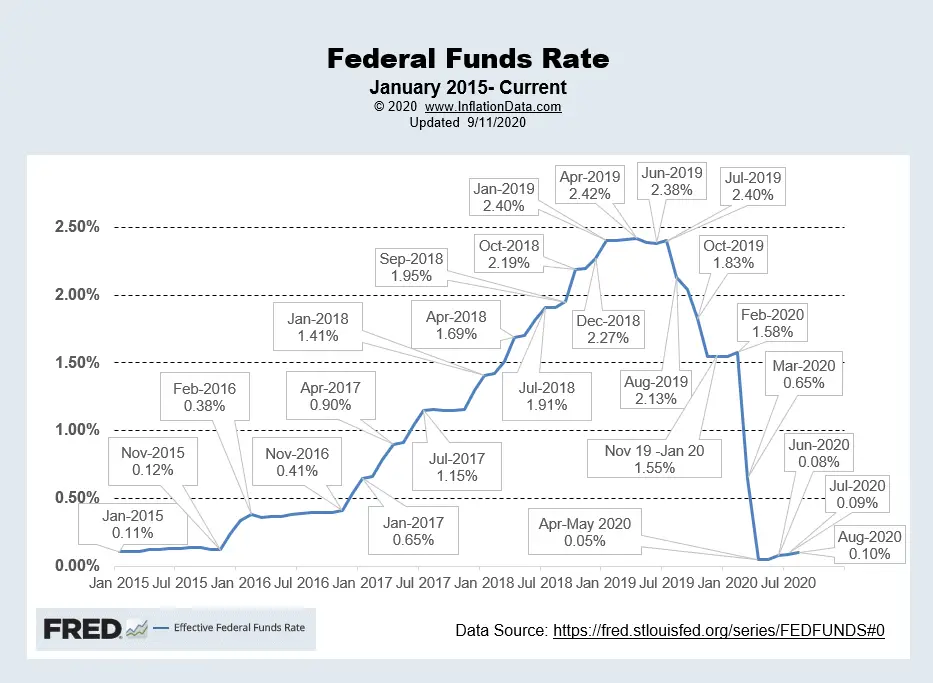
In the chart below, we can see that the FED Funds Rate peaked at 2.42% in April 2019 at that point the FED began fearing that it was holding too tight and the stock market was suffering so it began easing. It leveled off in November at 1.55% where it stayed until February. At that point, COVID tanked the market, and the FED loosened rates to virtually zero (actually 0.05%) five one-hundredths of a percent. In June they moved it up to eight one-hundredths of a percent and then in July, it inched up another one-hundredth of a percent. Then in August, it moved up another one-hundredth of a percent. These increases are essentially symbolic it is still virtually zero.
For more info See NYSE ROC and MIP.
Misery Index
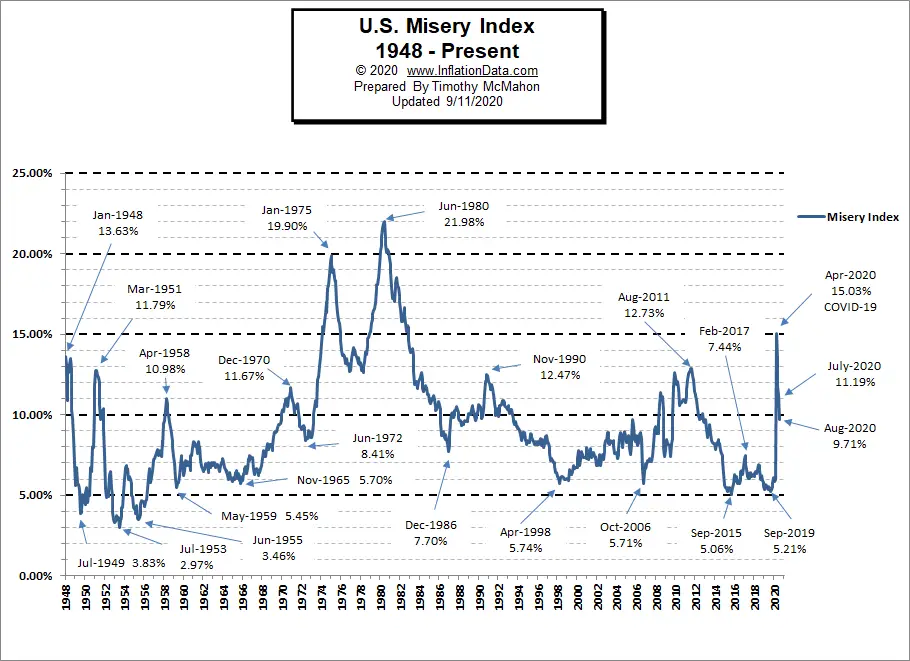 In September 2019, the Misery index was near all-time lows at 5.21%.
By March 2020, it had climbed slightly to 5.94%. But in April, due to the COVID-19 shutdown and consequent high unemployment, the Misery Index shot up to 15.03% based on 14.7% unemployment and 0.33% inflation. In May both inflation 0.12% and Unemployment 13.30% fell, resulting in a Misery index of 13.42%. By July unemployment had fallen to 10.2% and inflation had risen slightly to 0.99% resulting in a Misery index of 11.19%. In August, unemployment had fallen to 8.4% as COVID shutdowns began winding down but inflation rose slightly to 1.31%.
[Read More…]
NYSE Rate of Change (ROC)©
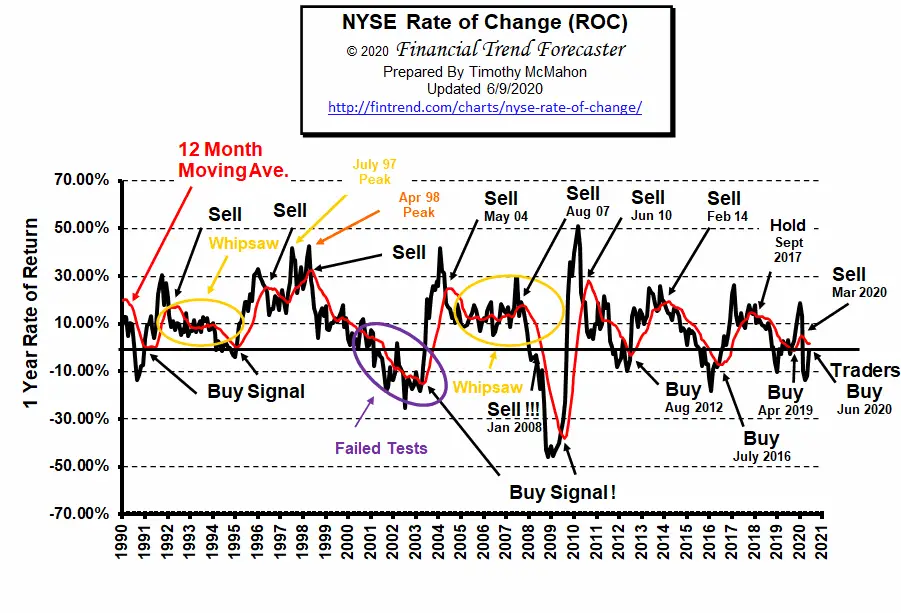
Sell Signal
Last month we said, “At this point we have a buy signal but we could easily see another whipsaw down moving us back to sell territory” and that is exactly what happened.
See the NYSE ROC for more info.
NASDAQ Rate of Change (ROC)©
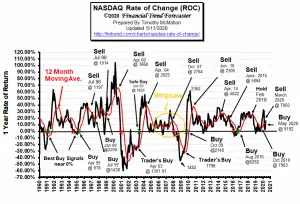
Hold Signal!
The ROC index is ABOVE its moving average. But as we said in the NYSE ROC the FED might be tightening and the ROC has turned down from last month, so caution is warranted. Thus the HOLD Signal.
See NASDAQ ROC for more.
Regional Inflation Information
The U.S. Bureau of Labor Statistics also produces regional data. So if you are interested in more localized inflation information you can find it here.
| AL | AK | AR | AZ | CA | CT | CO | DC | DE | FL | GA | GU | HI | IA |
| ID | IL | IN | KS | KY | LA | MA | MD | ME | MI | MN | MO | MS | MT |
| NC | ND | NE | NH | NJ | NM | NV | NY | OH | OK | OR | PA | PR | RI |
| SC | SC | SD | TX | UT | VA | VI | VT | WI | WA | WI | WV |
You Might Also Like:
From InflationData.com
- Gold vs. Dollar vs. BitCoin Revisited
- July’s Annual Inflation 0.99%
- 3 Factors Causing the Current Gold Rally
- Inflation Quintuples… Still Below 1%
- Is the FED Tightening or Is Hyperinflation on the Horizon?
Read more on UnemploymentData.com.
- Latino Unemployment Lower than Asian Unemployment for First Time
- 7 Steps to Finding a Career Without a College Degree
- 4 Ways a Criminal Record Can Affect Your Employment
- Hopeful Entrepreneur: Starting Your Own Business With Limited Funds
- Medical Office Administration Career
From Financial Trend Forecaster
- Oil Majors That Bet Big On Renewables
- Oil Demand Impacts Foreign Exchange Rates
- 2020 Pandemic Bankruptcy Statistics
- Saudi Arabia Eyes Total Dominance In Oil And Gas
- 4 Investments Making Waves in the Technology Sector
From Elliott Wave University
- Gold: See What This Fibonacci Ratio Says About the Trend
- Forecasting Markets by Looking at Chart Patterns
- Seeking Certainty in Uncertain Times?
- Emerging Markets and Epidemics
- Deflationary Psychology Versus the Fed: Here’s the Likely Winner
From OptioMoney.com
- Should You Buy a Second Home?
- Learning to Trade from Video Tutorials
- How Saxo Bank Democratizes Trading and InvestmentFive Business Tips to Help Your Company Thrive
- Have Minimal Car Insurance? What to Do in Case of an Accident
- How to Choose a Residential Roofing Contractor
From Your Family Finances
- 4 Tips for Saving Money on Household Repairs
- Guide to Creating an Annual Family Budget Plan
- Purchase Agreements, Disclosures, Deeds, and Other Vital Documents in a Real Estate Sale
- How to Get Money to Cover an Emergency Repair
- 5 Mistakes Most First-Time Homebuyers Make


Leave a Reply