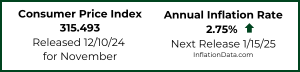
 The consumer price index, personal consumption expenditures, and producer price index point to cooling inflation, but no one can say for certain what the economy will do next. High inflation rates have a devastating effect on economies and the people within them, so a slower rate of inflation over the next few months and years could make everyone breathe a little easier. However, with so many factors up in the air — the U.S. presidential election and ongoing geopolitical conflicts, among others — you might not want to make any drastic moves with your personal finances.
If inflation rates slow down and the economy returns to a more normal healthy state, you should adjust your financial strategy to take advantage of these changes. Here are a few tips that anyone can follow to optimize their wealth-building activities should inflation rates improve.
Consider Introducing More Variable Debt
There are two types of debt: fixed and variable. With fixed debt, the interest rate is locked in forever, until the debt is fully paid. With variable debt, your interest rate will shift based on the prevailing rates. As interest rates rise, financial experts warn against taking on new variable debt, because you could end up paying significantly more when the rates adjust. However, cooling inflation promises lower interest rates, which makes variable debt more attractive.
If you’re considering whether to use a line of credit or emergency savings to fund a business venture or other major move, you may want to choose credit. Your emergency fund should be able to cover three to six months’ worth of living expenses. If you have that money in a high-yield account (more on this below) and inflation is cooling, it makes more sense to take advantage of the line of credit’s low interest rate while your savings earn higher interest. Then, if an issue arises and it’s tough to afford your credit payments, the interest you’re earning on the emergency fund can help.
Another trick is to use the introductory zero-interest period currently offered by many credit card companies to customers with good credit. Since they charge a fee to transfer balances you are better off simply stopping the use of your current card and then start using the new zero-interest card. At that point, you make maximum payments on the old card and minimum payments on the new card. And before long your old card is paid off and you have several months left interest-free to pay off the new card. Just be sure you aren’t getting yourself into more debt simply because you have more credit.
Be More Daring in Your Investments
Generally speaking, most personal investors aren’t interested in taking on risky investments when inflation is high. Though high inflation doesn’t necessarily have a negative impact on the stock market, the truth is that investors tend to gravitate toward more reliable investments, like bonds and money market accounts, where they can be relatively certain to avoid major losses.
As inflation cools, it will be time to reevaluate your investment strategy. This is true of general wealth-building, but it is especially true of retirement planning for those who are late to developing a robust retirement fund. You should look toward creating a more balanced portfolio, with both traditional investments and non-traditional investments. Because you can’t be certain that the period of high inflation is over for good, you want some resilience in your investments, but given the trajectory of the economy, you should feel more comfortable experimenting with risk going forward.
Start Planning for Real Estate Investment
The number-one rule of savvy personal finance management is: Own your home, don’t rent. Unfortunately, when inflation rates are sky-high, wannabe homeowners have a difficult time building savings toward a mortgage down payment, and the absurdly high interest rates send monthly house payments above rents. Therefore, over the previous few years of high inflation, fewer would-be homebuyers have been able to put money toward real estate.
All that could change in the coming months. High rates have slowed the demand for housing in many parts of the country so prices are coming down and as the rate of inflation slows, the Fed will cut interest rates, reducing monthly payments further. When rates are falling, you might consider a variable-rate mortgage, which will help you take advantage of continuing interest rate decreases over the next few years. When interest rates are low you want to lock in rates with a fixed-rate mortgage.
Maintain Your High-Yield CD
Before interest rates drop, if you have some long-term savings you can lock in higher rates with a Certificate of Deposit (CD). Currently, banks are anticipating falling rates so you can’t lock in 5% for the next 10 years. Typical rates on longer-term CDs are lower than on short-term CDs. For instance, a bank might offer 4.5% on a 1-year CD, 4.0% on a 2-year CD, and only 3.75% on a 5-year CD.
Bonds
Bonds on the other hand usually reflect current interest rates. So, you should be able to buy bonds at a discount with a longer maturity. Then as rates fall the value of the bond will rise reaching 100% at the maturity date of the bond. For instance, as of this writing, you can get a bond issued by Bank of America rated A1 by Moodys, that will yield 6.706% through 11/2029.
You might also like:
- July 2024 Annual Inflation Falls Again
- What Causes Stagflation?
- Inflation Causes Inequality
- Navigating High Inflation: Should You Buy, Sell, or Hold Off on Real Estate?
- Annual Inflation Falls Below 3%


Leave a Reply