A variety of factors affect the price of gold. Currently, many of them are combining to drive the price of gold to all-time record highs. Let’s look at a few of the factors that affect the price of gold.
1) Uncertainty- Gold is a Crisis Hedge
We have said this many times over the years but it bears repeating again gold is more of a crisis hedge than an inflation hedge. When uncertainty rears its ugly head… gold does well. That uncertainty can take many forms and one of them is “monetary uncertainty”. So if people don’t know what the value of their money is going to be in the future (i.e. inflation) they will shift some of their assets to gold (driving up the price of gold). So as far as that goes, yes gold does provide some inflation protection.
But other forms of uncertainty also drive up gold’s price. This could be wars (or even rumors of wars), pandemics, elections, riots, etc. So as you can see, we have a major confluence of these uncertainty factors in play this year. And as of Monday, July 27, 2020 gold had reached a new record high beating the previous record of $1884.20 set in early September 2011. The following chart from Kitco shows the price of gold since 2000.
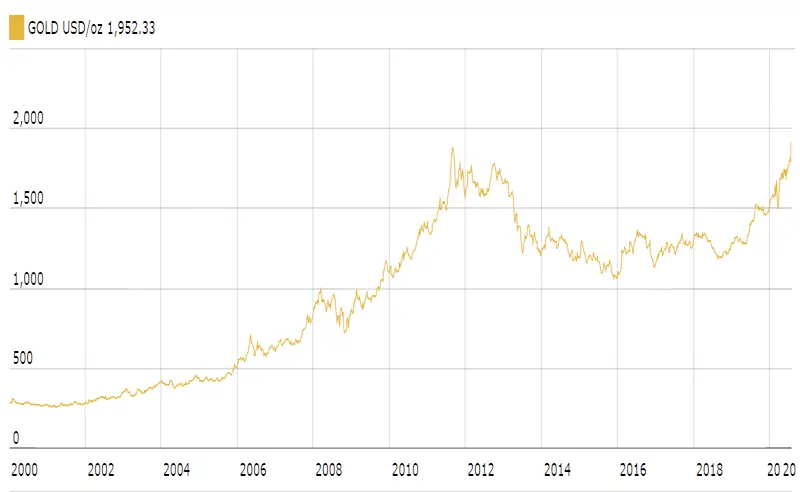
As far as our contention that Gold is not strictly an inflation hedge… that is not to say that gold doesn’t rise with inflation, it does. Gold is a commodity and so as other prices rise (money becomes worth increasingly less) the dollar-denominated price of gold will go up but there are other factors in play that can make gold rise faster or slower than other commodities. From January 2000 through December 1, 2009 gold rose from $290 an ounce to $1194 a four-fold increase. (Although by December 31 it had fallen to $1087.) Gold was the top-performing asset of the decade while inflation was up “only” 28.31%. So, in this case, gold outperformed inflation by a massive margin. But in the chart below we can see the inflation-adjusted price of gold since 1913.
Up until 1971, the price of gold was fixed by the government, so the “nominal” price only went up when the government said so, i.e. it “stair-stepped” but the inflation-adjusted price actually fell for most of the time from 1933. When individuals were allowed to own it again the nominal price skyrocketed to its 1980 peak. Making the 1970’s another stellar decade for gold. And since it was also a high inflation decade it gave rise to the idea that gold was a good inflation hedge.
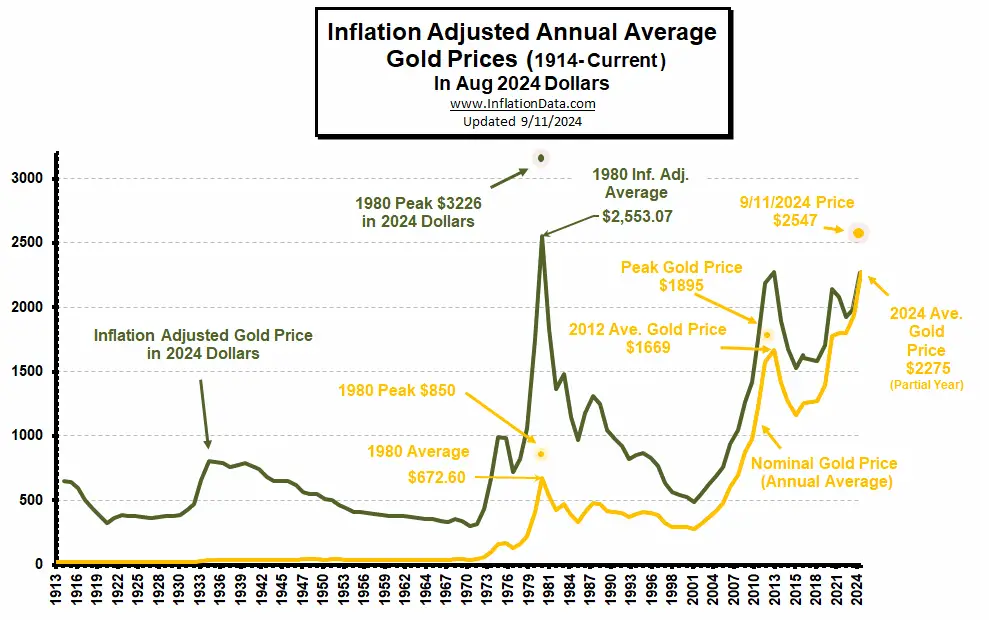
But if you had purchased gold in 1980 and held it for 20 years, you would have seen the nominal price decline from around $672 (the average price for 1980) to $290 (the average price for 2000). But in inflation-adjusted terms, you would have done even worse. Because during that 20 year period, there was 123% inflation. So everything else cost more than twice as much as it did 20 years earlier (except gold which actually declined 57% in price). Although, if you take a really long term view, i.e. over the last 50 years, gold has kept up with inflation. In the short-term, gold doesn’t always keep up with inflation. If gold truly was an inflation hedge (in the shorter term) the inflation-adjusted line in the above chart would be much flatter.
That doesn’t mean that gold is worthless or a “bad” investment. Obviously, during some decades it is an excellent investment i.e. the 1970s and the 2000s. It also has very little correlation to the stock market so it can provide a good buffer during market crashes.
Interestingly, in inflation-adjusted terms, gold isn’t at an all-time high yet. Based on the chart above we can see that the annual average price for gold would have to get above $2104 or a daily peak of $2659 for gold to be more expensive than 1980 in inflation-adjusted terms. However, gold has just surpassed the 2012 annual average peak in inflation-adjusted terms.
2) FED Money Printing
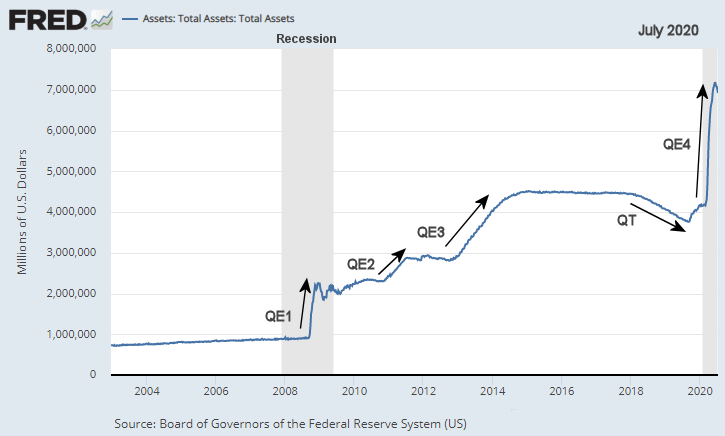
In addition to its “crisis hedge” properties, gold tends to benefit when people perceive that the FED is RAPIDLY inflating the money supply. This does give it some inflation protection properties. But the key is rapid expansion of the money supply. As we saw above, the gradual inflation of the money supply from 1980 to 2000 had zero effect on the price of gold (prices actually declined). But the current massive money creation through Quantitative Easing has also contributed to the rapid increase in the price of gold.
In the following chart, we can see the current increase in the money supply. QE4 is as sharp as QE1 during the market crash of 2009 but is a magnitude almost equal to QE1, QE2 and QE3 combined. We can note in this chart that there is a slight decrease in FED “assets” in June but that is due not so much to tightening as to eliminating the bank subsidies that the FED had instituted. See Is the FED Tightening or Is Hyperinflation on the Horizon? for more information.
3)Falling Dollar
Another related factor in the market price of gold is the value of the currency that it is denominated in. Often you will see the price of gold in dollars moving in a different direction than the price of gold in Yen, Euros, Pesos, or whatever; based on the strength of the individual currency.
Since gold is a worldwide commodity and one ounce of gold in Europe or Japan or the U.S. is the same as an ounce anywhere else, traders can use arbitrage to buy gold denominated in one currency while selling gold denominated in another currency. Looked at another way gold not only is gold a commodity but in some respects it acts as an alternative currency albeit one that is outside the control of individual governments. So if traders believe currencies are losing value they can switch to the “metal currency” i.e. gold.
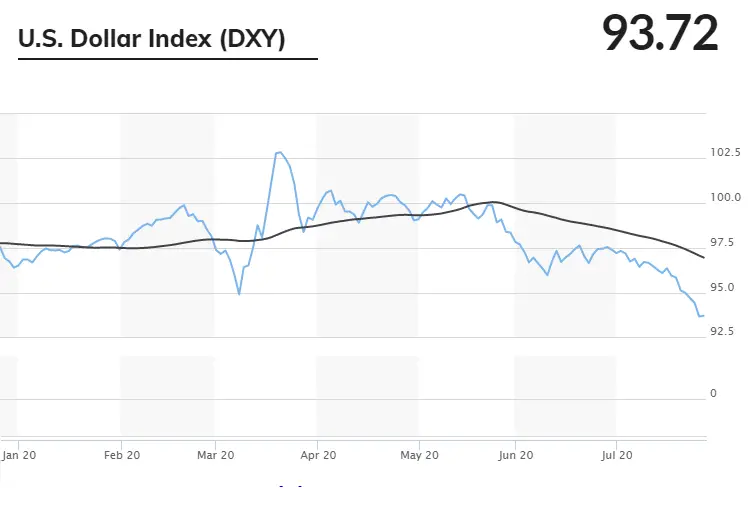
In the following chart from MarketWatch, you can see a roughly 8% decline in the U.S. Dollar since mid-May. This means that part of the increase in the U.S. Dollar price of gold is actually due to the decrease in the value of the dollar. And of course, a decrease in the value of the dollar does translate into inflation. So in that way, gold does hedge against a falling Dollar in the short term.
 So we can see that there are a variety of interwoven factors that influence the price of gold including FED actions, currency fluctuations, fear, and uncertainty.
You might also like:
- Gold is a “Crisis Hedge” not an Inflation hedge
- Is the FED Tightening or Is Hyperinflation on the Horizon?
- Why buy gold?
- What are “Foreign Exchange Reserves”?
- Why Gold is a Good Investment for Inflationary Times
- Gold and the Federal Reserve
- How Does Gold Fare During Hyperinflation?
- What is Hyperinflation?
- What is Fiat Currency?


Leave a Reply