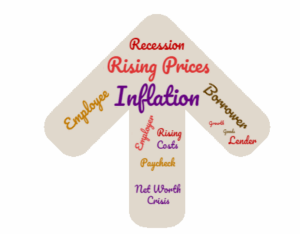
 The cause and effect are both commonly called “inflation” which can cause some confusion. Typically, “Inflation” is defined as “an increase in the cost of a basket of goods over time”. Technically this should be called “Price Inflation” which is often the result of “Monetary Inflation”. As we have discussed in “What is Inflation“, monetary inflation can also be referred to simply as “inflation.”
Inflation is a common phenomenon that affects millions of households every year. Let’s look at how it affects various types of individuals.
Inflation and Income
A fixed income combined with rising prices decreases the ability of people to purchase the same number of goods. As inflation increases, many people face difficulties due to their reduced ability to buy the same number of goods as they were able to purchase before. In other words, with rampant inflation, real (i.e. inflation-adjusted) income falls, reducing purchasing power, and causing increased misery. The “Misery Index” attempts to measure this by combining both inflation and unemployment rates into a single simple well-being indicator.
Inflation causes Employees to expect an increase in their paycheck every year.
Generally, most businesses give their employees some sort of Cost of Living Adjustment (COLA) This tends to lead people to believe that they are entitled to more money every year. This is logical if overall prices have inflated because the company will also have raised the prices of their product or service along with the general inflation rate.
However, what if prices have not risen? If the worker is still putting the exact same widget onto the same thing-a-ma-jig as they did last year, why are they entitled to more money? Of course, if they can do it faster or their increased experience and knowledge makes them a more valuable employee, then they do deserve a performance-based raise in addition to the COLA. But this performance-based raise is earned, not automatic, and not related to inflation.
One disadvantage of the COLA is that it is not retroactive. That is, you don’t get the increase until the next year. So you have already experienced a year of increased prices before you get the raise. This is not too noticeable at low inflation rates but can be very serious at higher rates. Assuming a 12% inflation rate equally spread over a year, we can see its effects. At the end of January, prices will have increased by 1% and at the end of February they will have increased by 2%, and so on. At the end of December, you get a 12% raise but throughout the year you paid an average of 6% more for everything you purchased. So you start the next year behind by 6%.
Fixed Income Problems
Those on fixed incomes suffer more damage caused by inflation since the costs they pay increase every year but their income does not, so each year they can afford to buy less and less. This is why Social Security includes a COLA as well. Unfortunately, the Social Security COLA in the U.S. is indexed to the Consumer Price Index for Urban Wage Earners and Clerical Workers (CPI-W) using a complex formula rather than the experimental CPI-E which is more closely related to the actual expenditures of the elderly who tend to spend more on healthcare and less on mortgages, etc.
Lenders vs. Borrowers
Inflation has different effects on lenders versus borrowers and the longer the term of the loan the greater the effect. Inflation is actually a borrower’s friend, in that it allows a borrower to pay off the loan with “cheaper dollars”. Lenders, on the other hand, are getting less and less value as the term of the loan continues.
So for example, if the inflation rate averages 5% and a person borrows money for a 30-year mortgage… based on the Rule of 72 inflation will have doubled in roughly 14.4 years. This means that it only costs half as much in “real” purchasing power to make your mortgage payment and by the end of the mortgage it will only be costing you a quarter as much in “real” purchasing power. This makes lenders less likely to want to make loans unless they charge much higher interest rates in order to offset the loss of purchasing power over the life of the loan.
Income and Wealth
Obviously, income and wealth are integral components of the economic wellbeing of an individual but they aren’t the same thing. An individual can have a high income but not be “wealthy”.
Income generally refers to the flow of funds such as earning from production and selling of goods. In this case, income refers to wages or salary. However, wealth refers to your “Net Worth” which includes tangible assets, such as real estate, gold, and vehicles, etc. Wealth also includes personal funds, such as cash, checking and savings accounts, brokerage accounts, and retirement accounts. This means a person could easily have substantial income but very little wealth. If they spend every penny and save very little. Surprisingly, this is more common than you might expect as high-income individuals want to present an image of “success” and thus buy a bigger house than they can afford, a fancy car, and spend on credit thus incurring large interest payments. A person could also be “wealthy” but have little income such as a farmer who owns millions of dollars in real estate but only earns a small income from the farm. Or a retiree who has a million dollars in the bank but is only earning 0.5% interest on that money i.e. $5,000/yr.
Income-Based Individuals
So, how does inflation affect such individuals? As we mentioned previously, individuals with large amounts of debt do get a bit of a reprieve by being able to pay off the debt with “cheaper money” but if the debt is of a short term nature i.e. Credit cards, Payday Loans, etc. the boost from inflation is very minimal and the interest is often exorbitant. Even if you are a high-income person your purchasing power will still be falling behind inflation since you don’t get your raise until the following year.
Asset-Based Individuals
High net worth individuals will fare somewhat better if their assets are properly deployed. Certain tangible assets, such as real estate and gold, tend to hold their value during periods of high inflation. While stocks and inflation-indexed bonds tend to do well during times of moderate inflation. Dividend-paying stocks, Corporate Bonds, and fixed income assets like Savings Accounts, Certificates of Deposit (CDs), and Money Market Funds do well when other markets are falling. So, wise investors create a balanced portfolio of some of each type of asset so that no matter the inflation environment, their portfolio will grow and provide them with enough income to live on comfortably.
You might also like:
- What Causes Inflation? Rising Prices Explained
- Inflation Expectations and the Massive Fed Stimulus
- What is the Federal Funds Rate?
- Will the $2 Trillion Covid-19 Stimulus Cause Inflation?
- Does the FED Control Mortgage Rates?
- The 2008 Financial Crisis
- What are Central Banks?


Leave a Reply