• Home
  • Related Sites
    • Financial Trend Forecaster
      • Moore Inflation Predictor
      • NYSE Rate of Change (ROC)
      • NASDAQ Rate of Change (ROC)
      • Crypto ROC- BTC & ETH
    • Unemployment Data
      • Historical Employment Data
      • Unemployment Rate Chart
      • Labor Force Participation Rate
    • Optio Money
    • Elliott Wave University
    • More Resources
  • Definitions
    • What is Inflation?
    • What is Core Inflation?
    • Inflation vs CPI
    • What is Deflation?
    • What is Disinflation?
    • What is Agflation?
    • What is Stagflation?
    • What is Hyperinflation?
    • What is Quantitative Easing?
    • What is Quantitative Tightening?
    • What is Velocity of Money?
    • What is Fiat Currency?
    • How Do I Calculate Inflation?
    • What are “Sticky Prices” and Why Do They Matter?
  • Featured Content
  • About Us
  • Feedback
    • Sitemap
  • Subscribe Now

InflationData.com

Your Place in Cyber Space for Inflation Data

CPIWidget-July26
  • Numerical Inflation Data
    • Current Inflation Rate
    • Monthly Inflation Rate (Moved)
    • Historical U.S. Inflation Rates
    • Historical CPI
  • Inflation Charts
    • Ann. Inf. Rate Chart
    • Long Term Inflation >
      • Ave. Inf. by Decade
      • Total Inf. by Decade
      • Inflation 1913-1919
      • Inflation 1920-1929
      • Inflation 1930-1939
      • Inflation 1940-1949
      • Inflation 1950-1959
      • Inflation 1960-1969
      • Inflation 1970-1979
    • Cumulative Inflation
    • FED Monetary Policy and Inflation
    • Inflation and Recession
    • Confederate Inflation (1861 – 1865)
    • Misery Index
    • The 3 Stages of Inflation
    • 15-Yr Inflation Trends Chart
  • Inflation Calculators
    • Cumulative Inf. Calc.
    • How Much Would it Cost
    • Historical Inflation Calculator since 1774
    • Salary Inf. Calc.
    • U.K. Inf. Calc.
    • Cost of Gas Calc.
    • Net Worth Calc.
    • Lifetime Earnings Calc.
    • Savings Goal Calc.
    • Financial Calculators
  • Inf. Adjusted Prices
    • Energy >
      • Inflation Adj. Gas Prices
      • Historical Oil Prices Chart
      • Crude Oil Price (Table)
      • Natural Gas Prices
      • Electricity Prices
      • Oil vs Gold
    • Gold >
      • Inflation Adjusted Annual Average Gold Prices
      • Gold is a “Crisis Hedge” not an  “Inflation Hedge”
      • Comparing Oil vs. Gold
    • Corn Prices
    • Education Inflation
    • Housing Prices
    • Mortgage Rates
    • NYSE Index
    • Inf. Indexed Bonds
    • Movie Revenues
    • Inflation-Adjusted Wages
  • Cost of Living
    • Calculate Cost of Living
    • Cost-of-living Adj. (COLA)
    • Consumer Price Index CPI
      • Historical CPI
      • Current CPI
      • CPI Release Dates
    • Gas Prices >
      • Cost of Gas
      • Cost of Gas Per Month
      • Gas vs. Oil Price Chart
    • Food Prices 1913 vs 2013
    • Health Insurance
  • Blog
    • Key Inflation Articles
    • International Inflation
    • Historical Inflation Rates for Japan (1971 to 2014)
You are here: Home » Blog » Government » The Federal Reserve » What is the Federal Funds Rate?

What is the Federal Funds Rate?

Published on April 2, 2020 by Tim McMahon Leave a Comment

By law banks are required to maintain a certain percentage of their assets in reserves at any given time. This money is held at the Federal Reserve bank and is called the “Reserve Requirement”. Generally, this money does not earn any interest. But, any money over and above this minimum can be loaned to other banks to who might not have enough reserves.

The rate that banks can charge each other is called the “Federal Funds rate” or “Fed Funds Rate”. The monetary policy-making body of the Federal Reserve System, is called the “Federal Open Market Committee” or “FOMC”. The FOMC meets eight times a year to discuss the economy and decide on any changes to monetary policy. One of the major policy factors that they discuss is where they will set the Fed Funds Rate.


Because the stock market hangs on every word that comes out of FOMC they carefully craft the wording of the report of their actions. They use the Fed Funds rate to tweak the economy. If they believe the economy is getting too sluggish they might lower the Fed Funds rate in an effort to stimulate borrowing which they hope will increase buying and therefore create more jobs and snowball into a healthier economy.
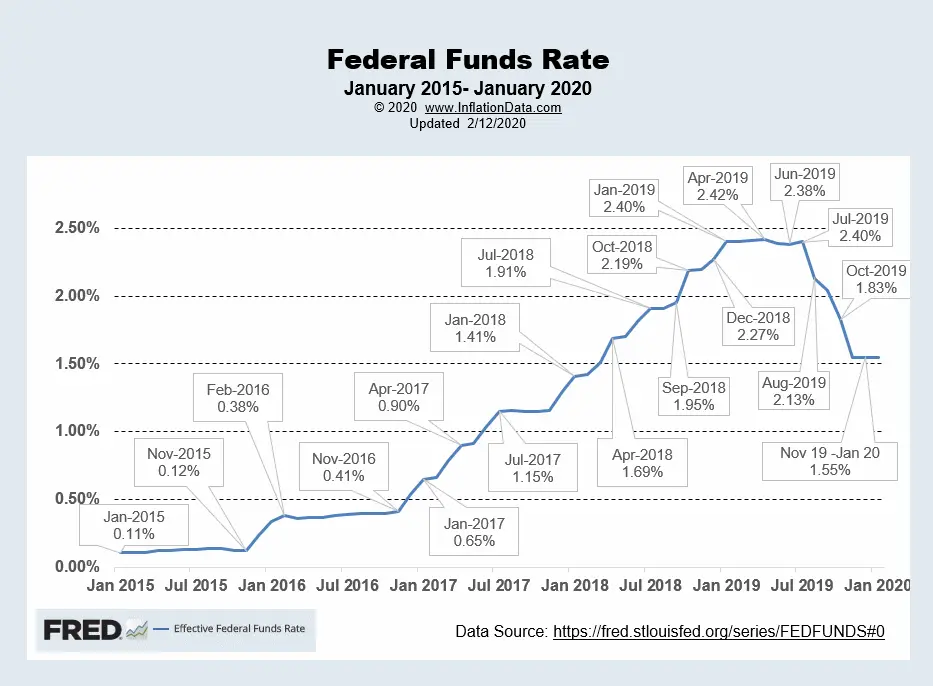
Effective FED Funds Rate Jan 2020

On the other hand, if the FOMC believes that the economy is getting “overheated” they might raise interest rates in an effort to dampen borrowing and buying, and thus reduce inflationary pressures.

Recently, Fed Funds rates began rising around January 2016 as the FED felt the economy was recovering and was able to sustain higher rates. They continued rising until January 2019 at which point the stock market was faltering so the FED halted any further raises. At their July 2019 meeting they announced that they would begin lowering the FED Funds rate which they did until November 2019 when they began holding steady at 1.55%.

Why Raising Interest Rates Might Dampen Inflation

When people expect things to cost more tomorrow than they do today (i.e. inflation) they tend to spend money faster rather than hold it or save it. After all, why hold onto something that will be worth less tomorrow than it is today. They may actually even borrow money they otherwise wouldn’t assuming that they can repay it with “cheaper dollars”. The speed that people want to spend their money is called “Velocity of Money”.

Raising interest rates makes that practice less profitable. It also raises the cost of buying a house, or borrowing to buy a car. Thus, fewer people can afford to buy things and this slows the economy down. Inflation and Velocity of money go hand in hand. The higher the inflation rate the faster people want to spend their money. But the faster they want to spend it the less likely they are to be “shopping around” looking for the best deal so venders can charge more which raises the inflation rate. By slowing the demand it also slows the velocity of money as well.

How the FED “Enforces” the FED Funds Rate

Technically, the Federal Reserve can’t enforce the FED Funds Rate. It is instead negotiated between the two banks, so the FED Funds Rate is simply a “target” range set by the FED. However, the FED also controls the “Discount Rate” which is the rate at which it will loan out money to individual banks. So, in effect it can set a cap on how much a bank has to pay.

Therefore, if the FED sets the FED Funds rate at 2% it might set the discount rate at 2.25%. That way no bank is going to pay another bank more than 2.25% if it can borrow directly from the FED for the discount rate.

The FED can also increase or decrease the money supply which will affect the reserves of both banks.  Thus increasing the money supply will add reserves to both banks. This will decrease the first banks need to borrow and increase the 2nd banks desire to lend. Based on supply and demand factors this will have the effect of lowering the interest rate both banks are willing to trade at.

See Also:

  • Does the FED control Mortgage Rates?
  • Imports, Exports, and Exchange Rates
  • How the Economy Works
  • Inflation: The Hidden Tax
  • How the FED Controls the Money Supply

About Tim McMahon

  • Web
  • |
  • Twitter
  • |
  • Facebook
  • |
  • LinkedIn
  • |
  • More Posts(422)

Filed Under: The Federal Reserve Tagged With: FED, Fed Funds Rate, FOMC, inflation

Leave a Reply Cancel reply

Your email address will not be published. Required fields are marked *

This site uses Akismet to reduce spam. Learn how your comment data is processed.

Recent Posts

  • June Inflation Down Sharply
  • How Explosive Growth in AI Triggers Inflation
  • Warsh’s First FOMC: No Dot, No Guidance, and No Dovish Pivot
  • May Inflation Up to 4.25%
  • May 2026: BLS April Inflation

Subscribe Now

eTrends Signup Form

A Message from Our Editor

Eliminate Debt

Post Archives

Sponsored:

As a Seasoned Investor I thought I'd seen everything... But recently I discovered TradingView which has really improved the information I have at my fingertips.~ Tim McMahon, editor

TradingView gives me an edge... including powerful charting tools, real-time market data, and a global community of traders—all in one easy to use platform. It has hundreds of indicators, and even custom scripts for more advanced users, and you don't need to change Brokers just use its seamless brokerage integration... TradingView isn't just a charting tool—it's your full trading command center.

Trade smarter. Trade faster. Check Out TradingView for free.

----------

The Best Place to Buy Your Crypto

Coinbase is the largest Crypto Trading platform in the U.S. and the easiest to use. ~Tim McMahon, editor

Check out Coinbase here

Home | Articles | Sitemap | Terms of Service | Privacy | Disclaimer | Advertise With Us

Copyright © 1996-2026 · Capital Professional Services, LLC · Maintained by Design Synergy Studio · Admin

Do Not Sell My Personal Information