
By Doug Casey The over-leveraging of the U.S. federal, state, and local governments, some corporations, and consumers is well known. This has long been the case, and most people are bored by the topic. If debt is a problem, it has been manageable for so long that it no longer seems like a problem. U.S. government debt has become an abstraction; it has no more meaning to the average investor than the prospect of a comet smacking into the earth in the next hundred millennia. Many financial commentators believe that debt doesn’t matter. We still hear ridiculous sound bites, like “We owe it to ourselves,” that trivialize the topic. Actually, some people owe it to other people. There … [Read more...]
Bank Closures “Could Never Happen Here”

By Jared Dillian I was watching the 6 o’clock news and saw images of closed banks in Greece and people lined up at ATMs. I’m sure you did, too.This must seem surreal to most people because it seems so remote. But put yourself in these people’s shoes for a second. You have money in the bank. Suddenly you can’t get to it. After standing in long lines, you can only get 60 euros at a time, which isn’t going to last you very long. What if you didn’t plan adequately and haven’t stashed away any cash? The banks will be closed for a while. What happens? How do you pay for rent? Or food? How does your employer pay you? Do you go homeless? Or hungry? Do you get really angry, take … [Read more...]
Is It Time to Admit That Gold Peaked in 2011?
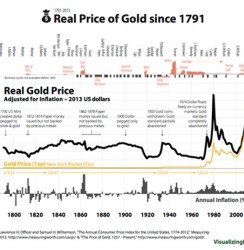
By Jeff Clark, Senior Precious Metals Analyst Have you seen this “real price of gold” chart that’s been making waves? Among other things, it purports to show the gold price adjusted for inflation over the past 223 years. Notice the 1980 vs. 2011 levels. The chart makes it seem that on an inflation-adjusted basis, gold has matched its 1980 peak in 2011, or nearly so. A mainstream analyst who still thinks of gold as a “barbarous relic,” a government official who doesn’t want people to think of gold as money, or an Internet blogger looking for some attention might try to convince you that this proves that the gold bull market is over, arguing that the 2011 peak of $1,921 is the equivalent … [Read more...]
How “Excess Reserves” and the Money Multiplier Could Trigger Inflation

Banks have $2.5 trillion parked in "excess reserves". This is money on deposit with the FED. The FED pays a miniscule amount of interest on these reserves but the banks are willing to loan it to the FED because it is easy no risk income. But it is also the reason that the money multiplier is falling! And when the money multiplier is falling the FED has a very hard time increasing the money supply. So if the FED really wants to increase the money supply all it has to do is decrease the interest rate it pays on excess reserves and the banks will find some place else to deploy it. Which could trigger massive inflation. ~Tim McMahon,editor A Fed Policy Change That Will Increase the Gold … [Read more...]
Understanding Inflation and What to Do About It

Inflation erodes our purchasing power causing manufacturers to have to raise prices or reduce quantities in order to make the same profit margin. Neither consumers nor manufacturers benefit, so who does? Why is inflation so prevalent? Yes, the level of inflation will vary and may recede briefly but the erosion continues. To say that low inflation is better than high inflation is like saying a death of a 1000 cuts is preferable to beheading. Either way you are dead, one just takes longer. With low inflation however you may not notice the cuts since they are so small. Unfortunately, just because the government says the cuts are small doesn't mean that they actually are. See Can We Trust … [Read more...]
The FDA Thinks You’re Stupid

I always bristle when I hear that the government is doing something for my own good. Generally, I prefer to decide what's best for me by myself. Obviously, there are exceptions relating to criminal behavior and dishonesty but in most cases, I figure I am a big boy now and I can make my own decisions and take care of myself. In today's article Chris Wood looks at another instance of the Federal Government pushing business around. In this case, it's the FDA. Take a look and decide for yourself if this is where the FDA should be focusing its efforts. ~Tim McMahon, editor. The FDA Thinks You’re Stupid Does the FDA think you're too stupid to have access to your own genetic information? It … [Read more...]
Inflation and Your Retirement Nest Egg

Inflation has a big effect on the future value of our nest egg. As we begin to think about retirement we dream of our "magic number" that amount of money that we will need to retire comfortably. But with the rate of inflation constantly changing in is like trying to take aim at a moving target. To make matters worse it's not just the value of the money that is changing it is also the amount of interest you can earn on that money. With the FED actively working to keep interest rates low your savings often earn virtually "Nil" in the way of interest and to make matters even worse once inflation and taxes take their bite your nest egg might actually be shrinking. In today's article Dennis … [Read more...]
Pushing on a String, Velocity of Money and Money Multiplier Conspire Against the FED

Under certain circumstances such as high national indebtedness, fear of bad economic times or when interest rates approach zero, monetary policy becomes ineffective in enticing consumers into spending more money. Economists refer to this as "Pushing on a String" because if the basic demand doesn't exist to induce people to spend money, it can't be forced through monetary policy. Prime examples of this are during the Great Depression in the United States and in Japan since the 1990s. And as Lacy Hunt explains we are once again facing this problem in the United States since 2008. ~Tim McMahon, editor Federal Reserve Policy Failures Are Mounting By Lacy H. Hunt, Ph.D., Economist The Fed's … [Read more...]
How The Federal Reserve is Making Us Poorer

In today's article Lacy Hunt looks at the Federal Reserve's economic model and a few important questions regarding their policy, including, "How accurate have the FED's previous predictions been?" and "Has the Fed facilitated errant fiscal policies?" and "Is the Fed relying on an outdated understanding of how the macro-economy works?". He also shows how because of (not in spite of) FED actions, "real income of the vast majority of American households fell" and "worsened the income/wealth divide". In other words the FED has made us poorer. ~Tim McMahon, editor The Federal Reserve (FED) By Lacy H. Hunt, Ph.D., Economist In May 22 testimony to the Joint Economic Committee of Congress, … [Read more...]
A Monetary Master Explains Inflation
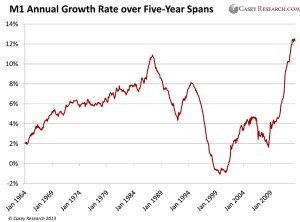
Today we'd like to host a discussion between Terry Coxon, a senior editor of The Casey Report and David Galland, a partner in a research firm employing about 40 analysts. David says... Terry is my go-to guy. He cut his teeth working side by side for years with the late Harry Browne, the economist and prolific author of a number of groundbreaking books, including the 1970 classic, How You Can Profit from the Coming Devaluation. The timing of Harry's book should catch your eye, because his analysis that the dollar was headed for a big fall was spot on. Anyone paying attention made a lot of money. As coeditors of Harry Browne's Special Reports, Terry and Harry made a formidable team for … [Read more...]
