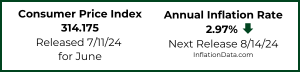
Inflation has a big effect on the future value of our nest egg. As we begin to think about retirement we dream of our “magic number” that amount of money that we will need to retire comfortably. But with the rate of inflation constantly changing in is like trying to take aim at a moving target. To make matters worse it’s not just the value of the money that is changing it is also the amount of interest you can earn on that money. With the FED actively working to keep interest rates low your savings often earn virtually “Nil” in the way of interest and to make matters even worse once inflation and taxes take their bite your nest egg might actually be shrinking. In today’s article Dennis Miller looks at your retirement nest egg and some factors you need to consider. ~Tim McMahon, editor.
A Million Dollars Isn’t What It Used to Be
By Dennis Miller
 We all share a common goal: to grow our nest eggs and make sure they last over the long haul. Our generation was taught to live off the interest and never touch the principal, but interest rates for CDs and Treasuries no longer allow for that. Frankly, they don’t even keep up with inflation, so we have to invest our money elsewhere if we want it to last.
It is a challenge to keep up with inflation and earn enough income to supplement our Social Security. Also, when our respective parents died, my wife and I each inherited a bit of money to add to our retirement fund, and we hope to do the same for our children. Many of you likely have a similar goal.
In 2007, an investor with $1 million could earn $60,000 annually on a certificate of deposit. Today, that same CD would earn $12,000, which makes things a lot more difficult. We will use $1 million in our examples simply because it’s an easy number to follow and do math with in our heads. However, the principles we’ll discuss apply no matter what size your retirement portfolio happens to be.
The Old Rule of Thumb
Back in the good old days, there were four estimates that worked well for conservative retirement planning:
- Return on your portfolio: 6%
- Inflation rate: 2%
- Age your money needs to last to: 120 years old
- Percentage of your portfolio to invest outside of CDs and high-quality bonds: 100 minus your age at retirement
Will 100 Minus Your Age Work Today?
A retiree who invests 65% or more of his or her nest egg in Treasuries or CDs will not earn enough to keep up with inflation, let alone pay the bills. Furthermore, while fixed-income investments were once considered safe, they carry significant risk, as rising inflation rates could destroy their value. So, retirees are under a two-sided attack.
How Should We Factor in Inflation?
This is really a twofold question: what is the inflation rate; and how does it affect our personal buying power?
Regardless of what the inflation rate is, to maintain the buying power of our nest egg, our principal must be adjusted every year. If we have $1 million and plan for 4% inflation to leave a little room for error (that’s a little over twice the official September 2013 annual rate), we need to earn $40,000 at the end of the year to cover inflation. Anything above that is supplemental income, or we can keep it in our portfolio.
There has been a lot of discussion about what the real rate of inflation actually is. The Bureau of Labor and Statistics’ (BLS) formula is quite complicated, and takes into consideration housing costs, food, and health care, etc. However, the BLS inflation rate can seem irrelevant when your costs are increasing much faster than it suggests they should.
In our reader poll, folks estimated their personal inflation rate at 8.1%, on average. Using that number, you would need to earn $81,000 on $1 million dollars just to stay even. Depending on your personal expenses, inflation will affect you differently. So, take a good look at your expenses and find a reasonable rate that suits the rising costs in your life.
Inflation varies from year to year. Most folks think the increase to our 2013 Social Security checks did not even come close to covering the true inflation rate for 2012. While inflation over the last 30 years may have been 2-3%, it is much better to err on the side of caution. I’d rather overshoot the number than not. So, set a reasonable inflation target that’s somewhere above the official 2.0% rate.
Personally, I believe there is a commonsense rule that applies. A few years ago my wife Jo and I had a terrific year, with overall returns in excess of 25%. When that sort of windfall occurs, a retiree who wants to stay retired will use some common sense and not go on a spending binge. They will take out only what they need to meet regular expenses and leave the balance in their portfolio to grow. When a lean year comes along, we may fall a percent or two short. Life is much less stressful if during most years we bank a little extra to build a cushion.
What About 4% to Supplement Your Income?
Unlike inflation and CD rates, there are some variables over which we do have control. Income and 4% are great examples.
Many baby boomers and retirees are choosing to exercise caution here. I recently heard of a baby boomer who sat down with his analyst and saw that while he had enough money to retire, it would be close. He enjoyed his job and wanted to enjoy retirement without worry, so he decided to keep working for a couple of years to build up a cushion.
In addition, a lot of retirees are now back in the work force. While some may have to work in order to put food on the table, others have simply taken part-time employment doing something they enjoy. A friend of mine who needed a new car decided to go back to work to pay for it instead of taking the money out of his nest egg. He didn’t have to, but thought it better to err on the side of caution.
During the first few years of our retirement, taking out 4% to cover living expenses was no problem at all. Now I see lots of folks, Jo and myself included, who are looking at expenses much more critically. They are cutting back on a lot of things that really don’t affect their lifestyle. Maybe we don’t need to pull out 4% anymore.
As an illustration, we used to have XM radio. It was cool because we could listen to ‘50s and ‘60s music without a bunch of CDs falling all over the place. When we bought it, it was $9.95/month – no big deal. Now it is close to $15/month per vehicle. My son pointed out I could download all of our music onto our cellphones, and it can play through the Bluetooth on the radio. Now we sing along to the same music without the monthly cost.
Controlling Financial Risk
If you feel extremely behind in your retirement, you may have made some mistakes in the past. However, remember there’s only one thing worse than making one big mistake – it’s making two big mistakes.
We cannot put more of our life savings in high-risk investments to try to pick up the slack. That is like a gambler doubling his bet to make up for his losses – and we all know how that story ends. We are at a point in life where a do-over is unlikely. The consequences of losing a major portion of our nest egg are too catastrophic to justify foolhardy risks.
So, while it’s tempting to play catch up by taking on more risk, we recommend staying safe instead of possibly getting yourself in even deeper trouble. You may have to adjust your lifestyle a bit, but that is much better than losing a major portion of your life savings to a poor investment decision.
Some of my Money Forever regular readers are already retired and some are a few years out. Either way, they have all committed the time and resources necessary to become their own money managers—to continually learn more about handling their money. Remember: no one has more of a vested interest in you getting this right than you do.
From the very first issue of Money Forever our goal—my mission¬¬—has been to help those who truly want to take control of their retirement finances. I want our subscribers to have more wealth, a better understanding of how to create an income-producing portfolio, and confidence their money will last throughout retirement.
With that in mind, I’d like to invite you to give Money Forever a try. The current the subscription rate is affordable – less than that of your daily senior vitamin supplements. The best part is you can take advantage of our 90-day, no-risk offer. You can cancel for any reason or even no reason at all, no questions asked, within the first 90 days and receive a full, immediate refund. As you might expect, our cancellation rates are very low, and we aim to keep it that way. Click here to find out more.
See Also:
- Is There a Magic Retirement Number?
- Should You Buy an Annuity?
- What Does 8% Inflation Really Mean?
- The Impact of Inflation on Savings
- The Impact of Inflation on Retirement Planning
Resources:


Image courtesy of cooldesign / FreeDigitalPhotos.net

Leave a Reply