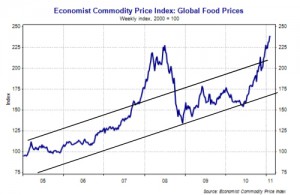
Agflation, is a relatively new term coined by analysts at Merrill Lynch in 2007. Back then rising demand for agricultural products started driving up prices. Agflation is simply a combining of the words agriculture as in "agricultural commodities" and the word inflation. Inflation is commonly used to mean an increase in prices (although it originally meant an increase in the money supply which eventually resulted in an increase in prices). So agflation is simply an increase in the prices of agricultural products. But agflation is not the result of an increase in the money supply like typical inflation, but rather it is simply a result of supply and demand factors. In 2000, the world wide … [Read more...]
Inflation and Velocity of Money
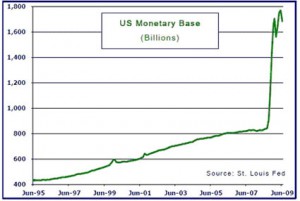
How do you define inflation? In some ways it's a slippery thing, like trying to nail Jell-O to a tree. One common definition amounts to "a general and sustained rise in the price of goods and services." Another is "a persistent decline in the purchasing power of money." Others argue that inflation is directly tied to the money supply. That is to say, they believe a substantial rise in the money supply is the same thing as inflation. (This is one small step removed from Milton Friedman’s old assertion: "Inflation is always and everywhere a monetary phenomenon.") Why is the debate important? Because of the infamous chart you see below (courtesy of hedge fund QB Partners and the St. Louis … [Read more...]
What is Debtflation?
By David Galland, Managing Editor, The Casey Report We recently received the following comment in our Q&A Knowledge Base. Investors should be prepared to sell gold as either increased inflation expectations or doubts around debt sustainability force a sharp increase in US Treasury bond yields. Simply put, in an environment of high real interest rates, the allure of gold could disappear as quickly as it did in the early 1980s when Paul Volcker took control of the Federal Reserve. My response… First off, I want to congratulate the reader for trying to anticipate the conditions that might mark the end of the gold bull market. Because, make no mistake, the gold bull market will come … [Read more...]
How Do I Calculate the Inflation Rate?

The following article explains how to calculate the current inflation rate, if you know the Consumer Price Index. If you don't know it, you can find it here. If you don't care about the mechanics and just want the answer, use our Inflation Calculator. The Formula For Calculating Inflation The formula for calculating the Inflation Rate using the Consumer Price Index is relatively simple. Every month the Bureau of Labor Statistics (BLS) surveys prices and generates the current Consumer Price Index (CPI). Let us assume for the sake of simplicity that the index consists of one item and that one item cost $1.00 in 1984. The BLS published the index in 1984 at 100. If today that same item … [Read more...]
What is the Real Definition of Inflation?
By Tim McMahon Define Inflation: A simple way to define inflation is "an increase in the price you pay for goods" but that only tells part of the story... It could also be seen as a "decline in the purchasing power of your money". But there is more to inflation than that. There are two sides to inflation "Price Inflation" and "Monetary Inflation". Jump to: Inflation Definition | Inflation Cause | Inflation Risk | Inflation Rate | Inflation Hedge Price Inflation vs Monetary Inflation: Technically, Price Inflation is when prices get higher or it takes more money to buy the same item and this is what people commonly think of when they hear the word inflation. Monetary Inflation … [Read more...]
Which is Better: High or Low Inflation?

It would seem intuitively obvious that low inflation is good for consumers, because costs are not rising faster than their paychecks. The problem with high inflation is that even with "cost of living" increases there is a time lag between when the cost of goods increases and when you get your raise. But recently commentators have been saying that "Low inflation introduces uncertainty". This is nonsense. During the high inflation "Eighties" I remember commentators saying "High Inflation introduces uncertainty". This is not quite true either. The truth is that steady inflation, whatever its level, if it can be relied upon to remain steady, does not introduce uncertainty. Changing … [Read more...]
Deflation and Depression through the Years
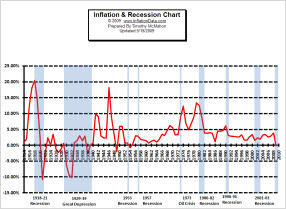
By Tim McMahon, Editor Deflation has cropped up at various times throughout the nineteenth and twentieth centuries. Overall since 1913 when the Bureau of Labor Statistics began tracking inflation we have had 22 years that had one or more months when the annual inflation rate was negative (i.e. deflation). Most of those are clumped into larger deflationary periods. The six major deflationary periods are: January 1921 - February 1923 26 months July 1924 - November 1924 5 months July 1926 - November 1933 7 ½ years (with only 5 positive months and 5 zero inflation months.) March 1938 - January 1940 18 months May 1949 - June 1950 … [Read more...]
Stagflation – What is it?

What is Stagflation? The simple definition of Stagflation is a "stagnant economy coupled with price inflation". Thus the term Stagflation... it has nothing to do with Deer. In other words, in stagflation prices are going up while the economy is going down. The word was coined during the inflationary period of the 1970's. Under normal conditions one would expect inflation to heat up the economy i.e. increase buying demand. That is one reason the FED generally increases interest rates during periods of higher inflation. This helps to cool the economy and prevent inflation from spiraling out of control. Of course ,if you have read other articles on this site, you will know that … [Read more...]
Disinflation – What is it?
Definition of Disinflation By Tim McMahon To fully understand disinflation we need to first understand inflation. The reasons this is trickier than it first appears is because the word inflation is actually used in two different contexts. The most common usage of the word inflation means rising prices. Commonly "consumer prices" so when you go to the gas station or the grocery store and the things you buy cost more than last month (or when it is really bad even more than last week) this is more precisely defined as "price inflation". The second meaning of the word inflation is actually the original meaning. And that is an increase in the money supply that causes "price … [Read more...]
Inflation and Recession Chart
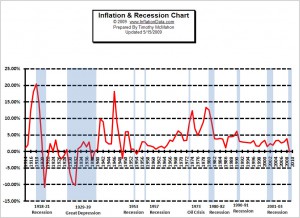
How does Inflation and recession correlate? Current Commentary Does high inflation correspond with a recession? Or does high inflation precede a recession? This chart shows the historical average Annual Inflation rate (red line) compared to the time periods where the country was in recession (blue shaded areas). Since 1914 there have been eight recessions. Three lasted for a single year, (in 1953, 1957 and again in 1990). The longest recession was actually the "Great Depression" which lasted ten years from 1929 to 1939. … [Read more...]
