Many of us aren’t old enough to remember Gasoline at 20 cents a gallon. I can remember gas during the 1960’s at 29.9 cents a gallon. The last time that gasoline averaged 20 cents a gallon was in 1942. That was during WWII ! But if you know us here at InflationData.com you probably know that we usually talk in inflation adjusted prices. So adjusting for inflation, the price of gas in 1942 would have been $2.78 if you are paying in January 2012 dollars. But that is still a long way away from the average price of Gas in 2011 of $3.48.
We track the inflation adjusted price of gasoline based on the annual average price using the Consumer Price Index (CPI) generated by the U.S. Bureau of Labor Statistics and a chart is always available from the menu bar above under Inflation Charts and Data / Inflation Adjusted Prices.
But this article isn’t about inflation adjusted prices using some artificially created index, and it isn’t about prices of gasoline during WWII. How would you like to buy a gallon of gasoline for 20 cents today? Yes, two thin dimes! Well, I recently I read an interesting article called Why Gas Prices Are actually Falling and in it was this picture:
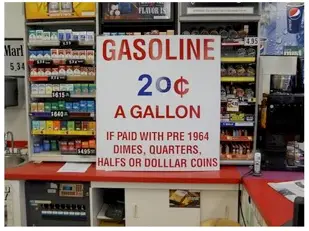
So there you have it a store that is currently selling Gasoline for 20 cents a gallon. And if you look at it closely you will find that he is actually making “excessive” profits as the monetarists might say. You see, today as I write this, Silver is trading for about $35.51 per ounce. A silver dime contains 0.0724 ounces of silver. So at current prices a Silver Dime is worth $35.51 x 0.0724 or about $2.57 so the guy who is selling gas for two silver dimes is actually getting $5.14 per gallon of gas!
So that leads to one of two conclusions (besides the fact that if anyone actually takes this guy up on his offer they are crazy!)
Either:
1) Gas is incredibly cheap on a historical basis
or
2) Silver is Expensive.
Interestingly a dime didn’t actually contain 10 cents worth of silver. In this case it was the government who was making “excessive” profits on every coin they minted. Just as it doesn’t cost the government a dollar to print a dollar today. This is called “Seigniorage” and is basically the difference between the cost of producing the money and the “face value”. As you can see from the table below, originally, in 1892 when they first started making the “Barber Dime” there was only 6 cents of silver in it but by 1964 there was 9 cents of silver in it (due to inflation) and the government realized that soon there would be no profit in producing coins so they developed a way to create “clad” coins. In other words, they hollowed out the silver from the middle and put a cheaper metal in but kept the look the same.
| Type | Year | Silver Price | Silver Value in a Dime |
| Barber Dimes | 1892 | $0.84 | $0.06 |
| 1893 | $0.70 | $0.05 | |
| 1894 | $0.62 | $0.04 | |
| 1895 | $0.68 | $0.05 | |
| 1896 | $0.66 | $0.05 | |
| 1897 | $0.59 | $0.04 | |
| 1898 | $0.60 | $0.04 | |
| 1899 | $0.60 | $0.04 | |
| 1900 | $0.65 | $0.05 | |
| 1901 | $0.56 | $0.04 | |
| 1902 | $0.49 | $0.04 | |
| 1903 | $0.56 | $0.04 | |
| 1904 | $0.61 | $0.04 | |
| 1905 | $0.67 | $0.05 | |
| 1906 | $0.70 | $0.05 | |
| 1907 | $0.55 | $0.04 | |
| 1908 | $0.49 | $0.04 | |
| 1909 | $0.53 | $0.04 | |
| 1910 | $0.55 | $0.04 | |
| 1911 | $0.56 | $0.04 | |
| 1912 | $0.64 | $0.05 | |
| 1913 | $0.58 | $0.04 | |
| 1914 | $0.50 | $0.04 | |
| 1915 | $0.56 | $0.04 | |
| 1916 | $0.76 | $0.05 | |
| Mercury Dimes | 1917 | $0.90 | $0.07 |
| 1918 | $1.02 | $0.07 | |
| 1919 | $1.34 | $0.10 | |
| 1920 | $0.66 | $0.05 | |
| 1921 | $0.66 | $0.05 | |
| 1922 | $0.64 | $0.05 | |
| 1923 | $0.65 | $0.05 | |
| 1924 | $0.69 | $0.05 | |
| 1925 | $0.69 | $0.05 | |
| 1926 | $0.54 | $0.04 | |
| 1927 | $0.58 | $0.04 | |
| 1928 | $0.58 | $0.04 | |
| 1929 | $0.49 | $0.04 | |
| 1930 | $0.33 | $0.02 | |
| 1931 | $0.30 | $0.02 | |
| 1932 | $0.25 | $0.02 | |
| 1933 | $0.44 | $0.03 | |
| 1934 | $0.54 | $0.04 | |
| 1935 | $0.58 | $0.04 | |
| 1936 | $0.45 | $0.03 | |
| 1937 | $0.44 | $0.03 | |
| 1938 | $0.43 | $0.03 | |
| 1939 | $0.35 | $0.03 | |
| 1940 | $0.35 | $0.03 | |
| 1941 | $0.35 | $0.03 | |
| 1942 | $0.45 | $0.03 | |
| 1943 | $0.45 | $0.03 | |
| 1944 | $0.45 | $0.03 | |
| 1945 | $0.71 | $0.05 | |
| Roosevelt Dime | 1946 | $0.87 | $0.06 |
| 1947 | $0.75 | $0.05 | |
| 1948 | $0.70 | $0.05 | |
| 1949 | $0.73 | $0.05 | |
| 1950 | $0.80 | $0.06 | |
| 1951 | $0.88 | $0.06 | |
| 1952 | $0.83 | $0.06 | |
| 1953 | $0.85 | $0.06 | |
| 1954 | $0.85 | $0.06 | |
| 1955 | $0.91 | $0.07 | |
| 1956 | $0.91 | $0.07 | |
| 1957 | $0.90 | $0.07 | |
| 1958 | $0.90 | $0.07 | |
| 1959 | $0.91 | $0.07 | |
| 1960 | $0.91 | $0.07 | |
| 1961 | $1.03 | $0.07 | |
| 1962 | $1.20 | $0.09 | |
| 1963 | $1.29 | $0.09 | |
| 1964 | $1.29 | $0.09 |
As we saw earlier, currently a Pre-1964 dime has $2.54 of silver in it. Does that mean that all of that increase is due to inflation? Not necessarily. Because silver is an industrial metal as well as a monetary metal, even while silver was officially money the value of a dime fluctuated between $0.02 and $0.09. And since the value of the silver in a dime was $1.58 in 1979 and it was $0.34 in 1996 no one would argue that there was no inflation (and actually severe deflation) during the intervening 17 years.
In the following table, we look at how many gallons of gas the silver in a Pre-1964 dime would buy.
| Cost/gal | Value of Silver in a dime | # of Gallons Silver in Dime would buy | |
| 1918 | $0.25 | $ 0.07 | 0.295102 |
| 1919 | $0.25 | $ 0.10 | 0.386906 |
| 1920 | $0.30 | $ 0.05 | 0.158073 |
| 1921 | $0.26 | $ 0.05 | 0.18462 |
| 1922 | $0.25 | $ 0.05 | 0.186213 |
| 1923 | $0.22 | $ 0.05 | 0.213909 |
| 1924 | $0.21 | $ 0.05 | 0.238575 |
| 1925 | $0.22 | $ 0.05 | 0.227731 |
| 1926 | $0.23 | $ 0.04 | 0.169353 |
| 1927 | $0.21 | $ 0.04 | 0.200996 |
| 1928 | $0.21 | $ 0.04 | 0.198928 |
| 1929 | $0.21 | $ 0.04 | 0.168244 |
| 1930 | $0.20 | $ 0.02 | 0.11946 |
| 1931 | $0.17 | $ 0.02 | 0.129468 |
| 1932 | $0.18 | $ 0.02 | 0.102164 |
| 1933 | $0.18 | $ 0.03 | 0.175771 |
| 1934 | $0.19 | $ 0.04 | 0.207293 |
| 1935 | $0.19 | $ 0.04 | 0.222535 |
| 1936 | $0.19 | $ 0.03 | 0.172998 |
| 1937 | $0.20 | $ 0.03 | 0.158556 |
| 1938 | $0.20 | $ 0.03 | 0.154936 |
| 1939 | $0.19 | $ 0.03 | 0.133368 |
| 1940 | $0.18 | $ 0.03 | 0.139973 |
| 1941 | $0.19 | $ 0.03 | 0.133749 |
| 1942 | $0.20 | $ 0.03 | 0.162176 |
| 1943 | $0.21 | $ 0.03 | 0.154453 |
| 1944 | $0.21 | $ 0.03 | 0.154453 |
| 1945 | $0.21 | $ 0.05 | 0.244091 |
| 1946 | $0.21 | $ 0.06 | 0.298909 |
| 1947 | $0.23 | $ 0.05 | 0.234828 |
| 1948 | $0.26 | $ 0.05 | 0.194923 |
| 1949 | $0.27 | $ 0.05 | 0.196553 |
| 1950 | $0.27 | $ 0.06 | 0.214519 |
| 1951 | $0.27 | $ 0.06 | 0.23597 |
| 1952 | $0.27 | $ 0.06 | 0.223367 |
| 1953 | $0.29 | $ 0.06 | 0.212956 |
| 1954 | $0.29 | $ 0.06 | 0.212956 |
| 1955 | $0.29 | $ 0.07 | 0.225938 |
| 1956 | $0.30 | $ 0.07 | 0.220579 |
| 1957 | $0.31 | $ 0.07 | 0.209726 |
| 1958 | $0.30 | $ 0.07 | 0.216959 |
| 1959 | $0.30 | $ 0.07 | 0.220579 |
| 1960 | $0.31 | $ 0.07 | 0.213463 |
| 1961 | $0.31 | $ 0.07 | 0.241255 |
| 1962 | $0.31 | $ 0.09 | 0.280025 |
| 1963 | $0.30 | $ 0.09 | 0.312044 |
| 1964 | $0.30 | $ 0.09 | 0.312044 |
| 1965 | $0.31 | $ 0.09 | 0.301978 |
| 1966 | $0.32 | $ 0.09 | 0.292541 |
| 1967 | $0.33 | $ 0.15 | 0.451952 |
| 1968 | $0.34 | $ 0.14 | 0.417152 |
| 1969 | $0.35 | $ 0.13 | 0.373791 |
| 1970 | $0.36 | $ 0.12 | 0.328817 |
| 1971 | $0.36 | $ 0.10 | 0.280349 |
| 1972 | $0.36 | $ 0.14 | 0.397396 |
| 1973 | $0.39 | $ 0.23 | 0.582356 |
| 1974 | $0.53 | $ 0.32 | 0.599827 |
| 1975 | $0.57 | $ 0.30 | 0.518867 |
| 1976 | $0.60 | $ 0.31 | 0.524538 |
| 1977 | $0.64 | $ 0.34 | 0.532366 |
| 1978 | $0.65 | $ 0.43 | 0.660511 |
| 1979 | $0.88 | $ 1.58 | 1.792723 |
| 1980 | $1.22 | $ 1.19 | 0.97283 |
| 1981 | $1.35 | $ 0.61 | 0.452205 |
| 1982 | $1.28 | $ 0.77 | 0.598771 |
| 1983 | $1.23 | $ 0.66 | 0.536878 |
| 1984 | $1.20 | $ 0.48 | 0.403871 |
| 1985 | $1.20 | $ 0.43 | 0.355243 |
| 1986 | $0.93 | $ 0.39 | 0.417585 |
| 1987 | $0.96 | $ 0.49 | 0.512079 |
| 1988 | $0.96 | $ 0.44 | 0.460645 |
| 1989 | $1.06 | $ 0.40 | 0.378597 |
| 1990 | $1.12 | $ 0.29 | 0.262967 |
| 1991 | $1.10 | $ 0.28 | 0.256758 |
| 1992 | $1.09 | $ 0.27 | 0.24739 |
| 1993 | $1.07 | $ 0.36 | 0.337071 |
| 1994 | $1.07 | $ 0.35 | 0.322286 |
| 1995 | $1.10 | $ 0.37 | 0.338166 |
| 1996 | $1.19 | $ 0.34 | 0.287232 |
| 1997 | $1.19 | $ 0.43 | 0.361848 |
| 1998 | $1.02 | $ 0.40 | 0.395064 |
| 1999 | $1.12 | $ 0.38 | 0.338768 |
| 2000 | $1.46 | $ 0.36 | 0.244809 |
| 2001 | $1.39 | $ 0.32 | 0.227658 |
| 2002 | $1.31 | $ 0.33 | 0.254456 |
| 2003 | $1.51 | $ 0.35 | 0.232898 |
| 2004 | $1.81 | $ 0.48 | 0.267046 |
| 2005 | $2.24 | $ 0.53 | 0.236857 |
| 2006 | $2.53 | $ 0.84 | 0.330203 |
| 2007 | $2.77 | $ 0.97 | 0.349726 |
| 2008 | $3.22 | $ 1.09 | 0.337191 |
| 2009 | $2.31 | $ 1.06 | 0.460768 |
| 2010 | $2.74 | $ 1.46 | 0.533131 |
| 2011 | $3.48 | $ 2.54 | 0.731378 |
And finally we can look at the number of gallons of gas the silver in a dime will buy in Chart form.
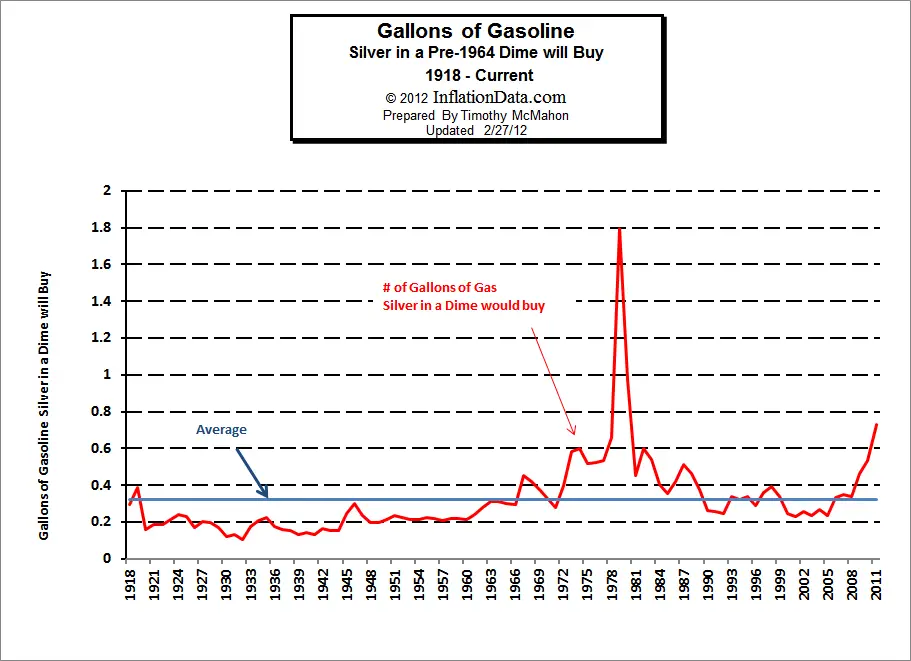
From the chart we can see that the average number of gallons of gas that the silver in a dime would buy was o.32 gallons or roughly 1/3rd of a gallon. Remember this is not the official value of a dime i.e. 10 cents but the value of the silver in the dime. On a pure barter basis it should take roughly 3 dimes to buy a gallon of gas. Based on the chart we can see that whenever the red line is above the blue line either gas is cheap or silver is expensive. And whenever the red line is below the blue line either gas is expensive or silver is cheap. From this we can see that the time to buy silver was between 1999 and 2006. For the equation to get back into balance either gas will have to double in price or silver will have to halve in price (or some combination of both). But it doesn’t have to happen quickly. Silver first became overpriced in 1972 and remained that way until 1990 (18 years). While prior to 1964 silver was undervalued compared to gasoline. During the 1990’s we see what we would expect in a normal market as the price of silver vs gas bounced above and below the average.
Since, both Silver and Gasoline are free to float on the open market (i.e. not subject to artificial price controls) we are not looking at the dollar price but simply the ratio between the two. So the difference in value is not due to inflation but simply due to supply and demand. As inflation increases (or the value of paper money decreases), both commodities should increase in price relatively equally based on inflation (so the ratio would remain roughly the same between Silver and Gas) but increased demand for either should skew the price in favor of that commodity.
You might also like:
- Inflation Adjusted Gasoline Prices
- Gasoline vs. Crude Oil Prices
- Historical Gas Price Chart
- Current Average Cost of Gas by County
- Gasoline Taxes by State
- Average Cost of Gas Per Month
- Calculating Miles Per Gallon
- Regarding Gas Inflation
- Historical Oil Prices Chart
- Gasoline Rewards Credit Cards
- More Inflation Adjusted Prices


I am a student at Carolina international school and I can not find out who the publisher is can you please tell me
Jacob,
Your college should have given you a “Style Guide” that tells you how to reference Web Pages. The three styles of citation most commonly
used are (APA, MLA and Turabian). Check with your instructor. Once you know which citation style you will use for a
specific paper, use only that style throughout the entire paper. For the Turabian style you would cite it like this:
McMahon, Timothy. “Gasoline 20 Cents a Gallon.” Inflation Data. Available
from http://inflationdata.com/articles/2012/02/27/gasoline-20-cents-a-gallon/.
Accessed 18 February 2017.
Hope this helps! If you need more info click the “About Us” link in the center at the very top of the page.
I am working on memoirs from 1930-2015. I find it difficult to get decade by decade reliable average gasoline prices. Can you help me?
Earle,
On two thirds of the way down this page http://inflationdata.com/articles/inflation-adjusted-prices/inflation-adjusted-gasoline-prices/ there is a table of all the average annual gasoline prices from 1918-2014 including nominal prices and inflation adjusted prices. You simply need to average each decade. The original source data can be found here: http://www.eia.gov/petroleum/data.cfm#prices. Hope this helps.
Gas Prices must have varied widely from region to region. in 1964, gas prices in Nashua NH (Boston Metro Area) were 11.9 cents per gallon.
Gasoline prices vary widely by state due primarily to State Highway (i.e. Gasoline Taxes). They also often vary widely from day to day (or at least month to month) so although the annual average price is one thing on any given day during that year they could be much different. See http://inflationdata.com/articles/2014/08/20/gasoline-taxes-state/ for more information.