• Home
  • Related Sites
    • Financial Trend Forecaster
      • Moore Inflation Predictor
      • NYSE Rate of Change (ROC)
      • NASDAQ Rate of Change (ROC)
      • Crypto ROC- BTC & ETH
    • Unemployment Data
      • Historical Employment Data
      • Unemployment Rate Chart
      • Labor Force Participation Rate
    • Optio Money
    • Elliott Wave University
    • More Resources
  • Definitions
    • What is Inflation?
    • What is Core Inflation?
    • Inflation vs CPI
    • What is Deflation?
    • What is Disinflation?
    • What is Agflation?
    • What is Stagflation?
    • What is Hyperinflation?
    • What is Quantitative Easing?
    • What is Quantitative Tightening?
    • What is Velocity of Money?
    • What is Fiat Currency?
    • How Do I Calculate Inflation?
    • What are “Sticky Prices” and Why Do They Matter?
  • Featured Content
  • About Us
  • Feedback
    • Sitemap
  • Subscribe Now

InflationData.com

Your Place in Cyber Space for Inflation Data

CPIWidget-Jan26
  • Numerical Inflation Data
    • Current Inflation Rate
    • Monthly Inflation Rate (Moved)
    • Historical U.S. Inflation Rates
    • Historical CPI
  • Inflation Charts
    • Ann. Inf. Rate Chart
    • Long Term Inflation >
      • Ave. Inf. by Decade
      • Total Inf. by Decade
      • Inflation 1913-1919
      • Inflation 1920-1929
      • Inflation 1930-1939
      • Inflation 1940-1949
      • Inflation 1950-1959
      • Inflation 1960-1969
      • Inflation 1970-1979
    • Cumulative Inflation
    • FED Monetary Policy and Inflation
    • Inflation and Recession
    • Confederate Inflation (1861 – 1865)
    • Misery Index
    • The 3 Stages of Inflation
    • 15-Yr Inflation Trends Chart
  • Inflation Calculators
    • Cumulative Inf. Calc.
    • How Much Would it Cost
    • Salary Inf. Calc.
    • Cost of Living Calc.
    • U.K. Inf. Calc.
    • Cost of Gas Calc.
    • Net Worth Calc.
    • Lifetime Earnings Calc.
    • Savings Goal Calc.
    • Financial Calculators
  • Inf. Adjusted Prices
    • Energy >
      • Inflation Adj. Gas Prices
      • Historical Oil Prices Chart
      • Crude Oil Price (Table)
      • Natural Gas Prices
      • Electricity Prices
      • Oil vs Gold
    • Gold >
      • Inflation Adjusted Annual Average Gold Prices
      • Gold is a “Crisis Hedge” not an  “Inflation Hedge”
      • Comparing Oil vs. Gold
    • Corn Prices
    • Education Inflation
    • Housing Prices
    • Mortgage Rates
    • NYSE Index
    • Inf. Indexed Bonds
    • Movie Revenues
    • Inflation-Adjusted Wages
  • Cost of Living
    • Calculate Cost of Living
    • Cost-of-living Adj. (COLA)
    • Consumer Price Index CPI
      • Historical CPI
      • Current CPI
      • CPI Release Dates
    • Gas Prices >
      • Cost of Gas
      • Cost of Gas Per Month
      • Gas vs. Oil Price Chart
    • Food Prices 1913 vs 2013
    • Health Insurance
  • Blog
    • Key Inflation Articles
    • International Inflation
    • Historical Inflation Rates for Japan (1971 to 2014)
You are here: Home » Blog » Inflation » Quantitative Easing » Why Quantitative Easing Has NOT Brought Back Inflation

Why Quantitative Easing Has NOT Brought Back Inflation

Published on March 25, 2011 Updated on September 16, 2016 by Elliott Wave International Leave a Comment

When the FED began quantitative easing to halt the deflationary crash of 2008, almost everyone was convinced that it would result in massive inflation. The lone voice proclaiming that it wouldn’t stop the deflationary express train wreck was Robert Prechter. In the following article Prechter explains why inflation never materialized. It is an excerpt from Prechter’s, Independent Investor eBook 2011. I hope you enjoy this short excerpt. See below for details on how to get the eBook in its entirety for free. ~ Tim McMahon, editor

Club EWI’s Free Independent Investor eBook 2011 (excerpt)


Chapter 1: Quantitative Easing Has Not Brought Back the Old Inflationary Trend
(From Prechter’s January 2011 Elliott Wave Theorist)

While long terms rates are rising, Treasury bill rates are stuck near zero. How is it possible?

… During hyperinflation, rates typically rise to double digits per month. Inflationists find it difficult to reconcile the Fed’s massive balance sheet growth over three years beginning in August 2008 with short term rates at zero and long term rates only in the 2-5% range.

Deflationists (all ten of us) understand why investors are willing to hold government paper at such low returns: The total supply of debt is contracting. Most bonds won’t survive. The federal government’s bonds will survive the longest.

Figure 10 shows that the total supply of “money” plus debt (all of which is in fact debt) peaked in 2008. This decline in overall money and credit is the first on an annual basis since 1929-1933. It is a big deal.
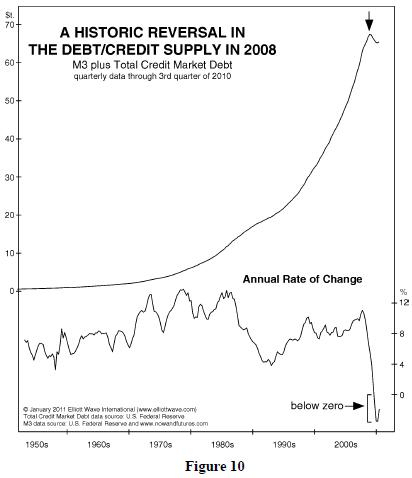
 

… This graph explains why gold in 2010 was so much lonelier in making an all-time high than stocks, commodities and real estate were in 2006, when everything was making an all-time high simultaneously: The total money + credit supply is down and cannot support new highs in all markets at once.

The Fed’s QE programs are failing to re-ignite inflation. By mid-2011, the Fed will have monetized just over $2 trillion worth of debt since 2008 to bring the value of its total assets to about $3t. This does represent a huge amount of fiat money. But the overall debt load is $65 trillion. Thus, the Fed will have monetized only 5% of the total, meaning that 95% of the outstanding debt is still suffocating the economy like a giant pool of sludge. …The Fed’s degree of monetization in light of these debts is very small.


For more insights on the markets, including why QE2 was a major tactical error, why rising oil prices are not bearish for stock, and why earnings don’t drive stock prices, read the rest of this FREE 51-page Independent Investor eBook. Download your free eBook NOW.

This article was syndicated by Elliott Wave International and was originally published under the headline Quantitative Easing: Why It Has NOT Brought Back Inflation. EWI is the world’s largest market forecasting firm. Its staff of full-time analysts led by Chartered Market Technician Robert Prechter provides 24-hour-a-day market analysis to institutional and private investors around the world.

Filed Under: Quantitative Easing Tagged With: deflation, FED, inflation, money supply, quantitative easing, The Federal Reserve

Leave a Reply Cancel reply

Your email address will not be published. Required fields are marked *

This site uses Akismet to reduce spam. Learn how your comment data is processed.

Latest Posts

  • Updated Cumulative Inflation Calculator
  • Inflation-Adjusted Silver Prices
  • December Inflation Down Slightly, Not Flat
  • December 2025 Inflation Report for November
  • How Deflation Created the Middle Class
  • October Inflation Numbers Delayed
  • Why the 2.8% COLA May Fall Short of Real Inflation
  • Delayed BLS September Inflation Data Released

Sponsored:

As a Seasoned Investor I thought I'd seen everything... But recently I discovered TradingView which has really improved the information I have at my fingertips.~ Tim McMahon, editor

TradingView gives me an edge... including powerful charting tools, real-time market data, and a global community of traders—all in one easy to use platform. It has hundreds of indicators, and even custom scripts for more advanced users, and you don't need to change Brokers just use its seamless brokerage integration... TradingView isn't just a charting tool—it's your full trading command center.

Trade smarter. Trade faster. Check Out TradingView for free.

----------

The Best Place to Buy Your Crypto

Coinbase is the largest Crypto Trading platform in the U.S. and the easiest to use. ~Tim McMahon, editor

Check out Coinbase here

Subscribe Now

eTrends Signup Form

Elliott Wave Resources

Free Elliott Wave Resources

What is Waveopedia?

Waveopedia is EWI’s free, comprehensive index of Elliott wave patterns and terms. Everyone from beginners to experts can benefit from it. It’s a great place to send your followers if they’re new to Elliott waves.

  • Deflation Hits China is the U.S. Next?

  • Why You Must Avoid the Herding Trap

  • Chasing Trends Can Cost You

  • More Education Resources

Post Archives

Home | Articles | Sitemap | Terms of Service | Privacy | Disclaimer | Advertise With Us

Copyright © 1996-2026 · Capital Professional Services, LLC · Maintained by Design Synergy Studio · Admin

Do Not Sell My Personal Information