
This question is interesting because most countries can’t just export their inflation because their currency is exclusive to their country. However, the U.S. is in the unique position of being the “reserve currency” of the world. In addition, several countries like Panama, Ecuador, and Zimbabwe, actually use the U.S. dollar as their currency and don’t even have their own currency at all. So the U.S. currency has a greater than normal influence on other country’s economies.
Exporting inflation is a Government’s dream scenario. If they could print all the money they wanted and not suffer the consequences of their actions, it would be a dream come true for politicians. Printing money boosts the local economy in the short term. Initially, the government gets to spend money without raising taxes and this money generally goes toward government projects like infrastructure, military, and boondoggles. This creates jobs and the workers spend the money into the economy and for a while, everyone feels richer. But eventually, the chickens come home to roost and a “bust” results as prices start rising because there is more money chasing fewer goods. But if the government could have the “good side” of inflation i.e. the “boom” without the “bust”… why then we’d have a politician’s dream come true.
For many years now the U.S. has been in this enviable position. And surprisingly it was created by one of the most vilified Presidents in U.S. history… Richard Nixon. I go into more detail in the article Oil, PetroDollars and Gold but the gist of the matter is that in 1973 Nixon and Kissinger struck a deal with Saudi Arabia that they would denominate all oil sales in dollars, and in exchange, the U.S. would supply weapons and protection to the Saudis. This system of requiring all worldwide oil sales to be performed in dollars increased the demand for dollars (since everyone needs oil) and became known as the “Petrodollar”. These petrodollars not only increased demand for the U.S dollar but also allowed the U.S. to export its inflation as these dollars never return to the U.S. but instead circulate worldwide and are used strictly for foreign trade. In addition to “PetroDollars,” the U.S. has an unlikely ally in exporting its inflation.
Why is being the World’s Reserve Currency Important?
From What are “Foreign Exchange Reserves”?
Being used as a foreign exchange reserve currency sharply increases the value and usefulness of that currency. When a particular nation’s currency is the de facto reserve currency, that’s nation’s economic power and influence is automatically spread globally. Like any other commodity, the value of the reserve currency is based on supply and demand… by rigging an artificially high demand for its currency, the U.S. was able to print more dollars without sparking significant inflation at home. In effect, it was able to export its inflation to other oil-consuming countries because after it printed them and spent them those dollars went abroad and never returned home, so they had no effect on domestic inflation.
How China Helps the U.S. Export Inflation
You might not think that China would want to help the U.S. export its inflation but that is exactly what is happening. Why? China has been the largest exporter of goods in the world since 2009 and their level of exports was increasing since way before then. The primary reason is because they are a low-cost producer. They have low wages and even use “slave labor” to keep costs low. This results in goods flowing from China to the U.S. and money flowing from the U.S. to China. If China were a capitalist country this would result in companies becoming wealthier and people having more money to spend locally and inflating their economy. It would also necessitate that the Chinese companies convert their U.S. dollars into local currency in order to be able to spend it. The exchange process would create a glut of dollars and a shortage of Yuan (aka. Renminbi). Based on the law of supply and demand, this oversupply of dollars should cause the Dollar to devalue on the world market and the Yuan to rise. But the government in China doesn’t want the Yuan to rise because that would make Chinese products more expensive and reduce exports and hurt their economy thus causing unrest and possibly revolt.
The Chinese “Cultural Revolution” (1966 until 1976) launched by Mao Zedong, Chairman of the Chinese Communist Party (CCP) resulted in economic activity being halted, and historical and cultural material destroyed and an estimated death toll of as many as 20 million. To an impoverished country like China was back in the 1960s some inflation is a good thing, it would allow wages to rise and people to perceive an opportunity to get ahead. But too much inflation would cause retail prices to rise too fast and people would feel they weren’t getting ahead. Thus in 1978, Deng Xiaoping became the new “paramount leader of China” and started a program that gradually dismantled the Maoist policies associated with the Cultural Revolution, and brought the country a Capitalist version of Communism.
So what does a Communist government do to prevent inflation? They siphon off a good chunk of the profits and buy U.S. Treasury Notes with the money. This pads the coffers of the Chinese Government and creates an I.O.U. on the U.S. Government’s books… but as long as China doesn’t actually try to cash in the I.O.U. nothing happens. It is simply a debit on the U.S. account and all the extra printed money becomes an asset on China’s books. China is happy because its assets are growing, U.S. politicians are happy because they got to spend money on boondoggles that pleased their constituents (while lining their own pockets through “political contributions” from lobbyists) and the only people who are unhappy are those who worry about the growing debt to China.
Low-Cost Competition
Another way that China inadvertently helped to keep U.S. inflation low was by providing low-cost competition. It is interesting to note that although inflation was major problem under his administration and initially it got worse before it got better, once again Nixon affected our economic situation in ways often ignored. In 1972 Richard Nixon went to China, basically, opening the opportunity for economic trade and creating a buffer against Russian military expansion. This paved the way for Deng Xiaoping to open up the country to U.S. trade which dumped massive amounts of low-cost labor on the world market. This allowed Americans to substitute cheaper Chinese goods for more expensive U.S. goods thus driving down costs for U.S. consumers (but hurting U.S. manufacturers). In response, U.S. companies were forced to become more efficient, move overseas, or go out of business. But the effect over the last 50 years has been dampened inflation through the purchase of cheap Chinese goods. In 1974 the average inflation rate was just over 11%. In 1979-81 U.S. inflation was well into the double-digits (see Historical Inflation Rates.) But as cheap Chinese products increasingly entered the U.S. market U.S. inflation rates continued to fall and have stayed low ever since.
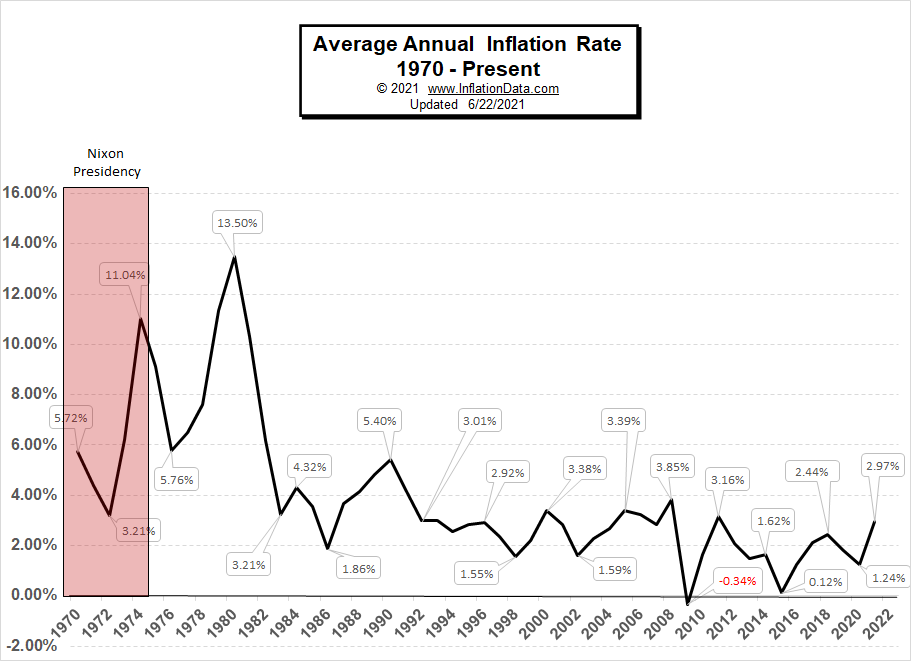
Click Chart for Larger Image
What about the Growing Debt to China?
So all is well as long as China doesn’t try to cash in its I.O.U.s. But what if they do? Theoretically, they could try but what would they get in exchange? Vast swaths of U.S. land? The United States gold reserves in Fort Knox? Theoretically, if the Chinese tried to force the issue they could crash the U.S. economy but what would that gain them? It might result in a massive devaluation of the U.S. dollar and worldwide depression but then the U.S. wouldn’t be able to buy their exports anymore and that would once again “hurt their economy thus causing unrest and possibly revolt”.
There is an old saying, “if you owe the bank a dollar you are in their debt but if you owe the bank a million dollars they are at your mercy.” In many ways that is the current situation, theoretically, if China tries to get too heavy-handed the U.S. could just pass a law saying that all foreign debt is “null and void”… try to collect it. And just like that, all those Chinese “assets” are worthless. Obviously, China doesn’t want that to happen either, so they go on pretending that the U.S. Treasury Notes are valuable and they don’t push the U.S. too far (just as far as they think they can get away with).
But China isn’t stupid and they know that the charade can’t go on forever, so in the meantime, China slowly acquires assets that aren’t paper, such as U.S. (and foreign) companies, and gold, etc. The Chinese also diversified into financial assets buying things like the Blackstone Group (an investment firm) and Morgan Stanley. From 2005 to 2019, Chinese companies invested $624.4 billion in North America and Europe i.e. buying up productive assets with their surplus Dollars. This tends to mitigate not only their liability but also to limit the U.S.’s ability to export inflation.
They take the long view and even invest in infrastructure in other developing countries trying to arrange their own version of “petrodollars”. In these cases, rather than gaining productive assets, in exchange for Chinese assistance, these developing countries must agree to buy Chinese goods. Overseas investment offers China an opportunity to not just bolster its own economy, but also leverage its economic strength to increase its influence abroad.
Another perspective on How the U.S. Exports Inflation:
More Articles like this:
- Oil, Petrodollars, and Gold
- Why Does China Want to Lower the Value of Its Currency?
- What are “Foreign Exchange Reserves”?
- Imports, Exports, and Exchange Rates
- What Is Fiat Currency?
- Using Forex to Hedge against Inflation
- Why (and How) China is Boosting the Price of Gold
- Could a Strong Dollar Actually Cause Problems?
- U.S. Foreign Exchange and The Chinese Currency Exchange Rate
- More Currency Articles


This is true, when you say exporting inflation is a Government’s dream scenario. I mean if they could print all the money they wanted and not suffer the consequences of their actions, it would be a dream come true for politicians. You are right there.