The History of Gold Prices (and How We Got Here)
To get the full picture of the current price of gold we have to look back nearly 100 years. In the 1800’s and early 1900’s gold played a key role in international monetary transactions. The gold standard was used to back currencies. Each country determined a fixed exchange rates for its currency, i.e. how many ounces of gold each unit of currency was worth.
Trade imbalances (importing more than they exported or vice versa) could rectified via the exchange of gold reserves. A country with a deficit would have to ship gold to the country with an excess. Any country experiencing inflation would lose gold and therefore would have a decrease in the amount of money available to spend.
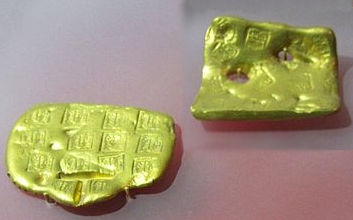
Ancient Chenyuan Gold “Coins”
However, during WWI and WWII economic warfare was employed in an effort to combat poverty in ones own country by employing a policy called “Beggar Thy Neighbor”. This involved shifting demand away from imports onto domestically produced goods, either through government policy, rather than free markets. The primary vehicles were tariffs (or import taxes), import quotas, or by devaluation of the currency (i.e. changing it’s value in relation to gold). For example, During the 1930s, the British created their own economic bloc to shut out U.S. goods because they felt they couldn’t compete with cheap U.S. goods.
In July 1944, towards the end of the war 730 delegates from all 44 Allied nations gathered in Bretton Woods, New Hampshire. During this conference the U.S. held most of the cards because it was the least financially damaged by the War. The original plan presented by John Maynard Keynes was to establish a world-wide currency called the “Bancor”. Each nation’s individual currency would be pegged to the Bancor (rather than Gold) at a fixed rate. Governments would then be required to buy or sell Bancors in order to maintain the value of their currency at the pegged rate.
However, at Bretton Woods…
The Golden Link- Price Advantage U.S.
During World War II, European nations were highly in debt and had transferred large amounts of gold into the United States both for safe keeping and in payment of debts. In addition, the two wars had devastated Brittain and it was requesting aid from the U.S. So when the United States signed an agreement on December 6, 1945 to grant Britain aid of $4.4 billion the British Parliament finally agreed to ratify the Bretton Woods Agreement.
French President Charles de Gaulle, bitterly fought U.S. officials but in 1945 de Gaulle was forced to grudgingly ask the U.S. for a billion-dollar loan. And thus he too agreed to the Bretton Woods Agreement. This meant that other countries would peg their currencies to the U.S. dollar, and would buy and sell U.S. dollars to keep market exchange rates within plus or minus 1% of parity. Thus, the U.S. dollar took over the role that gold had played under the gold standard in the international financial system. In order to bolster the other country’s faith in the dollar, the U.S. agreed to link the dollar to gold at the rate of $35 per ounce of gold. So, theoretically, foreign governments could still exchange dollars for gold. For instance, if France had a trade surplus with England, England would pay France in Dollars and then France could exchange them for Gold.
But this gave the U.S. an ability that no other country had, i.e. the ability to inflate their currency. The U.S. inflated their dollars and because of the peg to the dollar basically the other countries got the inflation. Obviously, the other countries didn’t appreciate this. By 1965 this became apparent as the free market value of gold was worth more than $35 an ounce. So De Gaulle decided to take his surplus out of the U.S. and made a profit at the same time. He basically bought $150 million worth of Gold from the U.S. Government at the fixed price of $35 an ounce and took it home to France. By 1969 it was worth $39 an ounce on the free market.
By 1971, the U.S could no longer maintain the illusion that gold was still worth $35/oz and could no longer afford to keep selling it at below market prices, so Nixon was forced to “close the Gold Window” and terminated our agreement to sell gold at the fixed price and reveal the dollar to be the fiat currency that it was. Not long afterwards fixed pegs to the dollar were also abolished and currencies began to “float” against each other once again.
This should have been the end of the Dollar’s reign but Nixon had one more ace up his sleeve. In the early seventies the US still was basically oil independent, i.e. it produced enough oil for its own consumption. In an effort to protect U.S. oil companies against foreign competition, it created imports restrictions. So, in exchange for the lift of import restrictions, the OPEC countries promised they would only accept dollars for their oil. This gave the dollar back the control it lost when it gave up gold convertibility.
Basically, every country that imported oil had to have dollars to buy it. This artificially increased demand for dollars and once again put the U.S. in an enviable position.
Along Comes China
In 1978, China began exporting more than it imported (i.e. it had a trade surplus). This started slowly but has grown exponentially. By 1980 China’s foreign currency reserves stood at approximately $2.5 billion. Being a “Communist” country with a “command economy” rather than a free market, China was able to create a unique environment. The Chinese currency (called either the ‘yuan’ or the ‘renminbi’) doesn’t float freely on the open market. The government sets a fixed exchange rate (similar to Bretton Woods) . So when a business earns dollars by selling overseas, it has no choice but to hand that money over to the People’s Bank of China (or PBOC, the country’s central bank), in exchange for local currency. And so the PBOC began accumulating more and more foreign reserves.
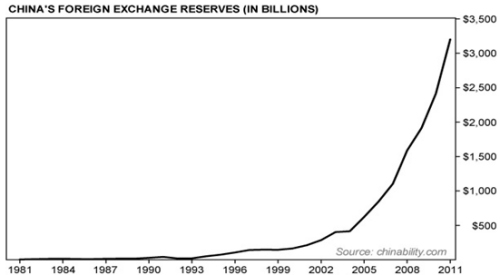
Thus the PBOC makes a profit on the exchange rate and collects valuable foreign currency in exchange for worthless local currency. At least that is the way it started. But recently, as the dollar has inflated… the dollar has become worth less… while the Yuan has become theoretically more valuable (except for the ‘peg”).
So now the Chinese are stuck with depreciating currency that they can’t dump (or else the value would be driven down on the remainder of their holdings). So they’ve been looking for options. Initially they bought U.S. Treasuries and at least earned interest on their money. But the FED has driven interest rates to near zero. So the Chinese diversified into the stock market buying things like the Blackstone Group (an investment firm) and Morgan Stanley. But we know what happened to the financials in 2008. So like everyone else, the Chinese got burned big time by the U.S. equities markets.
But they still need somehow to diversify their assets and reduce their currency risk. And where to park all those Dollars? So they started buying up gold and gold resource companies. They began buying gold in the early 2000’s. Up until this point most governments had been net sellers of gold in an effort to keep the price low and discredit it, so that they could keep up the demand for their currencies. But China realized that eventually paper currency would become worthless and Gold would always be valuable so they slowly began accumulating. Thus the beginning of Gold’s dramatic rise.
By 2011, China had become the world’s biggest buyer of gold. Overtaking even India. Historically, India has always been the world’s leading gold buyer. In India, people traditionally save and display their wealth in gold… wearing it around their necks rather than trusting banks.
In addition to being the biggest importer of gold it is also the biggest producer of gold. Yes, they produce more gold than Australia or South Africa or Canada etc. But they don’t export it! China actually produces more than 300 tons of gold a year–that’s almost 50% more gold than Australia, the world’s 2nd largest producer.
So where is all that gold going?
According to Richard Russell creator of “The Dow Theory”
“China wants the renminbi to be backed with a huge percentage of gold, thereby making the renminbi the world’s best and most trusted currency.”
So it is stockpiling all the gold produced within China and even buying more on the open market. In addition, it is encouraging its citizens to buy even more gold. In 2002, China lifted its ban on individual ownership of Gold, twenty-eight years after restrictions on holding private gold within the United States were removed. Then, in September 2009, China began to actively promote gold ownership to its citizens. The government actually started a major campaign to encourage all citizens to buy gold making it available at any Chinese bank in the country and at government “gold stores” which look a lot like jewelry stores but inside the cases, instead of jewelry, are various sizes of .9999 pure gold bars.
Why would the Chinese government actually encourage its citizens to buy gold?
- They are planning on confiscating it at some time in the future like they (and the U.S.) have in the past… or more likely
- They are preparing their citizens for a major shift in the world economy.
China has announced plans to open something called the Pan Asia Gold Exchange (PAGE), In June of 2012. This is designed to be a direct competitor to COMEX in New York and the London Metals Exchange in the U.K. and they promised that it would “level the playing field and allow for a fair global price discovery of precious metals.” But according to SGT Report, it “posed an enormous threat to the existing fractional reserve bullion banks.” And has been derailed. But that won’t stop China and there is another “fully regulated” exchange in the works.
China has also recently inked agreements with Iran to bypass the U.S. Dollar and trade Gold for Oil.
Will China “Corner” the World Market in Gold?
Many experts believe that the Chinese Government wants to establish a world-class currency, being the only one capable of being backed by gold. In this way they could supplant the U.S. just as we did to Great Brittain with the Bretton Woods agreement. This would give them tremendous economic leverage just as we had in 1944. In addition, to piling up government reserves, putting the massive population to work buying Gold reserves, producing gold from Chinese gold mines, and opening the Pan Asia Gold Exchange, China has also embarked on an ambitious accumulation program, buying world class gold mining companies outside of China.
They have bought significant portions of:
- Anglogold Ashanti with mines in South Africa, Brazil, Tanzania, Ghana, Guinea and Australia : 100,000 shares
- Goldfields Ltd with mines in Australia, Ghana, Peru and South Africa: 350,000 shares
- Kinross Gold Corp. with mines in the U.S., Russia, Mauritania, and Ghana: 250,000 shares
- Teck Resources: Canada, Mexico and Peru 101 million shares (17% ownership)
- China also holds US$145 million or 155,600 shares of gold-backed ETF SPDR Gold Trust shares.
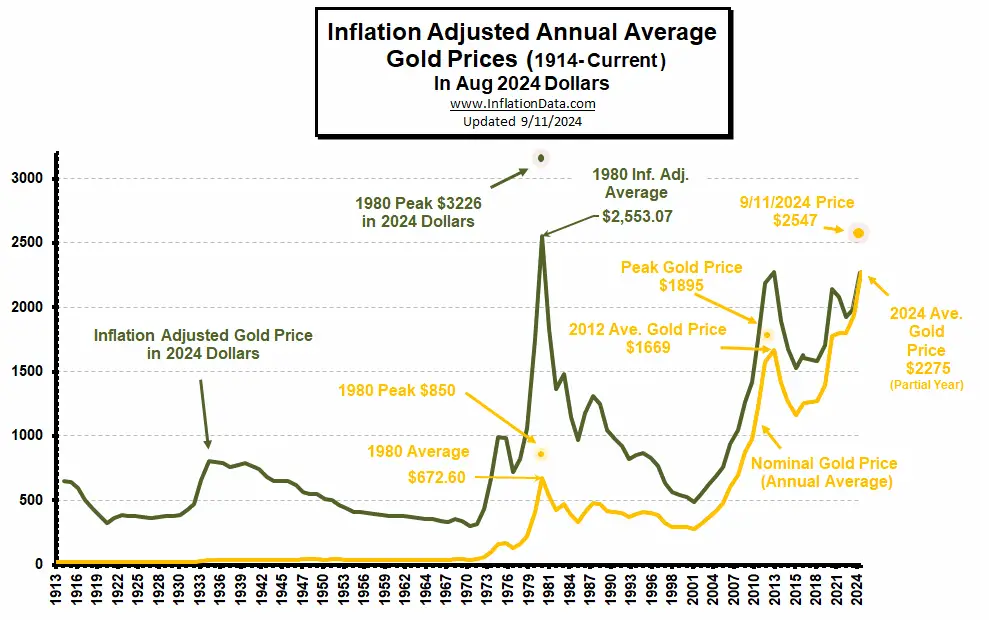
So it appears that China is getting serious about Gold and so previous spikes in the price of gold (See: Inflation Adjusted Gold Prices) may not be comparable when it comes to estimating how high Gold will go this time around. But China isn’t stupid and so it is probably timing its purchases and perhaps even selling at some points to mask its accumulation in an effort to get the best prices and not drive up the market as it continues to increase its holdings.
What Can We Do?
The question is how do we protect ourselves? What would happen if the U.S. dollar is no longer the preferred Oil currency? What if the Yuan or “Renminbi” becomes the reserve currency of the world?
None of this will happen overnight. The one advantage the Chinese have is that they take the long view. They don’t have to worry about 4 year presidential terms, or annual reports. Instead they think in terms of decades (or longer).
I think at this point the best way to play it is right alongside the Chinese. Accumulate Gold and Gold mining stocks, and ETF SPDR Gold Trust shares for the long term. In the long run they will retain their value and appreciate due to increased Chinese demand.
See Also:
- Gold is a “Crisis Hedge”
- Inflation Adjusted Annual Average Gold Prices
- Comparing Oil vs Gold
- Historical Oil Price Table
- What is Fiat Currency?
- What is Quantitative Easing?
- What are I bonds?
- Currencies


Tim
I agree with you, gold is more of an insurance premium against political and economic uncertainties post major crises. Historically, these take about 15-20 years to go away (1929-1945 and 1974 to the mid-1980s). Gold knew the WWII was lost in 1942 even before the Allies and the mad moustached man in Berlin knew it. Gold knew that the Evil Empire would implode (in 1982) before the Soviets even had an inkling.
That’s why gold will SOON tell us that Putin’s Mafia state will hit a major buffer in November … that’s why gold will become the worst performing asset class for the remainder of this decade (17 years after the GFC hit the world economies). It is already at an all-time high in REAL terms. Also, when you look at how many ounces you need to buy a house in the US, we are now getting close to an all-time low (since 1870) with a double bottom … another strong SELL signal!!
As for the Chinese and the Indians they are buying gold because they want to support Putin’s mafia state with the Rubel being pegged to gold. With China’s housing market imploding as we speak, the country now has a choice of working with the West or tying itself to a sinking ship … I know which route I would take … especially since Putin, like Alexander Nevsky, has already sold Russia into Mongul (Chinese) serfdom for the next 300 years.
GOLD IS A SELL … the same way Gordon Brown has sold the UK’s gold right at the bottom, the Chinese and Indians are switching into this asset class right at the top … and they know it … as Ray Dalio said: it was in the interest of the US to confront China sooner rather than later … and that’s what happened with Ukraine and Russia … China will now have to wait a very long time to take the global leadership role, simply because it got drawn in supporting a crazy mafia imperialist.
==> Gold will end the decade close to or below $1000/oz! Good times are ahead, more political and social stability is on the horizon, no more insurance premium needed!!
Tobias, Interesting perspective. I’m always worried when I start hearing predictions of $10,000 gold. Just looking at the Inflation Adjusted Gold Price chart we can see that we are currently at the annual average all-time high (in Inflation adjusted terms). But if gold gets to the real 1980 all-time high (on a daily basis) we’ve still got about $800 an ounce to go.
Tim
I have the same chart going back to 1900 and on that basis it is already at an all-time high … no doubt Gordon Brown would put the UK’s total reserves into gold NOW … here the link to my linkedin post …
https://www.linkedin.com/feed/update/urn:li:activity:7235598159479992323/
I have the house price in gold ounces chart as my profile chart (going back to 1870) and that too tells me GOLD IS A SELL!!
Personally I think the Chinese want to salvage their economy as quickly as possible, while Putin runs out of money … the Chinese need the West … so I’d say gold will no longer add another US$800/oz, but start its decline soon … it all reminds me of the 1982 to 1990 period, when gold and actually commodities became the worst performing asset class … non-domestic equities did best … so look out for Western equity markets (ex-US) such as Europe, Japan, LatAm and maybe India .
Tobias,
I’ve just updated our Gold vs Oil charts and Gold is certainly overpriced compared to Oil.
https://inflationdata.com/articles/comparing-oil-gold/
I am 85 years old but never worried or cared about gold, but has I passed through the two or three major stock market drops over the last 40 year and lost a large part of my retirement future, and stopped putting money in stocks except annuity I was locked into. This is the best article so far I have read on Gold. My confusion is who is controlling the world financial system and what is going to happen to the dollar? All I see is the same people who have controlled the worlds finances and started every war for profit and own or control all the world banks are still at it and want to crash America. Names like Rothchild, Mellon, Bush, Kennedy, Gates, Dupont, Vanderbuils, etc, etc. Am I wrong in this assumption that all of these powerful families are still at it and are the real globalist, working their evil behind the scenes, and somehow in the near future are going to crash the dollar and change it to a fiat crypto currency they will invent and control to take over the worlds finances? Based on this I am spending the money I had in small savings and cd’s to Gold even though it is at around$1850/oz . To me the dollar is already worthless and is only held up by the fed’s printing massive amounts of money to hold up the stock market. It cannot go on much longer and I see it coming to end within the next year. Then what? If so, will gold increase value dramatically?
Keith, It certainly looks like those in power are trying to inflate the Dollar out of existence and have a globalist agenda. I’m not sure if it will all come crashing down in the next year (everything always takes longer than you’d think it would) but it certainly looks like more inflation is in the cards. The surprise is that gold isn’t at its peak. I think crypto might be absorbing some of the money that would have normally gone into raising the price of gold.