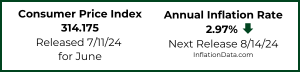
Inflation affects every consumer, business person and investor in some way or other. Inflation is one of the key factors that affect consumer prices, financial markets including Stocks, Bonds and Forex. As such, it is important for consumers, investors and traders to get a deeper understanding of what is inflation and what causes it.
What is Inflation?
 Understanding inflation is often complicated by the fact that the cause and the effect are often muddled together in people’s minds due to the lazy way we often refer to inflation. The effect of inflation is what people see when they go shopping and see increases in the general price of goods and services. When the individual prices of just a few goods go up, that is not necessarily inflation it could simply be a supply or demand issue. But if many goods and services across the economy are rising in price we have what we call “price inflation”.
As we will see below price inflation is primarily caused by “monetary inflation” i.e. an increase in the money supply. The confusion comes in when we get lazy and fail to distinguish between monetary inflation and price inflation and simply refer to both as “inflation”.
For more information see What is inflation?
What causes Inflation?
There are five main sources of inflation:
1) Government/National/Public Debt
If governments spend more than they take in they must either borrow or print money out of thin air in order to cover their operating expenses. When a country borrows its debt increases. To raise the money required for debt repayments, the government may use one of several methods including raising taxes or printing more money. An increase in taxes to businesses will result in higher prices of goods and services for customers because businesses must pass on the increased burden of the corporate tax. Interestingly as a government borrows money it “monetizes” it which is one way the government “prints money”. And as we said above, increasing the money supply is the primary cause of price inflation.
2) Monetary and Fiscal Policy
By lowering interest rates and instituting Quantitative Easing (QE), the Central bank (or FED) can create an expansionary monetary environment to increase the money supply in the economy and create a liquidity surplus. When there is surplus liquidity money flows freely. When money flows freely most participants in the economy have greater purchasing power, and the aggregate demand increases and this creates an upward pressure on prices. Individuals may use the extra discretionary income to buy more nonessential items while businesses may make more capital investments, hire new employees, or improve employee compensation.
The most common form of expansionary policy is through the implementation of monetary policy. The U.S. Federal Reserve employs expansionary policies whenever it lowers the benchmark federal funds rate or discount rate, decreases required reserves for banks or buys Treasury bonds on the open market.
3) Increasing Consumer Confidence and Demand
When an economy is doing well, people have more money to spend, unemployment levels are lower and wages tend to increase. More liquidity in the economy means more demand for consumer goods. By the law of supply and demand, increased demand pushes prices of goods and services up. This is referred to as the demand-pull effect and it results in more inflation.
4) Increase in Input Costs
Manufacturers initially “eat” the increase in input costs (raw materials, labour, utilities) but eventually have to pass on the cost to consumers by increasing the price of finished goods. For instance, an increase in the price of wheat can push up the prices of wheat products like bread. A better example is the increase in the price of oil, which can have a significant impact on production costs and thus the retail prices of most goods in the economy. This type of inflation is called cost-push inflation because increased costs push up prices as opposed to where increased demand pulls up prices.
5) Currency Devaluation
Currency devaluation is the loss of value of a currency. As the quantity of a currency increases its value becomes “diluted” so each dollar buys less goods in the local market. However, if other currencies retain their value this creates an imbalance between the two countries and exports become less expensive to buyers using the stronger currency, so they buy more. The lower value of each dollar combined with increased demand for goods from abroad tends to increase the prices locally and this causes price inflation. Currency devaluation also results in the reduction of imports as the people with the weaker currency can’t afford to buy foreign goods denominated in the stronger currency.
Inflation and Forex Rates
 As we’ve seen currency values and inflation go “hand-in-hand” as each currency’s value is based on its supply and also it’s demand from other countries. Ever since 1973, the U.S. has had an advantage due to the creation of the “Petrodollar“. in 1973 Richard Nixon struck a deal with Saudi Arabia that they would denominate all oil sales in dollars and in exchange, the U.S. would supply weapons and protection to the Saudis. This system of requiring oil sales to be performed in dollars increased the demand for dollars (since everyone needs oil) and became known as the “Petrodollar”. These petrodollars not only increased demand for the U.S dollar but also allowed the U.S. to export its inflation as these dollars never return to the U.S. but instead are used strictly for foreign trade. However, most countries do not have that advantage, so if they print too many Rupees, Yen or Dinar the purchasing power of their currency will fall and the Foreign Exchange (Forex) market will take that into account and its value compared to other currencies will fall as well. Another way of looking at it is that if you print too many Rupees not only will it buy less rice but it will buy fewer Dollars as well.
So higher inflation rates have negative effects on the value of a currency. The currency becomes weaker compared to other currencies which means it buys less of other currencies. Every investor dealing with international goods or services is affected by Forex rates. Businesses must take the value of all the currencies that they do business with into account. Otherwise, if they have expenses locked into a currency that is inflating while being paid in some other currency moving in the opposite direction they could get caught in a squeeze. Often large companies will trade currencies (Forex) to help balance this risk. Whether you trade commodities, stocks or currencies, if the currency you are using becomes weaker against another currency, then you need more of that currency to make your trade.
You might also like:
- What is inflation?
- What is Quantitative Easing?
- What is demand-pull inflation?
- Current unemployment levels


Inflation is more likely to have a significant negative effect, rather than a significant positive effect, on a currency s value and foreign exchange rate. A very low rate of inflation does not guarantee a favorable exchange rate for a country, but an extremely high inflation rate is very likely to impact the country s exchange rates with other nations negatively.