Inflation-Indexed Bonds (aka i-Bond)-
Although inflation is currently low it is still a key concern for investors, because with interest rates at record lows and the FED promising to keep them there for the foreseeable future even a small uptick in inflation can prevent an investor from achieving a real return on investment, as returns on investment fail to beat inflation rates.
If a return on investment fails to beat inflation, then in real terms you have not earned any money. You may have a larger figure for your total net worth, but in terms of purchasing power this will earn you less as the costs of living increased at a higher rate.
On target
 Inflation is currently tracking at around the 2% mark in the U.S., which is pretty spot on with the target set by the Federal Reserve. However, there are still concerns about the government’s handling of the economy, as was made clear in the recent Presidential election where Obama held on to his presidency comfortably in the end, but not without some rough moments along the way.
The U.S. is making a steady recovery from the financial crisis of 2008. However for many, it isn’t fast enough or convincing enough, and with a huge federal deficit that has not been significantly cut, there are fears the U.S. could slide back into trouble, with investments suffering as a result.
Index to Inflation
With all the uncertainty surrounding the financial climate, more secure investments are being sought out. With worries about inflation, the most secure type of savings bond are inflation-indexed bonds. These bonds are normally issued by the government, and their rate of return is linked with inflation.
The bonds pay out an agreed coupon rate which is combined with an inflation rate that is updated every 6 months in May and November, meaning if inflation goes up, the coupon goes up, if inflation goes down, so does the coupon. Other returns are available with a variable interest rate which is determined by inflation, together with a fixed rate agreed upon issue.
How this protects investments
What this does is guarantee that in real terms, the rate of return on the bond will remain essentially the same, guaranteeing a return over the life of the bond. It may include a nominal variable component to the bond, but in real terms, it is a fixed bond. Essentially a fixed bond is variable as its value is affected by inflation. By introducing the variable component, it has been ensured that these inflation-indexed bonds actually give a more guaranteed and fixed real rate of return than a bond with an actual fixed rate.
Editor’s Note: At least that is the theory. Let’s see how it is actually working out in practice.
How Inflation Indexed Savings Bonds are Performing
Since November 2010 the fixed rate component of the Inflation Indexed Savings Bonds has been zero yes 0%. And the variable component has varied from a low of 0.37% to a high of 2.30% as follows:
| DATE |
Semi-Annual Inflation Rate |
|---|---|
| NOV 1, 2012 | 0.88% |
| MAY 1, 2012 | 1.10% |
| NOV 1, 2011 | 1.53% |
| MAY 1, 2011 | 2.30% |
| NOV 1, 2010 | 0.37% |
The formula for calculating i-Bond returns is as follows:
Composite rate = [Fixed rate + (2 x Semiannual inflation rate) + (Fixed rate x Semiannual inflation rate)]
So the current rate of return is:
Composite rate = [0.0000 + (2 x 0.0088) + (0.0000 x 0.0088)]
or
Composite rate = [0.0000 + 0.0176 + 0.0000000] = 0.0176 = 1.76%
So let’s look at what your rate of return would have been if you had bought an I-Bond a year ago.
November 2011 i-Bond Analysis
Composite rate = [0.0000 + (2 x 0.0153) + (0.0000 x 0.0153)]=3.06%
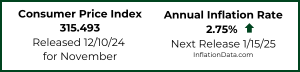
As of this writing the current official inflation rate is 2.2% (for the year ending in October) and based on the Consumer Price Index calculations by InflationData.com it is more precisely 2.16%.
So if you had bought an Inflation Indexed Savings Bond in November 2011 it would have been yielding 3.06% and over the year you would have suffered a 2.16% loss of purchasing power thus you would have had a real return of 0.9%
3.06% (return) – 2.16% (inflation) =0.9% (real return)
But based on Bonds bought now you will only receive 1.76% so if inflation stays at 2.16% you will actually lose 0.4%. Also, there is a 3-month penalty if you withdraw your money before 5 years so if you only held for one year you would have earned 3.06% * .75 = 2.295% or 0.135% more than the inflation rate of 2.16%.
Would you like to know How Have Inflation-Indexed Bonds Really Performed since their creation in 1998? See the inflation-adjusted performance of Inflation Indexed Bonds.
See Also:
- What to Do When – Not If – Inflation Gets Out of Hand
- What are I bonds?
- What is Quantitative Easing?
- Why (and How) China is Boosting the Price of Gold
- Its Weight in Gold: The Real Prices of Things
Author Bio: James McDonnel: When he’s not writing for sites like Inflation Data, he works with Swift Money helping users source short-term loans in times of need.

Leave a Reply