
 In today’s article, Charles A. Smith explains how bankers and bureaucrats conspire to consistently rob the common person through inflation. We have become conditioned to believe that 2% inflation is the norm, and not only that, but it is even desirable and beneficial.
Charles argues that, quite to the contrary, productivity improvements should create lower consumer prices, i.e., deflation. The reason that doesn’t happen is because “Inflation makes bankers’ and bureaucrats’ lives easier and keeps them in power”.
~Tim McMahon, editor.
Inflation Is a Giant “Skim” on the American People
The price of a McDonald’s hamburger in the United States has inflated 3.75 percent annually over the last seventy years. McDonald’s has grown from a tiny hamburger stand in Des Plaines, Illinois, to the second-largest fast-food chain on earth. Scale economies alone (never mind process and productivity improvements) should’ve allowed the price of a burger to decline materially over this period.
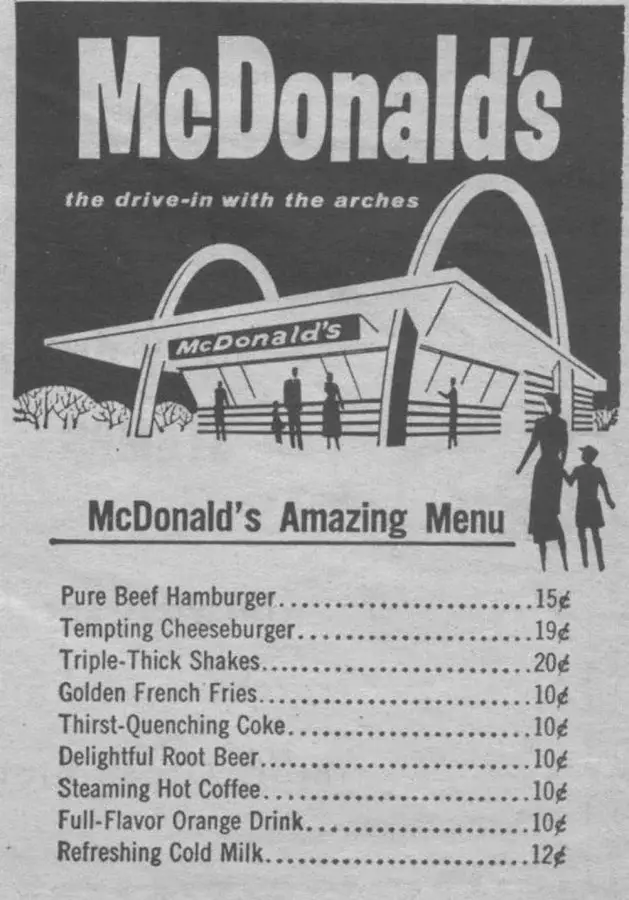
McDonalds 1953 prices
Why didn’t it? What forces and institutions have conspired to inflate the cost of a simple meal by more than thirteen times over two generations? Many Mises Wire readers know the answer, but few Americans are economically astute enough to understand or describe what Vladimir Lenin called the “surest means of overturning the existing basis of society.”
Simply put, inflation is a giant “skim”—perpetrated in a symbiosis of money creation by bankers and government-affiliated central bank bureaucrats, the two institutions with the power to create money from nothing. Inflation creates a nice, cushy existence for each group. And the bankers and bureaucrats always get their money.
If steady price deflation were operative—as is the case in a properly functioning consumer economy, where productivity improvements flow into lower consumer prices—the world would be quite different today and far more difficult for bankers and bureaucrats.
Although Deflation is Good for the People it is Bad for Bankers
With steadily falling prices, bankers must do proper credit analysis. They must set aside ample reserves and generally run their institutions more conservatively. Credit analysis is far more difficult in deflation as borrowers must continuously sell more goods to service their loans rather than relying on boosting prices. Secured loans become problematic as pledged assets devalue. Banking generally becomes a lot more work—and more risky. The period from 1865 to 1910 in the United States was a perfect example of this sort of environment. Record bank failures and enormous financial volatility accompanied steady deflation and one of the greatest periods of economic prosperity and innovation in our nation’s history.
In short, deflation creates risks for banks, so banks conspire with the government to create enough money so they don’t have to deal with it. The “balls to the wall” and “heads I win, tails you lose” practices we’ve become familiar with in banking today are both allowed and inspired by the permanent inflationary regime.
The Greatest Beneficiary of Inflation is Government
The other major inflation conspirator (and greatest beneficiary) is government. Think of inflation as oxygen for politicians and carbon monoxide as a public vote cast to raise taxes. Steady (2 percent, say?) inflation creates a reliable ratcheting effect on every taxpayer in the land and a nice, smooth, foamed runway for bureaucrats. And should our benevolent leaders decide the inflation/tax runway isn’t wide enough or smooth enough? They simply borrow the difference (i.e., the deficit) and inflate that away too!
Inflation created by central banks allows the government to ALWAYS have the money it wants—and be first in line to get it. If deflation were operative—as would be the case in a properly functioning economy where productivity improvements flow into lower prices—the government would have to explicitly tax instead of relying on inflation to drive revenue and devalue debt. Politicians’ careers would be much, much shorter.
In summary, there’s a reason deflation rarely (if ever) happens. Inflation makes bankers’ and bureaucrats’ lives easier and keeps them in power. The cost of a simple hamburger would be far lower without ever-expansive government and the willful destruction of our money. But it will never happen as long as bankers and bureaucrats work in perfect symbiosis to execute a massive skim on the American people.
You might also like:
- Do Private Corporations Cause Inflation?
- What is the Difference between the CPI-U and the CPI-W
- Radical Decentralization: the Key to Wealth and Freedom
- What is Deflation?
This article Originally appeared here and has been reprinted under the Creative Commons License. 
 About the Author: Charles A. (Charlie) Smith is the former Chief Investment Officer of Fort Pitt Capital Group in Pittsburgh. The Fort Pitt Capital Total Return Fund (FPCGX) outperformed the S&P 500 Index for the 20 years that he managed it.

Leave a Reply