
Inflation in the U.S. has reached levels not seen since the 1980s. That means that millennials have never seen inflation this high. Consequently, they are probably unaware of not only how devasting inflation can be, but also about the best ways to hedge against surging inflation. Simply stated, inflation ravages purchasing power, and the higher the inflation rate, the quicker purchasing power is destroyed.
Even if you receive a cost of living (CoL) raise it is usually “too little too late” just like the FED’s recent attempts to fight inflation. The reason a CoL raise doesn’t help much is because it is a lagging entity. In other words, even if you get a raise equal to the actual level of inflation you experienced (unlikely) you have already spent several months at the higher rate, which you will never get back. To make up for this shortfall you will be forced to dip into savings or at least save less.
However, inflation hedging can help to counteract the expected loss in the purchasing power of your currency. Hedging against surging inflation can also help safeguard an investment’s value. When inflation is considered, certain assets that appear to generate a good return might actually result in a loss. A conscientious investor may plan for inflation during inflationary periods by investing in asset classes that typically increase faster than inflation (or at least keep up with inflation). When everyone else is losing money the investor who just preserves capital looks like a genius. Although conventional bonds are a popular choice for income investors, they aren’t a good hedge in times of high inflation.
Stock Up
 The easiest way to hedge against rising prices is to buy stuff before the price goes up. Theoretically, if you could buy everything you would need for the next year now (at current prices) then when your raise arrives, if it equals the inflation rate, you would be no worse off. Obviously, you can’t purchase a year’s supply of perishables (although you can stock the freezer) but you can buy non-perishable things that you are sure you will need, such as detergent, soap, certain clothes, canned and dry goods, etc. Although you will benefit from stocking up, if everyone does it (which they will tend to do anyway) it increases something called the velocity of money (i.e. how quickly people tend to spend any new money they get). When the velocity of money rises it tends to accelerate the rate of inflation.
In addition to stocking up, you can try to stretch your shopping dollars by using coupons, comparison shopping, and buying items when they are on sale.
Real Estate
Typically physical assets tend to keep up with inflation while paper assets don’t. That means that real estate is usually a good inflation hedge. However, the residential and industrial real estate sectors have experienced very strong structural tailwinds over the last decade. Recently Bloomberg Opinion published a chart of data collected by Longview Economics showing a comparison of market capitalization in 2009 vs. 2021. This shows where all the excess liquidity that the FED created went.
Where Did the Excess Liquidity Go?
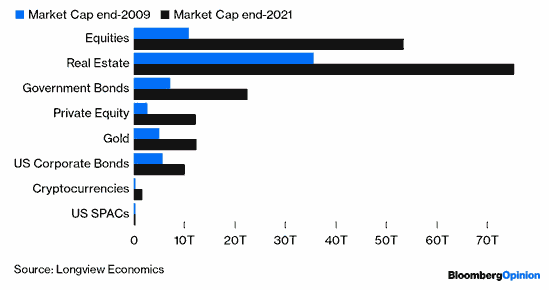
As we can see, real estate was the recipient of a massive portion of the excess liquidity. Resulting in housing prices skyrocketing (so they are currently overpriced). However, real estate still has several distinct advantages.
- As the population increases demand for housing increases.
- People need a place to live.
- The last thing a homeowner wants to do is lose their house.
- Inflation makes mortgages more affordable.
This doesn’t mean that housing prices won’t decrease but a homeowner always has a roof over their head. And if you have a fixed mortgage your costs are relatively fixed, unlike people who rent. And housing prices will eventually rebound.
Diversify Internationally
Not every country inflated its currency as much as the U.S. did. By diversifying among various currencies your money can retain a greater portion of its purchasing power and even increase in value against your home currency. Inflation protection can also be achieved through increasing foreign exposure, via vehicles such as offshore funds.
Stocks
 Stocks are generally a solid long-term inflation hedge, but as the chart above shows, percentage-wise stocks received even more excess liquidity than real estate did. Although, we must remember that the chart is comparing against 2009 prices after they had already crashed significantly. This chart would not be anywhere near as drastic if they compared against 2007 prices.
Not all equities are equivalent in terms of inflation protection. Look for firms with pricing power, which means they can raise prices to their consumers if their expenses grow. Additionally, as a company’s profits rise over time, so should its stock price. While inflation concerns may affect the stock market, the top firms can weather the storm because of their superior economics. Typically companies that produce commodities have pricing power. Conversely, companies that are high energy users like airlines see their fuel costs increase, combined with a decrease in demand for travel.
Gold
 When inflation rises or interest rates fall, gold has traditionally been considered a haven asset for investors. When “real” interest rates — i.e. the reported rate of interest minus inflation – are high gold does poorly because gold doesn’t pay interest. But when real interests are low or go below zero, gold tends to do well. Gold is frequently viewed as a store of value by investors during difficult economic times, and it has traditionally served this role. Gold is also a “Crisis Hedge” because physical gold is not simultaneously someone else’s liability and so it isn’t a “paper asset”.
One way to invest in gold is through an exchange-traded fund (ETF), eliminating the need to take possession and store gold. This is fine in all but the most extreme crises.
Inflation is a risk that every investor must consider. Money loses its value over time, and the rate of inflation in a given country varies according to current circumstances. There are, however, a variety of strategies for investors to protect themselves against inflation, including specialized investments in offshore funds and inflation-hedged asset classes.
You might also like:
- Millennials have never seen inflation this high
- The FED’s recent attempts to fight inflation (Too Little Too Late)
- Velocity of money
- Cost of living


Leave a Reply