News from the FED’s December 2021 FOMC Meeting
For nine months now, here at InflationData, we’ve been saying that inflation was becoming a problem. We’ve said this even though the FED denied it and initially said the problem was only “transitory”. The FED continued to massively increase the money supply via “Quantitative Easing” (QE) during that period. In our article Why Quantitative Easing is Inflationary… Sometimes, we showed that QE is inflationary when there aren’t counteractive deflationary forces. We also noted that QE had resulted in a massive increase in the money supply this time around.
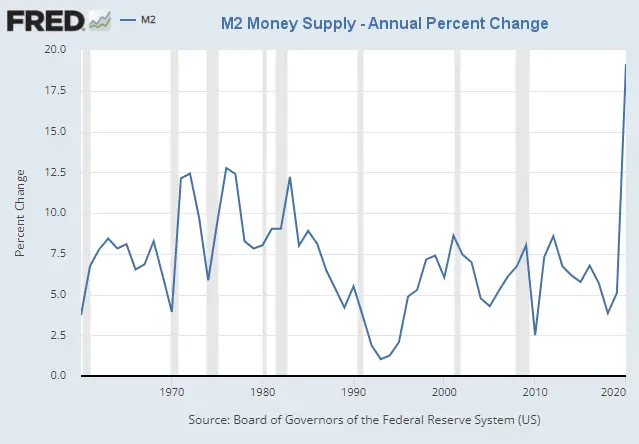
In his strangely named book Picnics on Vesuvius, former Financial Times Editor William Rees-Mogg says that since the 1970s, Monetarist Economists have known that an increase in the money supply results in inflation. But apparently, as this quote by Samuel Johnson suggests, “We frequently fall into error and folly not because the true principles of action are not known, but because, for a time they are not remembered”, the FED has forgotten the actual cause of inflation.
How Can the FED Forget What Causes Inflation?
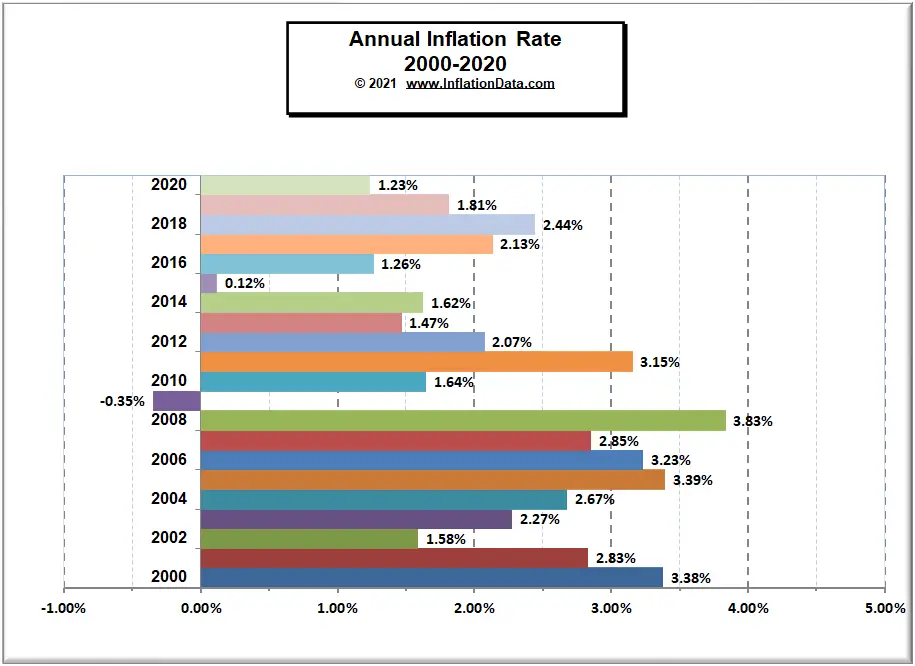
It appeared that nature had suspended the laws of inflation causation for most of the new millennium. From 2000-2020 the average annual inflation rate never exceeded 3.83% despite some massive Quantitative Easing beginning in 2009.
 This fluke may have lulled the FED into a false sense of security, thinking they had discovered the new monetary “Holy Grail”. As we’ve said, the only reason it worked previously is that the deflationary forces outweighed (or at least equaled) the inflationary forces of QE. In 2020, the FED got too “cocky”. They pumped up the money supply faster than what caused massive inflation in the 1980s.
Rather than slamming on the brakes at the first signs of inflation (or just letting off the gas), the FED kept the “pedal to the metal” for many more months. Generally, an increase in the money supply results in inflation from 12 to 18 months later. So the FED must be proactive rather than reactive to head off inflation. But the FED certainly appears to be behind the curve this time.
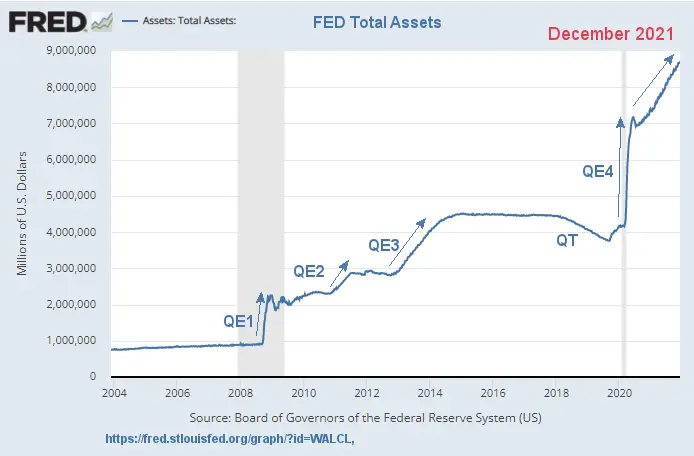 The steep angle on the above chart since 2020 shows how much QE the FED was doing in 2021. Tapering means that the angle would become less steep but still not be flat like 2014-2018 or decline like the Quantitative Tightening (QT) of 2018. But the interesting thing about money creation is that the stock market becomes addicted to the increase, and even slowing the supply of money often results in the market suffering from withdrawal symptoms. So we can almost guarantee a stock market “retracement,” if not an all-out crash once the FED starts tapering.
December 2021 FED Meeting Pronouncements
At their December meeting, the FED finally admitted that inflation was becoming an issue and vowed to “speed up the taper” and possibly raise interest rates as many as three times in 2022. Of course, speeding up the taper isn’t the same as slamming on the brakes or throwing it into reverse. No! “Speeding up the taper” means letting up off the gas a little quicker than initially planned. What??? Yes, the FED is still planning on accelerating, just a little slower sometime in the near future. And despite the lowest interest rates in memory, the FED might raise rates.
Tracy Miller, a commentator, writing for “The Hill,” put it rather succinctly saying, “If the Fed were going to act aggressively, rather than buying fewer government bonds each month, it would stop buying them altogether. It would also increase the interest rate it pays on bank reserves without hesitation.”
Miller then calls out the FED’s vision of the future of inflation when she writes:
“We should not expect to see inflation fall much from its November level of 5.5 percent. Although the Fed is forecasting only 2.6 percent in 2022, there is good reason to expect a much higher rate.
Specific phrases of the FEDs report are:
“Overall financial conditions remain accommodative, in part reflecting policy measures to support the economy and the flow of credit toU.S. households and businesses.”
In other words, We are continuing to follow a loose monetary policy.
“The Committee decided to keep the target range for the federal funds rate at 0 to 1/4 percent… until labor market conditions have reached levels consistent
with the Committee’s assessments of maximum employment.”
They also decided to reduce Treasury purchases by $20 billion per month and $10 billion/mo for mortgage‑backed securities (MBS) instead of the $10 billion and $5 billion per month reductions they announced in November. But that still leaves them with $40 billion a month in Treasury purchases in January and $20 billion in MBS. But at that rate, purchases would end in February rather than April.
Why the FED May Have Delayed the Taper
As we said in Why is a Little Bit of Inflation Considered Good for the Economy?, in 1976, Congress decided that instead of just targeting inflation, the FED should target both Inflation and Unemployment under a policy called a “Dual Mandate”.
So because unemployment was still high, the FED may have delayed tapering in an effort to boost employment. But this time around, unemployment is not the result of too few jobs but rather too few people willing to work.
According to data from the Census Bureau, millions of people haven’t returned to the workplace because they’re caring for their children, “suffering from COVID symptoms, caring for someone who is sick, or concerned about getting or spreading the virus.”
Perhaps the Government’s fear campaign for COVID was working too well… Or maybe, too many people got used to staying home with their kids… Therefore, they decided to forego a few extravagances and enjoy a simpler lifestyle.
Some parents have decided to homeschool their kids after seeing what they were being taught in public school.
Thomas Sowell, an American scholar and a senior fellow of the Hoover Institution at Stanford University, observed: “It is not merely that Johnny can’t read, or even that Johnny can’t think. Johnny doesn’t know what thinking is because thinking is often confused with feeling in many public schools.”
According to Alex Newman, “I tell parents at this point: if you love your children, if you want them to be successful, well adjusted, sensible, well educated, clear-thinking individuals, your only option is to remove them from the public school system. … You will not be able to get your children a decent education at a public school anymore,”
In a cost-benefit analysis of private school with a two-income household vs. homeschool and a one-income household for multiple students, it is often cheaper to homeschool. The scale is tipped even further toward homeschooling if the stay-at-home parent can do at least some remote work from home.
If it is a labor supply issue, rather than the traditional labor demand issue, all the loose money in the world may not convince people to return to the workforce.
Conclusion:
The FED has said it would fight inflation by tapering “sooner” than they had said initially but “later” than many people consider prudent. In the end, if inflation continues to increase at its current pace, the FED may be forced to taper even sooner and more drastically than they even their current projections suggest.
You Might Also Like:
How does the Money Supply affect our Inflation Rate?
Velocity of Money and Money Multiplier


Leave a Reply