
Nixon is not remembered well by history because of the single defining moment of Watergate and the high inflation rate during his Presidency. However, according to a 2017 C-SPAN Presidential Historians Survey, Nixon actually ranked 10th among all presidents for his foreign policy. And the Siena College Research Institute, Presidential Expert Poll of 2010 ranked him 11th on foreign policy accomplishments. Of the 21 different categories, this survey ranked Nixon an average of 27.6th out of 44 presidents… so only slightly worse than average.
Nixon’s China Visit
One of Nixon’s foreign policy actions was to open diplomatic relations with China. This one action would have long-lasting repercussions. At the time, this was a highly controversial action. How could he possibly offer an “Olive Branch” to the Communists?
According to Wikipedia, “The 1972 visit by United States President Richard Nixon to the People’s Republic of China (PRC) was an important strategic and diplomatic overture that marked the culmination of the Nixon administration’s resumption of harmonious relations between the United States and mainland China after years of diplomatic isolation. The seven-day official visit to three Chinese cities was the first time a U.S. president had visited the PRC; Nixon’s arrival in Beijing ended 25 years of no communication or diplomatic ties between the two countries and was the key step in normalizing relations between the U.S. and the PRC. Nixon visited the PRC to gain more leverage over relations with the Soviet Union. The normalization of ties culminated in 1979, when the U.S. established full diplomatic relations with the PRC… Improved relations with the Soviet Union and the PRC are often cited as the most successful diplomatic achievements of Nixon’s Presidency.” This meeting was the subject of a PBS documentary film, American Experience: Nixon’s China Game.
Although to us, this might seem like the logical move to play off the Soviets against the Chinese by opening up Diplomatic relations with China. But at the time, this was a radical move by Nixon. Shortly after Nixon was elected, Deputy National Security Adviser Alexander Haig, and Henry Kissinger (National Security Advisor and eventually Secretary of State under Nixon), had an unusual conversation about Nixon. Haig recalls Kissinger coming from the Oval Office, and saying “this fellow wants to open relations with China.” Haig responded, “Not a cold warrior like Nixon.” And Kissinger says, “I think he has lost control of his senses.”
But in hindsight, this may have been one of Nixon’s most brilliant moves. At the time, the Soviet Union was contemplating military moves against China… but by opening up US-China relations, the U.S. would catch Russia’s attention and get more leverage on them through playing this obvious China card. The idea was to improve relations with Moscow by stirring a bit of Russian paranoia by dealing with China but never getting so engaged with China that we would turn Russia into a hostile enemy.
By adding a third leg to the Foreign Relations “stool,” the entire world became more stable. Rather than simply having the U.S. face off against the Russians in a Cold War Nuclear Arms Race, if the Soviets attacked China, they would now need to be concerned about a U.S. response.
Prior to Nixon, Americans were not allowed to travel to China. The U.S. had no diplomatic or trade relations with them and the Chinese economy was impoverished by state ownership and central planning. Nixon’s visit opened the door to Chinese economic reform, known in the West as the opening of China. After the death of CCP Chairman Mao Zedong, the Communist Party leadership turned to market-oriented reforms to salvage the failing economy, instituting a series of economic reforms. These reforms may not have been possible without an open the door to U.S. markets.
The Inflation Factor
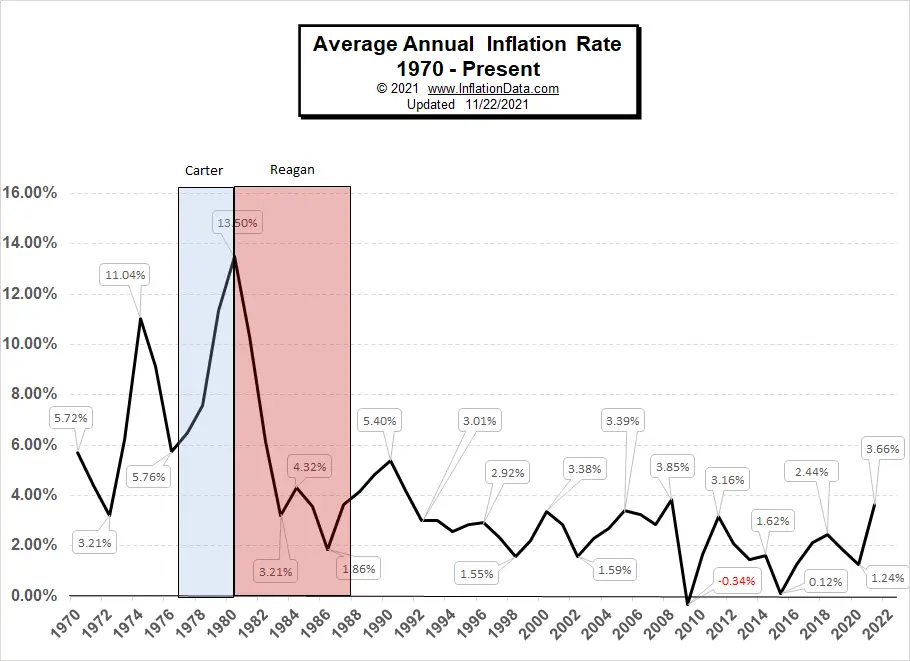
In addition to the Foreign Relations benefits of opening relations with China, there were also inflation-curbing benefits. In the following chart, we can see that Inflation was a big problem during the Nixon Presidency.
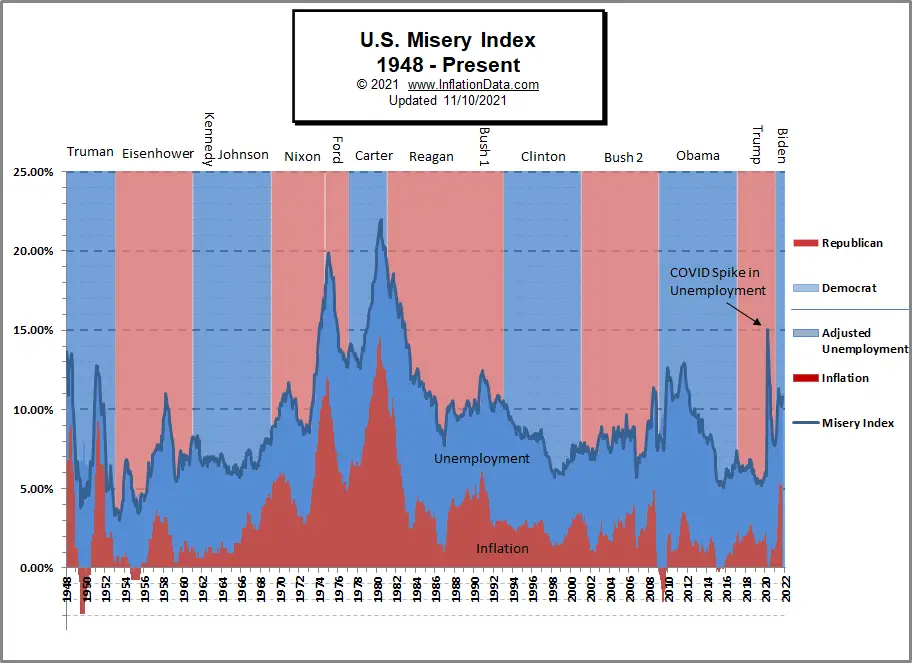
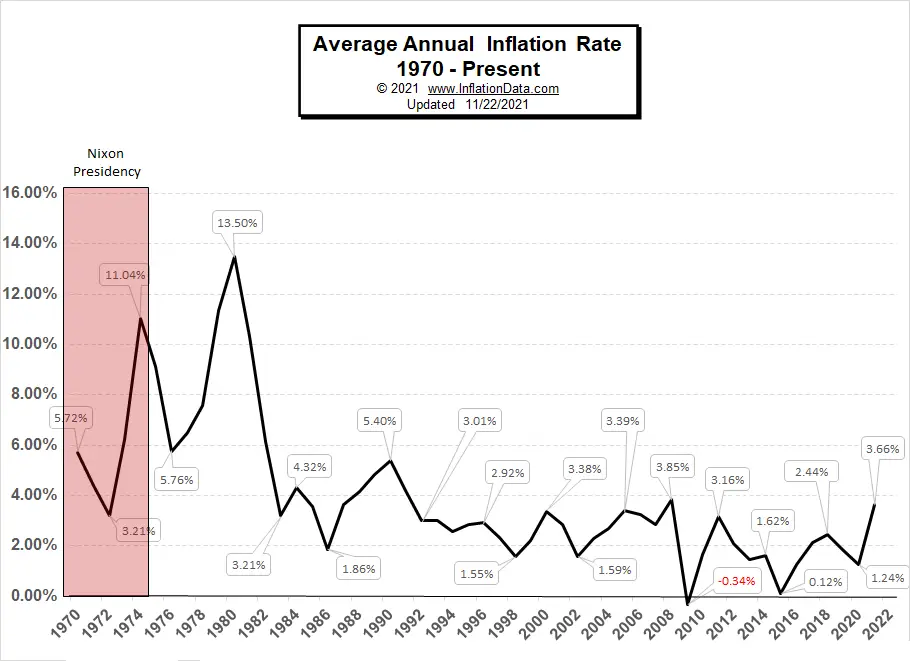 The Misery Index (the combination of Inflation and Unemployment) reached 20% under Nixon.
Socionomic Theory
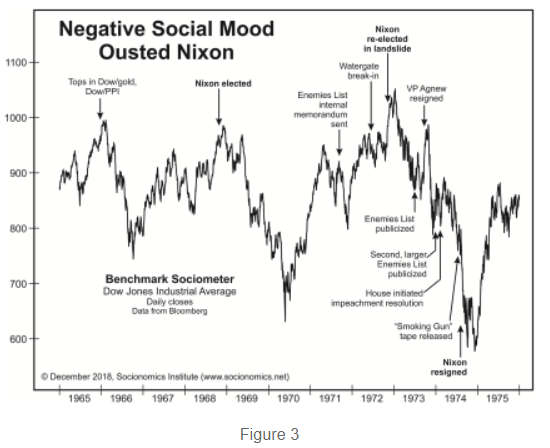
And according to Socionomic theory, part of the reason Nixon got such a bad rap for Watergate was simply that the social mood was so bad that Nixon got the blame (the soaring Misery Index was a significant factor in the poor social mood). The theory goes that the Watergate Scandal would have been a lot less severe had the economy been booming at the time (i.e., people are willing to overlook almost anything if the economy is booming).
According to Robert Prechter and Socionomics.net, “President Richard Nixon’s near-impeachment and resignation from office serve as a textbook case of how social mood influences the fortunes of public figures. Figure 3 shows the Dow Jones Industrial Average surrounding his time in office. The soon-to-be-infamous Watergate break-in occurred toward the end of a strong 67% rally in the Dow from May 1970-January 1973. That trend toward a positive mood helped Nixon win re-election in a landslide. But as mood trended toward the negative, the public’s view of its leader darkened, its appetite for scandal increased, the investigation accelerated, and Nixon’s fortunes changed. With almost certain impeachment looming, Nixon became the first president to resign from office on August 9, 1974.”
Inflation Falls Under President Ford
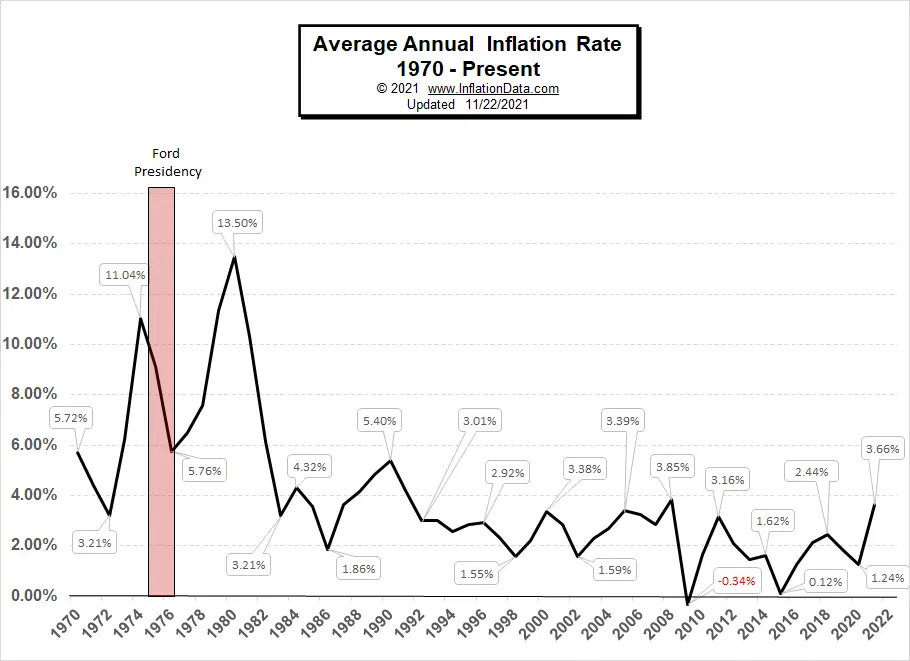
After Nixon resigned, Vice President Gerald Ford assumed the Presidency for the second half of Nixon’s second term. During that time-period, Inflation fell drastically ostensibly due to policies enacted by Nixon.
Inflation under Carter and Reagan
Inflation rose sharply under Jimmy Carter and then fell under Reagan.
 How Nixon’s China Deal Affected Inflation
Initially, the fact that Nixon opened up relations with China had little economic effect aside from cooling fears of Soviet aggression. However, the ability to trade with China resulted in massive downward pressure on prices in the long term. In our article, How Does a Country “Export” its Inflation? we discuss in detail how China Helped the U.S. Export Inflation. China had an unfair advantage by producing goods with cheap labor, and basic economic theory says that the low-cost producer will win. And that is what happened low-cost Chinese products flooded the U.S. market, effectively allowing the U.S. to export its Inflation to China. Chinese wages rose on the tide of U.S. dollars flowing to China and China buying U.S. Treasury debt.
Initially, products from China were of inferior quality to U.S. products… but as time went on, U.S. manufactured products became of less quality (in an effort to compete on price), and Chinese products increased in quality as they realized that consumers wanted at least some semblance of quality in addition to low prices. Eventually, much of U.S. manufacturing moved overseas because the U.S. couldn’t compete, and the U.S. economy focused on “High Tech”, the Service industry, and Software. This led Obama to opine that Trump would need a “magic wand” to bring back manufacturing jobs to the U.S., but, by lowering U.S. tax rates for corporations, Trump was able to entice some of the companies to move a portion of their manufacturing back to the U.S.
As we can see in the above chart, Inflation peaked at the beginning of Reagan’s term and has remained relatively low ever since. This was not due to a lack of monetary stimulus by the FED, but rather due to the downward pressure on prices from foreign producers primarily due to Nixon opening the door to Chinese goods.
You might also like:
- How Does a Country “Export” its Inflation?
- The Inflationary 1970’s Inflation and CPI 1970-1979
- Manufacturing Jobs Soar Under Trump
- How Bad Is Our Manufacturing Sector?
- Oil, Petrodollars, and Gold
- Why Does China Want to Lower the Value of Its Currency?
- What are “Foreign Exchange Reserves”?
- Imports, Exports, and Exchange Rates
- What Is Fiat Currency?
- Using Forex to Hedge against Inflation
- Why (and How) China is Boosting the Price of Gold
- Could a Strong Dollar Actually Cause Problems?
- U.S. Foreign Exchange and The Chinese Currency Exchange Rate
- More Currency Articles


Thank you for allowing me to take the liberty (on topic) for further clarity…
Nixon’s visit, in my, view, ‘Opened the Floodgates to/for Trade with China, which in turn, influenced U.S. Inflation for over 50 years’.