• Home
  • Related Sites
    • Financial Trend Forecaster
      • Moore Inflation Predictor
      • NYSE Rate of Change (ROC)
      • NASDAQ Rate of Change (ROC)
      • Crypto ROC- BTC & ETH
    • Unemployment Data
      • Historical Employment Data
      • Unemployment Rate Chart
      • Labor Force Participation Rate
    • Optio Money
    • Elliott Wave University
    • More Resources
  • Definitions
    • What is Inflation?
    • What is Core Inflation?
    • Inflation vs CPI
    • What is Deflation?
    • What is Disinflation?
    • What is Agflation?
    • What is Stagflation?
    • What is Hyperinflation?
    • What is Quantitative Easing?
    • What is Quantitative Tightening?
    • What is Velocity of Money?
    • What is Fiat Currency?
    • How Do I Calculate Inflation?
    • What are “Sticky Prices” and Why Do They Matter?
  • Featured Content
  • About Us
  • Feedback
    • Sitemap
  • Subscribe Now

InflationData.com

Your Place in Cyber Space for Inflation Data

CPI Index

CPIWidgetSept25
  • Numerical Inflation Data
    • Current Inflation Rate
    • Monthly Inflation Rate
    • Historical U.S. Inflation Rates
    • Historical CPI
  • Inflation Charts
    • Ann. Inf. Rate Chart
    • Long Term Inflation >
      • Ave. Inf. by Decade
      • Total Inf. by Decade
      • Inflation 1913-1919
      • Inflation 1920-1929
      • Inflation 1930-1939
      • Inflation 1940-1949
      • Inflation 1950-1959
      • Inflation 1960-1969
      • Inflation 1970-1979
    • Cumulative Inflation
    • FED Monetary Policy and Inflation
    • Inflation and Recession
    • Confederate Inflation (1861 – 1865)
    • Misery Index
    • The 3 Stages of Inflation
    • 15-Yr Inflation Trends Chart
  • Inflation Calculators
    • Cumulative Inf. Calc.
    • How Much Would it Cost
    • Salary Inf. Calc.
    • Cost of Living Calc.
    • U.K. Inf. Calc.
    • Cost of Gas Calc.
    • Net Worth Calc.
    • Lifetime Earnings Calc.
    • Savings Goal Calc.
    • Financial Calculators
  • Inf. Adjusted Prices
    • Energy >
      • Inflation Adj. Gas Prices
      • Historical Oil Prices Chart
      • Crude Oil Price (Table)
      • Natural Gas Prices
      • Electricity Prices
      • Oil vs Gold
    • Gold >
      • Inflation Adjusted Annual Average Gold Prices
      • Gold is a “Crisis Hedge” not an  “Inflation Hedge”
      • Comparing Oil vs. Gold
    • Corn Prices
    • Education Inflation
    • Housing Prices
    • Mortgage Rates
    • NYSE Index
    • Inf. Indexed Bonds
    • Movie Revenues
    • Inflation-Adjusted Wages
  • Cost of Living
    • Calculate Cost of Living
    • Cost-of-living Adj. (COLA)
    • Consumer Price Index CPI
      • Historical CPI
      • Current CPI
      • CPI Release Dates
    • Gas Prices >
      • Cost of Gas
      • Cost of Gas Per Month
      • Gas vs. Oil Price Chart
    • Food Prices 1913 vs 2013
    • Health Insurance
  • Blog
    • Key Inflation Articles
    • International Inflation
    • Historical Inflation Rates for Japan (1971 to 2014)
You are here: Home » Blog » Inflation » Investing to Fight Inflation

Investing to Fight Inflation

Published on November 4, 2019 by Tim McMahon Leave a Comment

While inflation has been low in most developed countries over the last decade, there are places where it is starting to pick back up, with stronger growth outlooks for several major economies. As we can see from the chart below the OECD is projecting massive inflation in 2020 for both Turkey and Argentina at 12.6% and 22.7% respectively.  The average of all OECD countries is a low 2.4%.
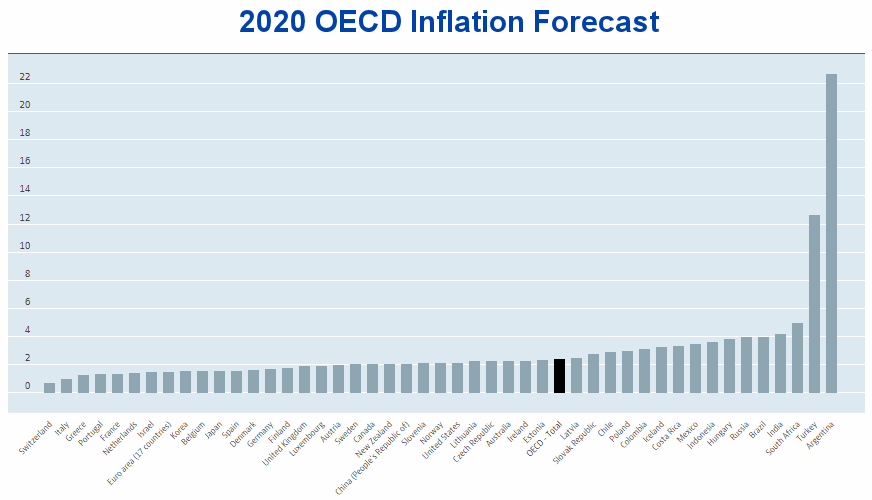
OECD Inflation Forecast 2020

The OECD Inflation projection for the European Union (EU) is also surprisingly low. Who would have thought that countries like Italy, Spain and Portugal could maintain such low inflation rates, with the highest being Hungary at 3.8%. Back in June 2019, the Telegraph published an article about how the EU was still fearing deflation. During deflationary periods where your money gains purchasing power, simply earning one or two percent and getting your original investment back is a good strategy. But if your dollars are rapidly losing purchasing power you have to do something else or your money will soon be worthless.
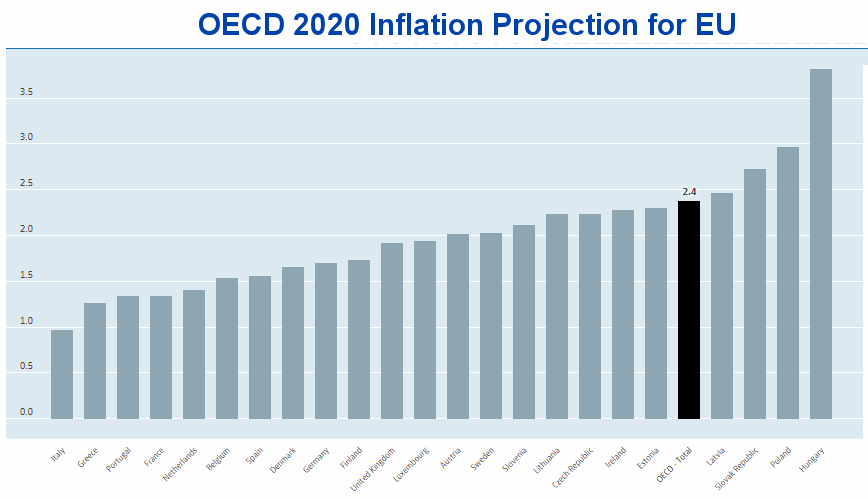
OECD Inflation Forecast 2020 for EU

Source: OECD Inflation

What Is Inflation And How Does It Impact Your Money Over Time?

The Bureau of Labor Statistics defines inflation as “the overall general upward price movement of goods and services in an economy”. So, when inflation occurs, your buying power is negatively impacted i.e. it takes more money to buy the same amount of goods and services than it did in the past. Therefore, the higher the rate of inflation is, the more it decreases the value of your money over time.

How Investing Can Help You Maintain Purchasing Power

As inflation shrinks the value of your savings, you need to find ways to counter this. Once you have enough savings to consider investing, you should make efforts to do so, as this can help you maintain (if not improve) your overall purchasing power. Therefore, taking a little bit of risk through investing can help you avoid losing money over time, but you also need to find the right savings and investment products for you.

Putting your money in classic savings accounts are low-risk options with easy access to your money. But you could also consider tax-advantaged accounts. These accounts, such as a 401k in the United States or a TFSA in Canada, can be great ways for you to save money and invest it for the future, while also taking advantage of protection from taxes. As we can see from the charts above how poorly your savings fare depends a lot on where you live and what currency your savings are denominated in. By eliminating the tax bite you can improve your overall rate of return and have a better chance of beating inflation.

What’s the Best Way to Mitigate and Control Your Risk While Investing?

If someone were to offer you 49% interest on your savings, you might initially jump at the opportunity. Although inflation “may” decline to 22.7% in Argentina as projected by the OECD, currently it is over 53% and banks are paying about 49% interest. So if you were to put your Argentine Pesos into a bank in Argentina you would actually be losing 4% of your purchasing power every year.

However, if the OECD projections prove right and you could lock-in 49% interest and inflation falls to “only” 22.7% you could actually make a good return on your money. One way that Argentinians have typically fought the loss of purchasing power is to keep their savings in other currencies such as the U.S. dollar, however, the government has often tried to stop this practice with various laws and exchange controls.  Argentina has had a poor record of maintaining its purchasing power, suffering hyperinflation from 1975 – 1993 and very high inflation rates over the last decade.

Another safe haven people choose to protect against inflation is gold. Since it is a commodity with a financial history it generally keeps up with inflation over the long run although it may experience periods where it does underperform or overperform inflation.

While investing can be a way to preserve your purchasing power, it can sometimes be very risky, depending on the financial instruments you use and the markets you invest in. For instance, the Forex market and the equity markets are considered to be the riskiest markets, while bonds and cash are considered relatively safe and conservative.

That’s why it’s important to determine your risk tolerance before investing. Using a different investment strategy for each stage of your life, depending on your age, can help you determine how much risk you’re willing to take to find the right asset allocation for you.

According to investment advisors, one method of allocating your portfolio is to ‘subtract your age from 100 – and that’s the percentage of your portfolio that you should keep in stocks. For example, if you’re 30, you should keep 70% of your portfolio in stocks. If you’re 70, you should keep 30% of your portfolio in stocks’. Other advisors recommend keeping up to 10% of your portfolio in Gold in order to protect against inflation and market crashes.

While inflation is generally inevitable (like death and taxes), you can use various investment and diversification strategies like currencies, gold and tax-advantaged accounts to take steps to protect yourself from inflation’s corrosive effects on your wealth, thus maintaining your purchasing power and safeguarding your savings.

You might also like:

  • What is the Real Definition of Inflation?
  • What is Deflation?
  • What is Core Inflation?
  • Gold and Inflation
  • Cumulative Inflation By Category 1996-2016
  • What is Hyperinflation?
  • Gold Price and its Relationship with Inflation


About Tim McMahon

Connect with Tim on Google+.

  • Web
  • |
  • Twitter
  • |
  • Facebook
  • |
  • LinkedIn
  • |
  • More Posts(404)

Filed Under: Inflation Tagged With: currencies, gold, inflation, tax-advantaged accounts

Leave a Reply Cancel reply

Your email address will not be published. Required fields are marked *

This site uses Akismet to reduce spam. Learn how your comment data is processed.

Latest Posts

  • How Deflation Created the Middle Class
  • October Inflation Numbers Delayed
  • Why the 2.8% COLA May Fall Short of Real Inflation
  • Delayed BLS September Inflation Data Released
  • September CPI Data Delay Causes Social Security COLA Concerns
  • August 2025 Inflation Report
  • Is the FED Getting Soft on Inflation?
  • July Inflation Report

Sponsored:

As a Seasoned Investor I thought I'd seen everything... But recently I discovered TradingView which has really improved the information I have at my fingertips.~ Tim McMahon, editor

TradingView gives me an edge... including powerful charting tools, real-time market data, and a global community of traders—all in one easy to use platform. It has hundreds of indicators, and even custom scripts for more advanced users, and you don't need to change Brokers just use its seamless brokerage integration... TradingView isn't just a charting tool—it's your full trading command center.

Trade smarter. Trade faster. Check Out TradingView for free.

----------

The Best Place to Buy Your Crypto

Coinbase is the largest Crypto Trading platform in the U.S. and the easiest to use. ~Tim McMahon, editor

Check out Coinbase here

Subscribe Now

eTrends Signup Form

Elliott Wave Resources

Free Elliott Wave Resources

What is Waveopedia?

Waveopedia is EWI’s free, comprehensive index of Elliott wave patterns and terms. Everyone from beginners to experts can benefit from it. It’s a great place to send your followers if they’re new to Elliott waves.

  • Deflation Hits China is the U.S. Next?

  • Why You Must Avoid the Herding Trap

  • Chasing Trends Can Cost You

  • More Education Resources

Post Archives

Home | Articles | Sitemap | Terms of Service | Privacy | Disclaimer | Advertise With Us

Copyright © 1996-2025 · Capital Professional Services, LLC · Maintained by Design Synergy Studio · Admin

Do Not Sell My Personal Information
