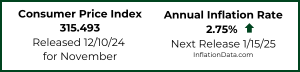
 Inflation is the increase in the price you pay for goods and services, which affects the purchasing power of your money. This is more accurately called “price inflation” as compared to “monetary inflation”. As inflation increases, the value of your money decreases.
There are many different causes of inflation, but the most important cause is an increase in a country’s money supply. When the government decides to print money or implement a quantitative easing program, the money supply is increased (i.e. monetary inflation), thus affecting the general level of prices.
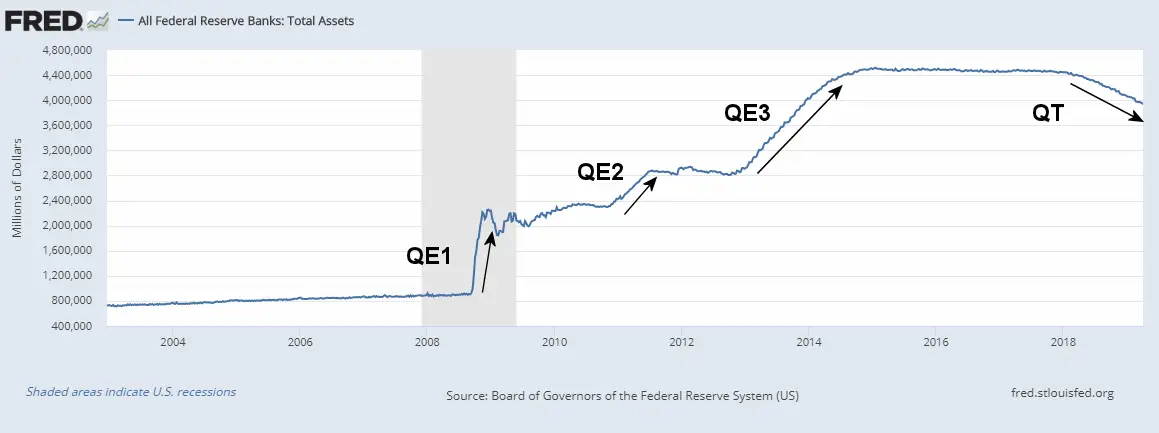
As we can see in the following chart, the Federal Reserve engaged in three phases of quantitative easing i.e. QE1, QE2, and QE3 and most recently has engaged in quantitative tightening (i.e. QT) where they are trying to reduce the value of assets on their books, by not purchasing additional government bonds when the old ones mature.
Legendary economist, Milton Friedman once said: “Inflation is always and everywhere a monetary phenomenon.” In other words, inflation is always caused by printing too much money. But the results are seen in prices of commodities like food, clothing, and energy after the printed money works its way through the economy. Many investors purchase gold in an effort to protect against this erosion of value. As economic uncertainty, inflation and market volatility increases, interest in gold as a hedge increases as well.
So if QE1-3 were inflationary, why didn’t we see significant inflation?
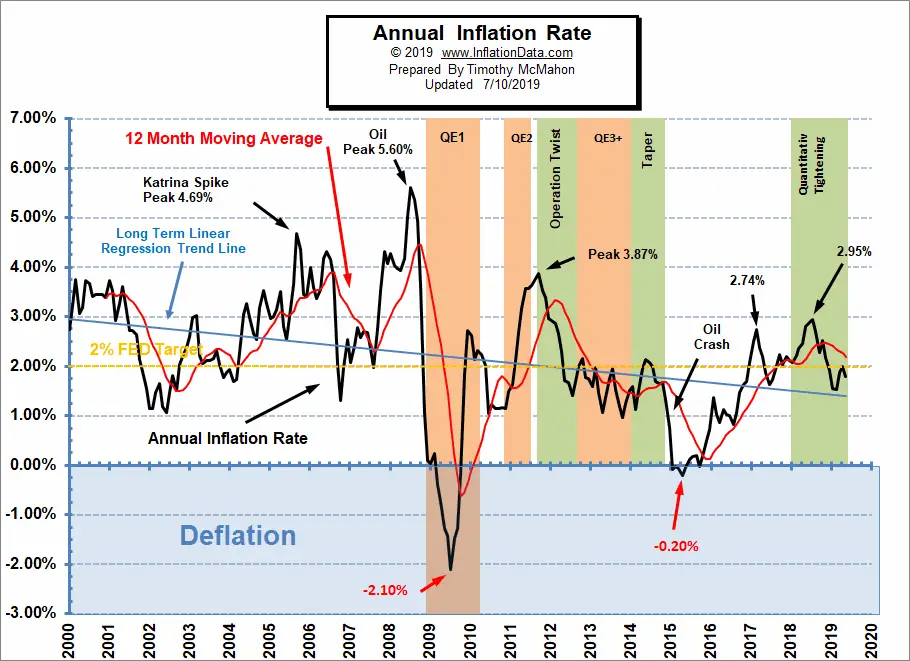
As we can see in the following chart, during the first half of QE1 the inflation rate continued to fall. The second half brought inflation back up to 2.72% by December 2009. But then the FED stopped QE1 and the inflation rate began falling again. So they instituted QE2 which resulted in inflation reaching 3.87% in September 2011. Then they began “Operation Twist” which was simply a program that sold short term treasuries and purchased longer-term treasuries (i.e. it just changed the maturity dates not the actual volume held). Rather than increasing inflation it actually had the opposite effect while QE3 had little to no effect. So why didn’t these monetary inflationary programs result in significant price inflation? Primarily because strong deflationary forces were at work in the economy. They were a contracting stock market and job market so the FED’s actions basically counteracted the markets contractions.
Because gold is considered a hedge against inflation, many investors decide to buy gold to protect their capital against value erosion, which arises from an increase in general prices. At the time of writing, gold’s rate against the USD is around $1,390 and has been strongly influenced by the Fed’s recent comments regarding potential upcoming interest rates cuts.
In many ways, gold can be considered an alternative currency, after all, it was the first currency. So when people lose faith in their own currency as in the case of Zimbabwe or Venezuela, residents will turn to an alternative currency that is more likely to hold its value. This might be the U.S. dollar, the Euro, Yen, or other “hard” currency or it could be gold. In some instances when inflation gets bad enough (i.e. hyperinflation) the entire economy will switch to accepting an alternative currency just as Zimbabwe began accepting U.S. dollars in preference to their own currency.
Central banks, Monetary Policy and Gold
Inflation is an essential factor in a central bank deciding whether or not to change its monetary policy. One would think that the primary goal of most central banks is price stability. However, that is not always the case. Often the Central Bank is tasked with conflicting goals, including financing wars, and boosting the stock market, (both inflationary) while simultaneously keeping inflation low.
In November 1977, during a period of a stagnating economy and high inflation known as stagflation, the Federal Reserve modified the Federal Reserve Act to explicitly identify the goals of the FED. These goals were “maximum employment, stable prices, and moderate long-term interest rates.” It is these goals that have come to be known as the Fed’s “dual mandate.” Often these goals are at odds, so the FED must choose some “middle of the road” approach to balance the goals as well as possible. If the FED increases the money supply in an effort to increase employment, inflation generally increases and interest rates go up. Thus throwing their balancing act out of whack. One reason interest rates rise is that banks fear that their loans will be repaid with “cheaper” (i.e. less valuable) dollars so they charge more in interest in an effort to mitigate that risk.
Another reason interest rates rise is that the FED actually pushes them up. They do this by raising the rate that they charge banks. So, on the one hand, the FED increases the money supply, causing inflation to increase (i.e exceeds the 2% FED target), but on the other hand, the FED is increasing interest rates. In other words, they have one foot on the gas and the other on the brake. Just as this can damage your car it can also have a negative impact on the economy.
While this can mean that demand for Gold may be stronger (to protect against currency value erosion), it also means that Gold is a less attractive investment vehicle – as Gold doesn’t earn any interest, investors can get higher returns with simple bank deposits. In this case, investors must decide whether their fear of inflation and market stability is greater than their greed for interest.
Worldwide Implications
Since most commodities throughout the world are denominated in USD, any changes in the value of the U.S. Dollar has an impact on commodity prices worldwide. Therefore, the U.S. Central Bank (aka. the Federal Reserve, or simply the Fed) has a large influence on gold’s price. Another big factor is purchases and sales by central banks. In recent years, China’s central bank has been a buyer of gold when the price falls to around $1,200/ounce and they cut back on purchases as the price rises. This has had the effect of putting a “floor” under the price of gold since 2012 (see small arrow).

Another factor to take into consideration is the fact that Gold and the American Dollar often move in opposite directions (they’re said to be negatively correlated). As commodities are denominated in USD, when the value of the US Dollar strengthens against its counterparts, it makes gold purchased with foreign currencies more expensive, which can reduce the amount of gold purchased internationally thus putting downward pressure on gold prices.
As with any other asset, when you invest in gold you’re expecting to grow your wealth and/or preserve it, that’s why you need to take inflation into account, as it can impact the value of your returns.
While it is often said that Gold and inflation are positively correlated, the inverse relationship between the evolution of interest rates, the dollar and gold should be put into perspective, since the Gold/inflation correlation relationship does not hold true 100% of the time.
You might also like:
- Is Gold an Inflation Hedge?
- Why Buy Gold?
- The Case of the Disappearing Gold
- 2 Types of Money
- What are “Foreign Exchange Reserves”?
- Why Gold is a Good Investment for Inflationary Times
- Gold and the Federal Reserve
- Civil Liberties Rest Upon Sound Money


Leave a Reply