At the conclusion of the Jackson Hole, Wyoming, FED meeting, Chairman Powell indicated that FED policy was changing. Recent FED History The Federal Reserve Act of 1977 modified the original act that established the Federal Reserve in 1913. The new policy gave the FED a “Dual Mandate” so they would no longer be tasked with just keeping inflation low but would simultaneously try to maintain “maximum employment”. Of course, these are sort of mutually exclusive. If the FED pumps a lot of liquidity into the market, unemployment goes down, but simultaneously inflation goes up, and vice versa if the FED gets too restrictive. So, the FED tried to walk a tightrope between the two extremes and set … [Read more...]
FED’s Semiannual Monetary Policy Report
Federal Reserve Chairman Jerome Powell delivered his semiannual Monetary Policy Report to Congress on June 24th and to the Senate Banking Committee on June 25th. Powell noted that U.S. real GDP expanded roughly 2.5% over the past year, supported by resilient consumer spending and a still-solid labor market. Payroll growth averaged about 124,000 jobs per month in the first five months of 2025—slower than the pace seen during the post-pandemic boom but still consistent with a gradually cooling economy. Inflation, however, remains somewhat above target. The Fed’s preferred gauge, core PCE inflation, is running near 2.6%, with overall personal consumption expenditures (PCE) around 2.3%, … [Read more...]
FED Holds Steady at May Meeting
On May 7, 2025, the Federal Open Market Committee held the FED funds target rate at 4.25% to 4.50%, a level unchanged since December 2024. In his statement, Chairman Jerome Powell said that, while economic growth remains solid, uncertainty has risen markedly amid evolving trade policies and global supply-chain strains saying, “If the large increases in tariffs that have been announced are sustained, they’re likely to generate a rise in inflation, a slowdown in economic growth and an increase in unemployment.” Chair Jerome Powell underscored at the post-meeting press conference that the current policy stance is “in a good place” but that the Fed will “await further clarity” before altering … [Read more...]
Central Banks Respond Differently to the Banking Crisis
Central bankers don't like surprises, so they tend to communicate among themselves in order to coordinate their response to every new crisis. And this week there was a wave of responses to the combination banking crisis and still high inflation. The Cause Raising interest rates from near zero to over 4.5% in a short period of time puts stress on banks' liquidity as it causes an "inverted yield curve", i.e., short-term interest rates are higher than the locked-in long-term rates. Thus banks are paying out more (on short-term deposits) than they are receiving (on long-term mortgages). The Effect So you would think the Central Bankers would be prepared to deal with the … [Read more...]
November FED Announcement Rocks Stock Market
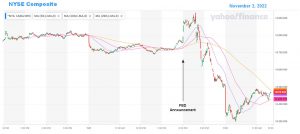
The FED Giveth and the FED Taketh Away On Wednesday, November 2nd, the FED held its "Federal Open Market Committee meeting" and made the announcement the market has been breathlessly awaiting. As expected, Chairman Jerome Powell announced a hike of 75 basis points in the fed funds rate. Along with the announcement, the market was hoping for some indication of a "pivot", i.e., that the FED would give some indication that it was going to be slackening off on its rapid rate increases. And in this respect, the November FED Announcement did throw the market a bone. It added the new phrase “Cumulative Tightening” to the standard announcement. So, going forward, the FED will take the fact … [Read more...]
Jerome Powell “Channels” His Inner Paul Volcker
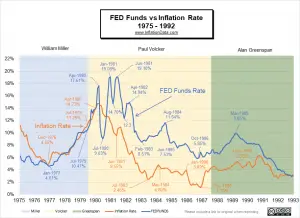
Federal Reserve Chairman Jerome Powell is sounding more and more like former FED Chairman Paul Volcker, who served as the chairman of the Federal Reserve from August 1979 to August 1987. Volcker is best known for his historic fight to vanquish inflation in the early 1980s. Before Volcker took over as the head of the FED, Inflation had risen from a low of 4.65% in December 1976 to 11.26% in July 1979. During that time, FED chairman William Miller raised the FED funds rate from 4.61% to 10.47% in July of 1979. During Miller's time, the FED funds rate pretty much tracked the inflation rate, with a couple of month lag. Prior to Volcker, the prevailing monetary theory was that the FED … [Read more...]



