
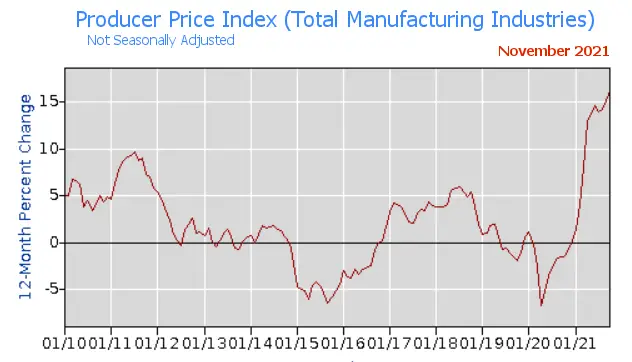
With the Producer Price Index for manufacturing industries increasing by over 15% on a not seasonally adjusted annual basis for the last couple of months, businesses are facing rapidly increasing costs. To remain profitable, companies only have two options, either raise prices or cut costs. In the short run, larger corporations can postpone the inevitable by taking a 3rd option, i.e., “to squeeze margins to maintain volumes” (which is just a fancy way of saying “eat the increased costs”. Small businesses are generally in a weaker position to adjust themselves when inflation knocks at their doors. It is more difficult for Small and Mid-size Enterprises (SMEs) to cope with the situation because they hold fewer cash reserves.
Here are some methods that businesses use to deal with the effects of inflation.
1) Focus On Efficiency And Productivity
As production costs rise with inflation, businesses can cope by increasing efficiency and/or productivity. Efficiency is defined as “the level of performance that uses the lowest amount of inputs to create the greatest amount of outputs”. One method of improving efficiency is via cutting waste. When times are good, and profits are rolling in, employees can get slack and wasteful. But as costs rise, an increased emphasis on cutting waste in material and energy can help postpone the necessity of raising prices for your goods.
Increasing productivity is the act of getting your employees to produce more in the same amount of time. This does not necessarily mean breaking out the whip but could involve improved training and better systems to get more done in the same amount of time.
The only way to deal with these worries is to brainstorm how to improve the quality of business operations. Try to improve efficiency and focus on doing more with fewer resources. In this way, companies can reduce costs and cope with the increased expenses associated with inflation.
2) Introduce automation
If your business uses too many manual processes such as accounting, bookkeeping, details recording, data management, and noting down of transactions, reducing human involvement via introducing automation can cut costs.
There are a variety of ways to minimize human input to save time and labor expenses. Over the last 20 years, computerization has automated processes and data handling. Travel time has been reduced via Zoom and FaceTime conferences. Work from home procedures have reduced Office expenses. Computer storage has been outsourced to companies like Amazon Web Services. And services like the Firmex Data Room have provided ways to save data and handle records and details regarding business projects remotely without hiring extra people.
3) Cut Unnecessary Expenses
Once all avenues for improving productivity, efficiency, and automation have been explored, businesses face the challenging prospect of cutting expenses such as salaries, electricity bills, warehouse cost, accommodation cost, etc. there are four main types of costs: direct cost, indirect cost, fixed cost, and variable cost.
Direct cost is associated with the production of products such as labor and cost of raw material, which is necessary to run the business. Indirect costs include expenses due to certain things such as providing laptops and Wifi to the employees.
Fixed cost is the amount that needs to be paid no matter what. It doesn’t depend on whether you are producing the product or generating sales or not, such as paying the rent on the property you are using to run the business. A portion of electricity bills are fixed, but some utility expenses can be reduced by turning lights and equipment when they aren’t being used.
Variable costs are costs that can change depending on the business’s performance. Such as material costs, which depend on how much you produce. The more you produce the more material you use, thus your variable costs increase.
4) Cut Personnel Expenses
Businesses hate to cut personnel because it creates hard feelings, hurts employees, and hiring new personnel is expensive. But sometimes, eliminating weak performers is the best solution. Eliminating certain employees can actually improve morale and increase productivity. Some employees are more of a distraction to other employees than they produce. For many years, General Electric had a policy requiring every manager to fire the bottom 10% of their performers each year and then hire replacements for them. This had the net effect of steadily increasing performance as only top performers were retained. Costs can be cut in the short run by not hiring replacements and requiring remaining employees to take up the slack. In the long run, this can result in employee burn-out and be counterproductive, but in the short run, it can help companies deal with rising costs.
Effects of Inflation on Various Types of Businesses
Climbing prices are not only bad for consumers but also for businesses as well. When prices get too high, customers reduce their spending and purchase only those items that are absolutely necessary i.e. reducing discretionary spending. This reduces business income, so not only are costs rising but income is falling providing a “double-whammy” to small businesses. Businesses providing discretionary items tend to be hurt the most but surprisingly businesses catering to the truly wealthy are often not affected as much as you would think, because wealthy individuals’ discretionary income is not as limited as those in the middle and lower class.
You might also like:

Leave a Reply