Inflation can affect business in strange ways. It can be good for business in small doses, but it can also be disastrous if it devolves into hyperinflation.
Hyperinflation is often described as massively increasing prices over a very short period of time, for example, in America during the Civil War. But even if inflation doesn’t get that bad, the later stages of ordinary inflation such as we saw in the 1980s can still be devastating to businesses.
Here are four ways that businesses are affected by inflation or hyperinflation, and what that might mean for their customers and other services they might invest in.
#1 It Can Increase Sales
In the short run, as the money supply increases, the general population feels richer and will often purchase higher ticket items that they couldn’t afford previously. We saw this with the recent COVID stimulus checks. Although some people who were already “living on the edge” used the checks for necessities, others simply considered it “free money”. This was a direct stimulus to the economy and people who previously couldn’t afford them suddenly were looking for big-screen TVs and laptops for sale.
However, these short-sighted people didn’t understand the effect that inflation can have on their investments and their financial well-being. Often it takes 12 to 18 months for government money stimulus (i.e. monetary inflation) to actually result in price inflation. So initially businesses are selling inventory that they purchased at a lower cost and so neither the business nor the consumer sees the price increases yet. But once the initial inventory is exhausted businesses find that their suppliers have raised prices, so in order to maintain their profit margins the manufacturers must raise their prices as well. This causes a domino effect and so retailers raise their prices and ultimately consumers must pay more for their new TV.
Since the turnover at grocery stores (often once or twice a week) is much faster than appliance outlets (which only have a turnover every 2 or 3 months), price increases will be noticed in grocery stores long before appliance outlets.
#2 A Rapid Increase in Sales Might Mean Empty Shelves
Similar to what we saw at the beginning of COVID, if a currency undergoes hyperinflation or even rapid inflation, people start to hoard things to get their money’s worth while they still can. This increased demand might come too rapidly for a business to support as we saw with toilet paper. As the shortage mentality takes hold, it becomes self-perpetuating as customers snatch up any available supply for fear of not being able to get any later on. If there are no intrinsic supply disruptions eventually consumers become satiated and stores are once again able to keep their shelves stocked. But if there are intrinsic supply issues caused by things like price controls, natural disasters, or government mismanagement (such as we see in Socialist countries like Cuba and Venezuela) then there could be perpetual shortages of necessities like food and toilet paper.
#3 Inflation Might Encourage Businesses to Make Capital Investments
If a company sees these increased sales and thinks that this is “the new normal” it might consider making a capital investment. Capital investment is, essentially, an investment in increasing capacity perhaps through expanding or upgrading plant and equipment.
However, once everyone realizes that the increase in wealth was a mere illusion and that although they may have more dollars they actually have the same (or even) less purchasing power than before they will stop buying luxury items and focus on the essentials. And if the demand isn’t there or as strong as it was before because people have hoarded as much as they can, at that point, the manufacturer that took on increased debt in order to increase capacity will find that those extra sales have dried up and now they are having difficulty servicing that increased debt.
#4 Rises the Cost of Borrowing
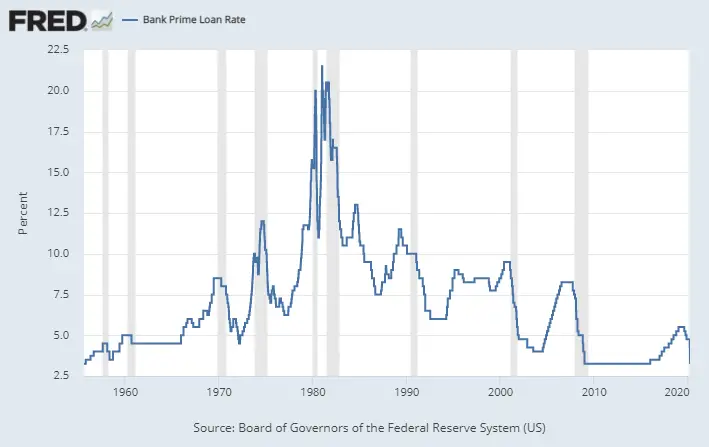
As the inflation rate rises, banks must raise interest rates since they will be repaid in rapidly depreciating dollars. Typically, lending institutions lend to their best customers at or near the “Prime Rate”. But when inflation rises as it did in the early 1980s the prime rate rises as well. At some point, banks may stop lending altogether and businesses stop borrowing since they are no longer interested in expanding but instead, they are only concerned with surviving.
When established businesses are simply trying to survive, this is very bad news for businesses that are just starting. Rates are higher and people are not spending, so new businesses don’t stand a chance. As the problem snowballs, some overextended businesses will go bankrupt, since they cannot make ends meet due to the loss of sales, increased costs, and an inability to borrow.
In Conclusion:
In the early stages of inflation, businesses and consumers feel euphoric as the increase in the money supply makes everyone feel richer. So, they spend the increase on luxuries and capital improvements, and they may even borrow to do so. But before long reality sets in, prices have risen, and consumers realize that although they may have more dollars, they really aren’t any richer than before. So now they not only have to pay for their regular expenses, but also for their increased debt load. So, they are forced to consume less than they would have had they not gone on the inflation-fueled spending spree. This is the primary cause of the boom-bust business cycle. If businesses are aware of the causes of this cycle they can prepare to weather the storm through prudent spending and not become over-extended during the boom phase.
You might also like:
- Inflation in the 1980s
- What is Hyperinflation?
- Civil War Inflation
- Monetary Inflation vs Price Inflation
- The Socialist Time Capsule


Leave a Reply