
How the Pandemic Created Inflation
 Given the current state of affairs and how the Covid-19 pandemic has impacted the global economic outlook, an unconventional recession has emerged, prompting many governments to inflate the money supply to counteract the artificially suppressed economic activity. In many countries, this inflated money supply has resulted in consumer price inflation and resulted in investors seeking a safe haven investment.
When there’s a high level of inflation, economic uncertainty, or financial markets are in turmoil investors flock to safe-haven assets. The rationale is that in times of crisis when most traditional investments are losing value, safe-haven assets tend to hold their value, or even appreciate. So, in order to protect their wealth from market volatility and fluctuations, investors turn to these alternatives.
Investments that appreciate when traditional investments are depreciating are called “contrarian” or high “beta”. According to Investopedia, “The beta calculation is used to help investors understand whether a stock moves in the same direction as the rest of the market. It also provides insights about how volatile–or how risky–a stock is relative to the rest of the market.”
In addition to typical stocks, a balanced portfolio might include things such as gold, government bonds, foreign currencies, or even riskier assets such as cryptocurrency. Now, before you scoff at the thought of buying Dogecoin or Bitcoin as a safe haven (given their volatile nature), there are several benefits that these assets provide over more traditional financial instruments, as we will explain later in this article. Generally, because they are volatile and move contrary to the prevailing trend, hedges only comprise a small portion of an overall portfolio. So, if you’re considering investing in these types of assets, be sure to research expert guides before taking the plunge.
According to the Washington Post, “inflationary pressures are mounting from the boost in demand created by the $2 trillion-plus in savings that Americans have accumulated during the pandemic; from large-scale Federal Reserve debt purchases, along with Fed forecasts of essentially zero interest rates into 2024; from roughly $3 trillion in fiscal stimulus passed by Congress; and from soaring stock and real estate prices.”
1 – Gold- The Ultimate Safe Haven
Gold has long been considered to be the most trusted hedges against inflation and market turmoil. In many parts of the world, gold is viewed as an “alternative currency,” especially in locations where the local currency is consistently losing value. The reason behind this is because gold is a real, tangible asset that is not simultaneously someone else’s liability.
While it is predominantly utilized as a store of value, gold still plays a pivotal role in our society and culture. It has many uses that further lend to its success as a stable financial asset. Nowadays, gold is used in various industries such as electronics, computers, dentistry, and even aerospace engineering, creating real-world demand for the precious metal in addition to just jewelry. Thus the value of gold is not simply reliant on speculation.
Although, it’s important to note that gold isn’t a foolproof hedge against inflation but is more of a crisis hedge. The major drawback to holding gold in the long term is that it doesn’t earn interest. Thus although it may retain its value it doesn’t compound in value. However, when everything else is LOSING VALUE no one seems to care about interest.
2 – Cryptocurrency- High Volatility Haven
While gold has an extremely long history of being a store of value, i.e. thousands of years, cryptocurrencies on the other hand have a very short track record. Nonetheless, Bitcoin and many other digital currencies, such as Ethereum, Dogecoin, and Cardano, have recently become considered “safe-haven assets” by some people because they are decentralized and not subject to government seizure or inflation. And their recent massive increase in perceived value has led to further increased popularity. See: Gold vs. Dollar vs. Bitcoin
Let’s look at Bitcoin as an example. Bitcoin is the king of the crypto world, with a maximum supply of 21,000,000 coins. This means that once the circulating supply hits this level, no further coins may be minted. To put it another way, BTC and most other cryptocurrencies are deflationary, meaning their purchasing power grows with time. The 21 million Bitcoin limit implies that there will be fewer Bitcoins than there is demand for them at some point in time, implying that the price per unit would rise as the supply drops. At the time of writing, Bitcoin has yielded a 62% increase since the start of the year.
In the following chart, we can see the relative performance of Gold vs. Bitcoin. Although since 2016 the price of gold has seen a low of $1,060.54 and a high of $2,067.15 that change is virtually imperceptible compared to Bitcoin’s meteoric rise.
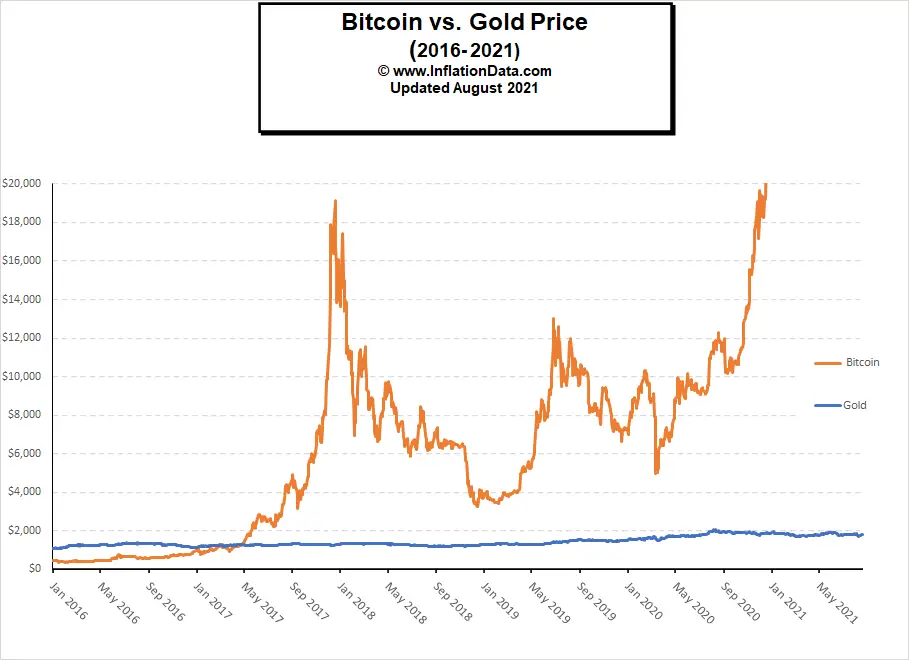 However, the obvious downside to using cryptocurrency as a safe haven asset is its volatility. Crypto markets can be ferocious, with double-digit daily swings occurring regularly. Furthermore, it’s not out of the realm of possibility for the value of the cryptocurrency market to plummet at the drop of a hat due to a black swan event or a massive government crackdown on digital currencies. In many ways, it’s more of a high-risk, high reward play than a safe haven investment.
3 – Government Bonds- Low Inflation Safe-Haven Investment
Finally, at the opposite end of the spectrum are government bonds. Because investors believe in the high expected creditworthiness of the U.S. government, bonds generally experience lower volatility than stocks or gold. So due to their stability and guaranteed interest payments, Government Bonds are the most quintessential example of a safe-haven investment. With the exception of European and Japanese bonds, which saw yields rise somewhat during the COVID market crisis, almost all international government bonds had positive returns during the pandemic. But because they have a fixed dollar value they do not perform well during periods of high inflation and/or interest rates.
Government bonds in the United States were the best performers during this period, as yields fell dramatically. When risk assets were tumbling in the early weeks of the COVID market crisis, bonds responded as expected: yields fell as central banks cut interest rates, and investors swapped risky assets for somewhat less risky government bonds. Furthermore, because the United States government backs them, they are considered among the safest investments in the world.
Final word
With the threat of inflation looming large, it’s wise to seek out safe-haven investments to protect your cash from losing its buying power and dwindling over time. For the most part, investors tend to turn towards conventional assets such as gold, government bonds, and other commodities. However, the rise of the cryptocurrency industry has provided another option that could prove more fruitful (and secure, in terms of inflation), as long as you can tolerate the increased volatility.
You might also like:
- Choosing the Right Investment: Gold vs. U.S. Dollar vs. Bitcoin
- Cryptocurrencies and Inflation
- 5 Reasons to Invest In Gold
- Gold Price and Its Relationship with Inflation
- Can Crypto Solve Venezuela’s Hyperinflation Problem?
- Cost of Living: LA and New York vs. The World
- What is Quantitative Easing?
- What is the Velocity of Money?
- What is Fiat Currency?
- Civil Liberties Rest Upon Sound Money

Leave a Reply