Inflation and Retirement
The stock market crash of 2008 may have left you feeling a little nervous about investing your money in the market. The fear of losing everything to another recession or depression has caused many people to make “safer” investment choices, and some people aren’t even investing at all, choosing to place their money in a “high yield” savings account, instead. Unfortunately, “high yield” these days is still lower than the rate of inflation, causing you to actually lose money.
Inflation Worse than a Crash
 Losing your money to inflation is actually much scarier than losing your money to a stock market crash. Stock market crashes are rare, but inflation is inevitable. As time ticks on, the purchasing power of your dollar decreases due to increases in the costs of goods and services, so whatever money you set aside for retirement needs to be growing over time to keep up with inflation.
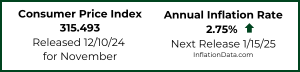
To help you understand this phenomenon, let’s use the Consumer Price Index provided by the U.S. Department of Labor.
According to the Consumer Price Index, the price of a one pound loaf of white bread in 2002 was around $1.00, while the price today is $1.40. Additionally, the price of one gallon of whole milk in 2002 was around $2.75. Today, the average price is around $3.45. That may not seem like a huge difference, but when you consider the increase in prices of everything from food to clothing to utilities to rent, inflation really does make a difference in how far your dollar goes and over the longer term it can significantly reduce purchasing power. Typically, inflation doubles prices every 20-30 years and retirement can easily last 30 years with lengthening life spans.
Inflation
To further simplify this idea, if you saved $2.75 in 2002 to fund your purchase of a gallon of milk in 2012, just 10 years later, that $2.75 would only be able to buy a little over 3 quarts of milk, almost 25% of your purchasing power evaporated. This example helps you understand the importance of finding a way to grow the money you save for retirement, because due to Inflation the amount you save now won’t have the same spending power 30 or 40 years down the road. It is also important to note the current social security crisis; it is no longer safe to assume that your SSI check will be substantial enough to bridge the gap.
Saving for Retirement
While there are several different ways to save for retirement, it is really important to invest some of your money in the stock market. Although stock performance is volatile and a high rate of return is not guaranteed, historical data has shown that the stock market generally yields a better return on investment than most other investment or savings tools.
Currently, the interest rates on savings accounts are too low and will not help you grow your money at all, and while you could invest some of your money in bonds, they can be risky if not held to maturity. And bond prices fall when interest rates rise and with interest currently near zero they can’t go much lower but can certainly go higher if inflation kicks in.
Other alternatives that often do well in times of high inflation include real estate, precious metals like gold, silver and platinum, other commodities like timber, oil and copper, inflation indexed bonds and stocks in companies that produce real products.
Diversification
Nearly everyone has heard this advice; diversify your investments. Put a little in bonds, a little in stocks, a little in real estate, etc. To help you with this task, seek the advice of a reputable and knowledgeable financial advisor who can help you make strong investment choices. Slow and steady investments are the best option for retirees who will eventually depend on the money for income.
In conclusion, inflation’s effect on your dollar’s spending power over the years means that if you don’t start investing the money you are saving now, retirement may not be as relaxing as you expected.
See Also:
- What to Do When – Not If – Inflation Gets Out of Hand
- What are I bonds?
- What is Quantitative Easing?
- Its Weight in Gold: The Real Prices of Things
About the Author: Jane Smith, a freelance blogger and writer, specializes in various types of information screenings, such as pre-employment background checks, criminal records and much more. Email her your questions and comments at janesmith161@gmail.com.
Photo Credits: By 401(K) 2012


Leave a Reply