
Proponents of the digital cryptocurrency Bitcoin are touting it as the latest Inflation hedge… perhaps better than gold… but is it?
Although gold may fluctuate significantly in the short run, this precious metal has fared relatively well as a hedge against inflation over the long term. One of gold’s significant benefits is that it is a commodity that if held in physical form is neither paper, nor government-controlled, nor another person’s liability. Gold’s other major advantage is its limited supply (i.e., requiring quite a bit of effort and energy to mine).
Recently, Bitcoin has arrived on the scene and become a “digital commodity” independent of the government, which has gained the respect of investors and financial outlets, declaring it “digital gold” and an inflation hedge. One of the interesting aspects of Bitcoin has been its algorithm that requires increasing amounts of energy to “mine” plus an absolute limit on the amount that can be created.
Since its creation, the bitcoin rise has become a modern-day phenomenon. A little more than a decade ago, you could purchase one singular bitcoin for less than a dollar. But, on November 10, 2021, bitcoin’s price hit a record high of $68,950. These unprecedented returns have been a blessing for early investors, massively outperforming inflation (and gold), but is it really an inflation hedge at current prices, or is it more of a speculation?
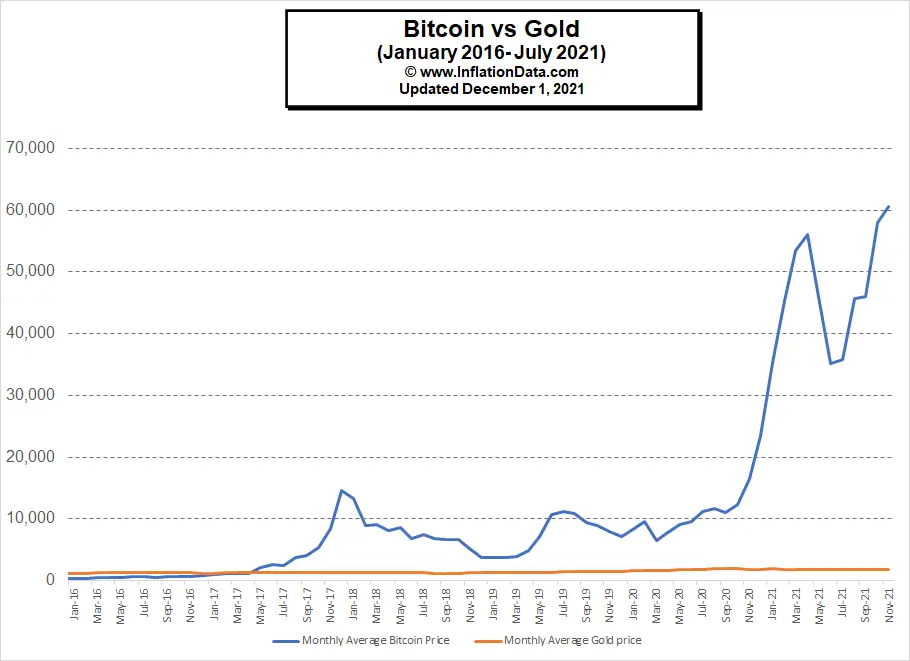
2021: The Rise and Fall and Rise of Bitcoin
Cryptocurrency has the reputation of being a volatile asset. The price of this digital currency is known to fluctuate one way or the other significantly. In fact, all it takes are a few comments from influential figures to cause a buy or sell wall.
An example of this occurred earlier this year. Elon Musk, Tesla head honcho and polarizing multi-billionaire, fired out several Tweets on bitcoin. In May, he declared bitcoin would no longer be accepted as a payment method by Tesla, citing environmental concerns as the reason. This led to the cryptocurrency plummeting approximately 15%. Additional Twitter-based comments from Musk further bludgeoned bitcoin. A month later, he stated that Tesla would again accept bitcoin once miners used “reasonable clean energy usage”, which caused the price to jump 8%.
If one person, no matter how famous or powerful, can significantly alter the bitcoin landscape, this calls into question the cryptocurrency’s viability as an inflation hedge. Skeptics will also point to the sharp drop bitcoin experienced not long ago. At the end of 2017, bitcoin sat around $20,000. A year later, it plummeted to below $4,000 – and it took until December 2020 for it to hit the $20,000 mark again.
It’s volatile. It can crash again. In 2021 alone, it has effectively halved and then doubled in value. Yet while the doubters view bitcoin as “too raw” or “risky” like stocks, even the biggest cynics admit the foundation is there for it to sit alongside gold as an inflationary hedge. Of course, many figures and establishments – including JPMorgan – already believe it has earned that status.
The Similarities to Gold
There’s more than one reason why “digital gold” is compared to its physical counterpart. Both are limited assets. Even though it is seemingly feasible to create more of a digital asset, once bitcoin reaches its maximum creation, no more bitcoins will be released during its lifespan. Gold is also a limited, finite resource, and new gold can only be found by mining, much like bitcoin, unlike fiat money, where the government controls the amount of money printed.
Due to their limited supply, the price of gold and bitcoin changes primarily depending on demand. Demand is based on the number of buyers compared to sellers. If buyers exceed sellers at a given price, it will lead to asset appreciation. If the reverse happens, the price of the asset depreciates.
That depreciation is something that has affected gold assets this year. In November, the gold price was down roughly 4% for the year. During the same period, bitcoin jumped up by almost 133%. Even with the uncertainty of long-term results, it’s easy to see why crypto fans are turning their back on physical assets and buying digital gold.
Advantage Bitcoin
Aside from current trends, there are numerous advantages that bitcoin holds over gold. These include:
Rarity
There is a maximum of only 21 million bitcoins in existence. As of this writing, there are 18,888,568.75 bitcoins in existence, or about 89.9% of the total. That leaves 2,111,431.25 bitcoins yet to be mined.
Currently, 900 new bitcoins are being mined every day. If production continues at that rate, it will only take about 235 more days to mine all of the bitcoins ever to be produced. However, due to the design of the bitcoin mining algorithm, it takes increasingly more energy (and computing power) to mine each additional bitcoin, so the closer it gets to the end, the longer it will take.
Divisibility
Due to their current lofty prices, Bitcoin investors don’t necessarily have whole bitcoins in their portfolios. Fortunately, a single bitcoin can be split into individual satoshis. One bitcoin = 100 million satoshis. Even though it’s possible to mint it into smaller denominations, gold cannot match the ease or precision of bitcoin’s divisibility.
Hard to Fake
There are thousands of cryptocurrencies, with more joining the party each day. However, bitcoin is impossible to copy or counterfeit. It’s also the most famous crypto around, which means it’s easy to recognize. Gold is similar, but certain circumstances call for a purity test to ensure it’s real.
Durability
Gold is known for its durability. Although in its pure form, it’s less known that gold is a notably soft metal. Bitcoins are stored throughout the internet. Due to Bitcoin’s distributed nature assuming the internet is up and running, bitcoins can be used. Although there have been cases of individuals losing their access to their bitcoins through the loss of their digital “wallet”.
Storage
Gold is a physical commodity. It needs to be stored. It typically requires maintenance. It can be stolen. In comparison, bitcoin is purely decentralized. There are no issues with maintenance or storage. Assuming you don’t lose your crypto wallet password or hand it over to a cybercriminal, your bitcoins are also safe.
Will Bitcoin Surpass Gold as an Inflation Hedge?
It’s a cop-out, but there is no definitive answer to the question. At least not at this stage. Gold has been used for thousands of years as a form of currency. Bitcoin, on the other hand, has only existed since 2009. Traditional investors will feel confident in gold remaining as a profitable inflation hedge with history on its side.
This is particularly the case when considering both bitcoin and gold do entirely different jobs. There’s room for both assets to happily coexist. Yet with the growth and potential displayed by bitcoin, and despite the risk and volatility surrounding it, nobody can dispute the potential of this cryptocurrency. If more investors are willing to dip their toes in the digital realm, it can quickly become the inflation hedge of choice.
You might also like:
- Is Bitcoin the Future of Money?
- How Does Bitcoin Mining Work? The Ultimate Guide
- Inflation-Adjusted Price of Gold
- Why Gold is a Good Investment for Inflationary Times
- Blockchain Goes to Ethiopia
- Ripple the Cryptocurrency of Banks
- The Price of Oil Denominated in Bitcoin
- Bitcoin Trends
- Choosing the Right Investment: Gold vs. U.S. Dollar vs. Bitcoin
- Gold vs. Dollar vs. BitCoin Revisited
- How has Venezuela’s Bitcoin experiment Fared?
- Cryptocurrencies and Inflation

Leave a Reply