
What is “Disruption”? According to Dictionary.com:
- forcible separation or division into parts.
- a disrupted condition: After the coup, the country was in disruption.
- Business. a radical change in an industry, business strategy, etc., especially involving the introduction of a new product or service that creates a new market:
2018 is seeing our world change rapidly in so many ways some due to various disruptions. This has caused some people to ask if disruptions cause inflation. This year U.S. inflation as of June is up from 1.63% in 2017 to 2.80% in 2018. Inflation on a global scale is a percent or two higher at 3.15% in 2017, and projected to see out the year 2018 at 3.31%. Bringing up the world-wide average are a few countries with hyperinflation. For instance for the year ending in December 2017 Venezuela had 652.67% inflation, South Sudan had 182.18% inflation and the Democratic Republic of the Congo had 41.67% followed closely by Libya 32.8%, Angola 30.92%, Sudan 26.87% and Egypt 23.54%. Current estimates according to the Miami Herald for Venezuelan inflation for 2018 is around 18,000%. That is a major disruption!
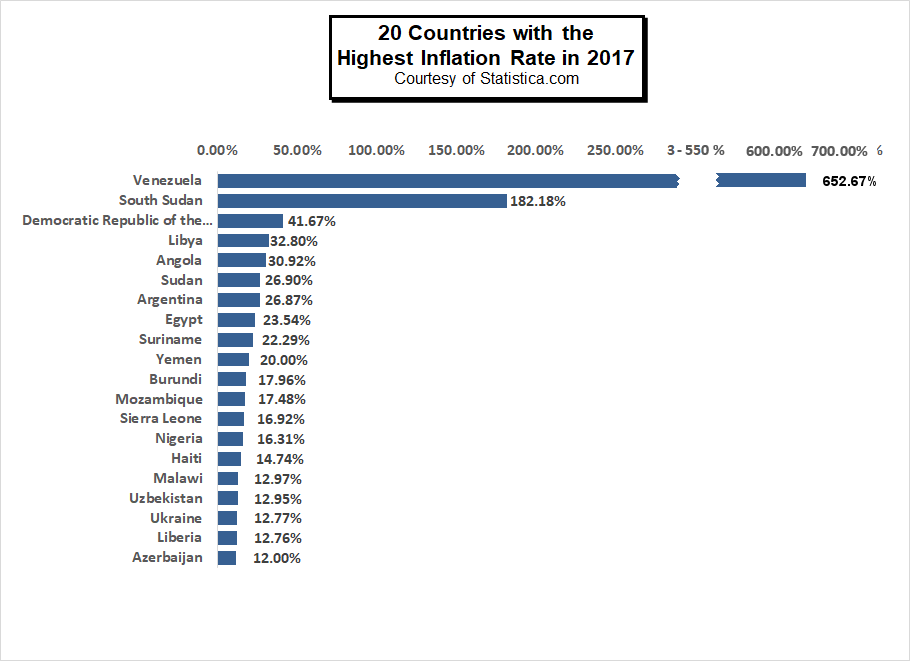
When inflation is taken to extremes as in hyperinflation it is often a sign of some sort of economic or political disruption (definition #2). The entire economy of these 20 countries is experiencing some form of economic disruption resulting in much higher than normal levels of inflation. This might be called “bad” disruption because the effects on the economy are almost always fatal, resulting in a regime change after massive suffering by the populace.
Disruption, Interest Rates and Inflation
When interest rates are low people are incentivised to borrow more money. This can drive new growth and deliver broader benefits to the economy. At first this is not disruptive since it starts gradually and builds slowly. But as time goes on it can become disruptive if the growth occurs too rapidly. And growth combined with loose monetary policies (including ramping up the money supply i.e. monetary inflation) usually results in price inflation. And so in an effort to reduce inflation, Central Banks raise interest rates often while continuing to print more money. This has a similar effect to slamming on the gas with one foot and the brakes with the other. This can cause severe economic disruptions as we saw in the U.S. from 1979 -1981 when the inflation rate was 11.22%, 13.57% and 10.35% respectively, with February – April of 1980 seeing annual inflation over 14%. Even at these levels economic suffering was great and as a result Jimmy Carter became a one-term President and Ronald Reagan was elected.
Disruptive Business Innovation
Business disruption is as they say “a horse of a different color”. In this situation, (definition #3) a business will develop some sort of technology that can change the economic landscape. This can be as large as the industrial revolution or as small as a major breakthrough in a single industry. A fairly recent disruption occurred when Bill Gates ushered in the information age by creating an operating system that was available to the masses and this combined with a massive mistake by IBM when they developed a personal computer from “off-the-shelf” components. These two events had a synergistic effect of creating the “clone” computer market and ushered in the information age. Before long, computing power that was previously only available to large corporations was available to individuals. In addition, based on “Moore’s Law” computing power doubled every 18 months. This had the effect of driving prices down and quashing inflationary pressures. This is generally the result of new technology as it makes companies more efficient, spurs competition and generally raises the standard of living while lowering costs and reducing inflation. This can be considered “good” disruption.
Disruptive technologies often have “ages” named after them, such as the development of Bronze, and Iron resulting in the “Bronze Age” and the “Iron Age” respectively. Other examples of this type of disruption include the development of the “Internet” (“information age”) which drastically improved communication just as the development of the transcontinental railroad, the telegraph and the telephone did. Other disruptive technologies were the development of human flight which “made the world a much smaller place”. Instead of taking weeks or even months people could get to another continent in days and now it takes a few hours. Electricity is another “game changer” as it allowed not only clean light but motors, factories and actually facilitated many of the previously mentioned disruptions. Some disruptions also came with some negative consequences in addition to the benefits, such as the development of gunpowder, dynamite, and nuclear fission.
Today we are seeing major breakthroughs at a much more rapid pace than at any time in history. They are in fields from medicine (mapping the human genome), to battery technology, to solar technology, to the ability to manipulate existing materials on a molecular level, self driving vehicles, robotics, 3d printing, advances in fracking and other energy technologies, along with new financial technologies. Fintech by definition is “financial Technology” which is changing the way that people interact with money in their daily lives. It affects how they pay bills, send money and invest. Not long ago PayPal was one of these technologies. More recently we’ve seen “Upstart” bring borrowers and lenders together and now we’re seeing innovation due to bitcoin technology.
Conclusion
There are various causes of disruption some of which can cause higher inflation or even hyperinflation such as political upheaval but there are other types of disruption (basically disruptive business innovations) that can actually lower inflation and improve people’s lives.
You might also like:
- How International Law Can Affect Your Investments
- Debt and Inflationary Pressures: A Lesson in Economic Interactivity
- The Effects of Inflation and Interest Rates on Commodity Prices
- How Does Inflation Affect the Price of Gold?
- Inflation Risk
- Hyperinflation: 5 Currencies that Self-Destructed
- How Oil Prices Affect Inflation


Leave a Reply