• Home
  • Related Sites
    • Financial Trend Forecaster
      • Moore Inflation Predictor
      • NYSE Rate of Change (ROC)
      • NASDAQ Rate of Change (ROC)
      • Crypto ROC- BTC & ETH
    • Unemployment Data
      • Historical Employment Data
      • Unemployment Rate Chart
      • Labor Force Participation Rate
    • Optio Money
    • Elliott Wave University
    • More Resources
  • Definitions
    • What is Inflation?
    • What is Core Inflation?
    • Inflation vs CPI
    • What is Deflation?
    • What is Disinflation?
    • What is Agflation?
    • What is Stagflation?
    • What is Hyperinflation?
    • What is Quantitative Easing?
    • What is Quantitative Tightening?
    • What is Velocity of Money?
    • What is Fiat Currency?
    • How Do I Calculate Inflation?
    • What are “Sticky Prices” and Why Do They Matter?
  • Featured Content
  • About Us
  • Feedback
    • Sitemap
  • Subscribe Now

InflationData.com

Your Place in Cyber Space for Inflation Data

  • Numerical Inflation Data
    • Current Inflation Rate
    • Monthly Inflation Rate (Moved)
    • Historical U.S. Inflation Rates
    • Historical CPI
  • Inflation Charts
    • Ann. Inf. Rate Chart
    • Long Term Inflation >
      • Ave. Inf. by Decade
      • Total Inf. by Decade
      • Inflation 1913-1919
      • Inflation 1920-1929
      • Inflation 1930-1939
      • Inflation 1940-1949
      • Inflation 1950-1959
      • Inflation 1960-1969
      • Inflation 1970-1979
    • Cumulative Inflation
    • FED Monetary Policy and Inflation
    • Inflation and Recession
    • Confederate Inflation (1861 – 1865)
    • Misery Index
    • The 3 Stages of Inflation
    • 15-Yr Inflation Trends Chart
  • Inflation Calculators
    • Cumulative Inf. Calc.
    • How Much Would it Cost
    • Historical Inflation Calculator since 1774
    • Salary Inf. Calc.
    • U.K. Inf. Calc.
    • Cost of Gas Calc.
    • Net Worth Calc.
    • Lifetime Earnings Calc.
    • Savings Goal Calc.
    • Financial Calculators
  • Inf. Adjusted Prices
    • Energy >
      • Inflation Adj. Gas Prices
      • Historical Oil Prices Chart
      • Crude Oil Price (Table)
      • Natural Gas Prices
      • Electricity Prices
      • Oil vs Gold
    • Gold >
      • Inflation Adjusted Annual Average Gold Prices
      • Gold is a “Crisis Hedge” not an  “Inflation Hedge”
      • Comparing Oil vs. Gold
    • Corn Prices
    • Education Inflation
    • Housing Prices
    • Mortgage Rates
    • NYSE Index
    • Inf. Indexed Bonds
    • Movie Revenues
    • Inflation-Adjusted Wages
  • Cost of Living
    • Calculate Cost of Living
    • Cost-of-living Adj. (COLA)
    • Consumer Price Index CPI
      • Historical CPI
      • Current CPI
      • CPI Release Dates
    • Gas Prices >
      • Cost of Gas
      • Cost of Gas Per Month
      • Gas vs. Oil Price Chart
    • Food Prices 1913 vs 2013
    • Health Insurance
  • Blog
    • Key Inflation Articles
    • International Inflation
    • Historical Inflation Rates for Japan (1971 to 2014)
You are here: Home » Blog » Precious Metals » Inflation is Officially Back

Inflation is Officially Back

Published on February 23, 2017 Updated on March 31, 2021 by Tim McMahon 1 Comment

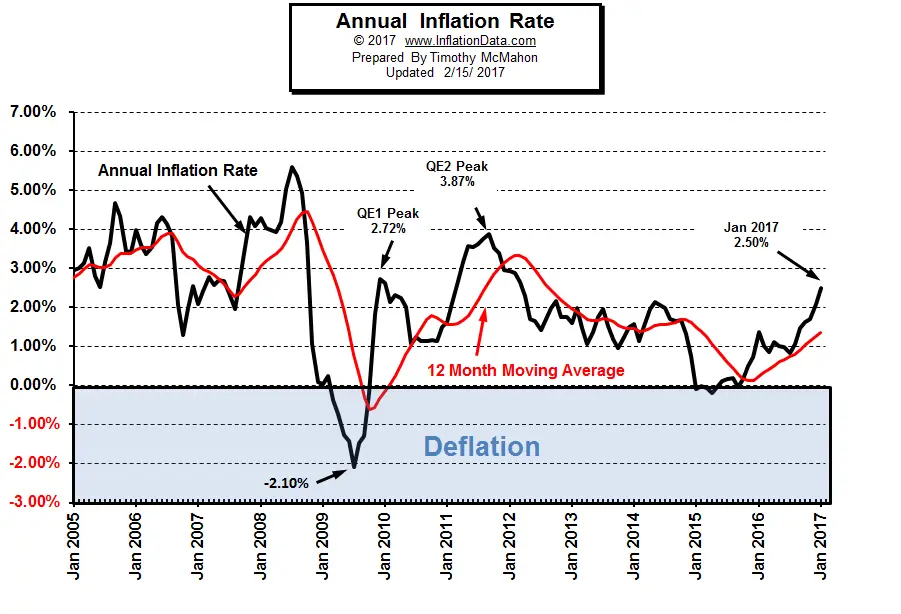
January 2017 saw a 0.6 percent hike in the Consumer Price Index, which pushed the annual inflation rate to 2.5 percent. This is the highest inflation rate in five years. The rate is higher than what many economists had anticipated. After several years of economists worrying that prices might  fall, inflation has officially come back for the first time since the peak created by the massive second round of “Quantitative Easing” i.e. QE2 in 2011.

QE 1 and QE 2

The first round of Quantitative Easing (QE1) resulted in an inflation rate of 2.72% in 2010 but as soon as the monetary spigot was turned off, the inflation rate fell, so the FED instituted QE2 which then resulted in an inflation rate of 3.87% but once again when the spigot was turned off, the inflation rate fell.

What is interesting this time is that the current increase in inflation is not the result of a massive money printing campaign. The Fed has publicly stated that their target inflation rate is 2% and although they have bemoaned the “deflationary pressures” of the last few years, inflation bounced between 1% and 2% from 2012 – late 2014. But then it took another dive toward deflation causing massive “hand wringing” and concern.
Annual InflationConsumer Prices are Rising

But according to the U.S. Bureau of Labor Statistics (BLS), consumer prices have been rising in recent months. Most upper middle class and well-off households may be able to shrug off paying several dollars more for groceries. However, the effect of rising inflation will be felt most by low-income households. Those living paycheck to paycheck may find the coming months to be particularly difficult if inflation is not contained.

However, some working households are already experiencing rising wages due to increased competition for jobs as the unemployment rate has fallen. That seems to be offsetting some of the burden of rising consumer prices, at least for now. Retail businesses may be struggling, but retail sales were up this January by a significant 0.4 percent. Shopping was largely driven by the bargain sales of the post-holiday season.

Many industries are seeing price jumps, including apparel and transportation.  Regardless, consumer confidence began rising immediately after the results of the election were announced despite all the anti-Trump riots.

Is Another Recession Around the Corner?

Inflation usually leads to an ominous outcome: recession. This time, however, economists assuaged fears that another recession might be possible anytime soon. Though current inflation rate is higher than it has been recently, it’s not as high as what was seen leading to the 2008 recession. The rising prices are very likely manageable.  Typically rates above 5% become troublesome to the economy and the Fed is hinting at a rate hike intended to curb inflation should it continue rising.


Protecting Investments against Inflation and the Aftermath

Inflation drives up overall costs and reduces profits for businesses in the long term. Certain investments, like bonds, suffer most when inflation is high and the FED raises interest rates which results in falling bond prices. More worryingly, inflation can lead to bubbles that eventually burst leaving investors with worthless paper. So, the conventional advice for inflationary times is to invest in gold.

Precious metals like gold are inversely proportional to the dollar exchange rate. This means that as other currencies appreciate against the dollar, gold will increase in Dollar terms since the gold market is world-wide and currency independent. So gold can protect against currency fluctuations.  More importantly, diversifying an investment portfolio with gold will hedge overall wealth against potential economic crises. Many advisers recommend to buy gold in coins, bars or bullion to protect against economic uncertainty, inflation, and currency fluctuations. The typical recommendation is that you hold from 5% to 10% of your portfolio’s value in gold. Due to gold’s inverse relationship with paper investments, this has the effect of reducing the overall volatility of your portfolio.


About Tim McMahon

  • Web
  • |
  • Twitter
  • |
  • Facebook
  • |
  • LinkedIn
  • |
  • More Posts(419)

Filed Under: Precious Metals Tagged With: gold, inflation

Comments

  1. Spencer says

    March 12, 2017 at 11:38 am

    Inflation rose as money flows increased. The overall level of prices in 2017 will be much higher than in 2016. Then they will fall going into 2018.

    Reply

Leave a Reply Cancel reply

Your email address will not be published. Required fields are marked *

This site uses Akismet to reduce spam. Learn how your comment data is processed.

Recent Posts

  • May Inflation Up to 4.25%
  • May 2026: BLS April Inflation
  • How will FED Chairman Warsh affect Rates and Inflation?
  • Ben Cowan: Is the Fed Heading Toward Checkmate?
  • The Truth About Truflation vs. the BLS’s CPI

Subscribe Now

eTrends Signup Form

A Message from Our Editor

Eliminate Debt

Post Archives

Sponsored:

As a Seasoned Investor I thought I'd seen everything... But recently I discovered TradingView which has really improved the information I have at my fingertips.~ Tim McMahon, editor

TradingView gives me an edge... including powerful charting tools, real-time market data, and a global community of traders—all in one easy to use platform. It has hundreds of indicators, and even custom scripts for more advanced users, and you don't need to change Brokers just use its seamless brokerage integration... TradingView isn't just a charting tool—it's your full trading command center.

Trade smarter. Trade faster. Check Out TradingView for free.

----------

The Best Place to Buy Your Crypto

Coinbase is the largest Crypto Trading platform in the U.S. and the easiest to use. ~Tim McMahon, editor

Check out Coinbase here

Home | Articles | Sitemap | Terms of Service | Privacy | Disclaimer | Advertise With Us

Copyright © 1996-2026 · Capital Professional Services, LLC · Maintained by Design Synergy Studio · Admin

Do Not Sell My Personal Information