• Home
  • Related Sites
    • Financial Trend Forecaster
      • Moore Inflation Predictor
      • NYSE Rate of Change (ROC)
      • NASDAQ Rate of Change (ROC)
      • Crypto ROC- BTC & ETH
    • Unemployment Data
      • Historical Employment Data
      • Unemployment Rate Chart
      • Labor Force Participation Rate
    • Optio Money
    • Elliott Wave University
    • More Resources
  • Definitions
    • What is Inflation?
    • What is Core Inflation?
    • Inflation vs CPI
    • What is Deflation?
    • What is Disinflation?
    • What is Agflation?
    • What is Stagflation?
    • What is Hyperinflation?
    • What is Quantitative Easing?
    • What is Quantitative Tightening?
    • What is Velocity of Money?
    • What is Fiat Currency?
    • How Do I Calculate Inflation?
    • What are “Sticky Prices” and Why Do They Matter?
  • Featured Content
  • About Us
  • Feedback
    • Sitemap
  • Subscribe Now

InflationData.com

Your Place in Cyber Space for Inflation Data

CPIWidget-Jan26
  • Numerical Inflation Data
    • Current Inflation Rate
    • Monthly Inflation Rate (Moved)
    • Historical U.S. Inflation Rates
    • Historical CPI
  • Inflation Charts
    • Ann. Inf. Rate Chart
    • Long Term Inflation >
      • Ave. Inf. by Decade
      • Total Inf. by Decade
      • Inflation 1913-1919
      • Inflation 1920-1929
      • Inflation 1930-1939
      • Inflation 1940-1949
      • Inflation 1950-1959
      • Inflation 1960-1969
      • Inflation 1970-1979
    • Cumulative Inflation
    • FED Monetary Policy and Inflation
    • Inflation and Recession
    • Confederate Inflation (1861 – 1865)
    • Misery Index
    • The 3 Stages of Inflation
    • 15-Yr Inflation Trends Chart
  • Inflation Calculators
    • Cumulative Inf. Calc.
    • How Much Would it Cost
    • Salary Inf. Calc.
    • Cost of Living Calc.
    • U.K. Inf. Calc.
    • Cost of Gas Calc.
    • Net Worth Calc.
    • Lifetime Earnings Calc.
    • Savings Goal Calc.
    • Financial Calculators
  • Inf. Adjusted Prices
    • Energy >
      • Inflation Adj. Gas Prices
      • Historical Oil Prices Chart
      • Crude Oil Price (Table)
      • Natural Gas Prices
      • Electricity Prices
      • Oil vs Gold
    • Gold >
      • Inflation Adjusted Annual Average Gold Prices
      • Gold is a “Crisis Hedge” not an  “Inflation Hedge”
      • Comparing Oil vs. Gold
    • Corn Prices
    • Education Inflation
    • Housing Prices
    • Mortgage Rates
    • NYSE Index
    • Inf. Indexed Bonds
    • Movie Revenues
    • Inflation-Adjusted Wages
  • Cost of Living
    • Calculate Cost of Living
    • Cost-of-living Adj. (COLA)
    • Consumer Price Index CPI
      • Historical CPI
      • Current CPI
      • CPI Release Dates
    • Gas Prices >
      • Cost of Gas
      • Cost of Gas Per Month
      • Gas vs. Oil Price Chart
    • Food Prices 1913 vs 2013
    • Health Insurance
  • Blog
    • Key Inflation Articles
    • International Inflation
    • Historical Inflation Rates for Japan (1971 to 2014)
You are here: Home » Blog » Government » Tax Revenues Tanking » Page 2

Tax Revenues Tanking

Published on May 18, 2009 Updated on September 20, 2017 by Casey Research Leave a Comment

Case in point, in January the government projected a $1.2 trillion deficit for fiscal year 2009… in March, just three months later, they upped the projection to $1.8 trillion. That $600 billion “adjustment” alone totaled more than any full-year budget deficit in the nation’s history.
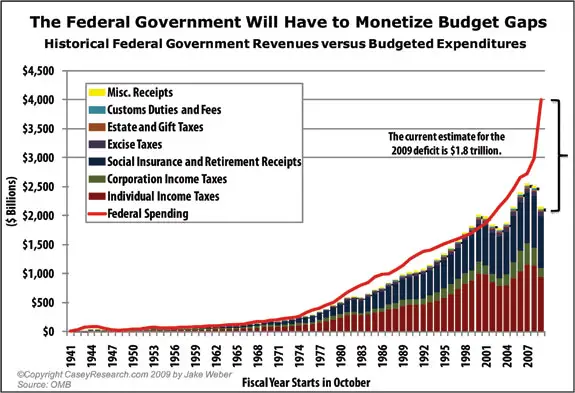
The Federal Government Will Have to Monetize Budget Gaps

Yet, the real fly in the ointment is that the actual borrowing by the Treasury is likely to be at least half a trillion dollars more than the deficit.

That’s because the Treasury is buying toxic paper (mortgage, credit card loans, etc.) and putting them on the books with a higher value than the market is willing to assign. While that makes the budget deficit appear smaller, it doesn’t negate the fact that the government still must borrow the money needed to buy the toxic paper in the first place. The additional revenue shortfall means they have to raise that much more money. Based on the struggle they had pushing the $14 billion in long-term notes at the latest auction, it becomes increasingly apparent that when push comes to shove, the only way the government is going to come up with the money needed to meet its aggressive spending is to print it up.

In other words, events are rolling out almost exactly as we have been anticipating. Below, for example, are some useful excerpts from an April 3 article titled “Widening Deficits” by Casey Research CEO Olivier Garret. To quote…

In the midst of the Great Depression, the 1931 federal tax revenues had fallen by 52% from their 1929 highs. While we do not expect anything that dramatic in 2009, it would not be unrealistic to see a 20% to 25% reduction in cash flow from tax collections this tax season. Such a drop would pose significant challenges given that spending commitments are off the charts and climbing.

Later in that same article, Olivier continued,

In the absence of sizeable increases in tax revenues, it is quite clear that the lion’s share of the planned sales of Treasuries in 2009 cannot be met by demand from the market. Either the Treasury will have to raise interest rates significantly, or the Fed will need to step in very aggressively to support the planned auctions. Our expectation is that both will happen. Auctions will fail and the Fed will step in. The market will react to more printing by anticipating inflation and demanding higher interest rates. Once the cycle starts, it will be very hard to pull interest rates back.

We continue to stand by our December forecast that the 2009 budget deficit is more likely to widen to levels between $2.5 and $3 trillion rather than the CBO’s $1.8 trillion forecast. We also believe that inflation could start setting in as early as Q3 of 2009 and will accelerate sharply by 2010. Treasury Rates will start climbing and the era of cheap money will end, making it harder for overleveraged consumers, businesses, and governments to service their debt.

Olivier’s forecast of failed auctions and rising interest rates on Treasuries proved more prophetic as a May 7th story from Bloomberg reported:

Treasury 30-year bonds fell the most in four months as investors demanded higher-than-forecasted yields at today’s auction of $14 billion of the securities with the U.S. slated to sell a record amount of debt this year.

“This is a problem,” said Chris Ahrens, head interest-rate strategist at UBS AG in Stamford, Connecticut, one of 16 primary dealers required to bid in Treasury auctions. “The market required a fairly significant discount to buy the bonds.”

Thirty-year bonds have lost investors 20.9 percent this year, Merrill Lynch & Co. indexes show, as the Treasury increases securities sales to help fund a swelling budget deficit. Yields climbed to a six-month high today as the auction drew a yield of 4.288 percent, higher than the 4.192 percent average forecast in a Bloomberg News survey of seven primary dealers. Demand was below average, judging by total bids.

The benchmark 30-year bond yield climbed 23 basis points, or 0.23 percentage points, the most since Jan. 5, to 4.316 percent, at 5:25 p.m. in New York, according to BGCantor Market data. It was the highest yield since Nov. 14. The 3.5 percent security due in February 2039 dropped 3 15/32, or $34.69 per $1,000 face amount, to 86 3/8.

The 10-year note yield increased 16 basis points to 3.345 percent, the highest since Nov. 24.

Two-year notes yielded 1 percent for the first time since March 18, while the rate on the three-month Treasury bill was 0.18 percent.

So, what does all this mean?

The rock-and-the-hard-place scenario we have been predicting is unfolding before our eyes. At this point, other than sharply changing course and letting the free market cope with the crisis through a brutal “survival of the fittest” scenario, the government is left with no other option than to accelerate its buying up of its own debt.

Which is to say, it must push even harder on the levers of its printing presses, further setting the stage for the massive period of inflation we continue to see as inevitable… and for the stunning rise in interest rates we are now positioning ourselves for in The Casey Report .

 

Pages: 1 2

Filed Under: Government Tagged With: taxes, US government

Leave a Reply Cancel reply

Your email address will not be published. Required fields are marked *

This site uses Akismet to reduce spam. Learn how your comment data is processed.

Latest Posts

  • Updated Cumulative Inflation Calculator
  • Inflation-Adjusted Silver Prices
  • December Inflation Down Slightly, Not Flat
  • December 2025 Inflation Report for November
  • How Deflation Created the Middle Class
  • October Inflation Numbers Delayed
  • Why the 2.8% COLA May Fall Short of Real Inflation
  • Delayed BLS September Inflation Data Released

Sponsored:

As a Seasoned Investor I thought I'd seen everything... But recently I discovered TradingView which has really improved the information I have at my fingertips.~ Tim McMahon, editor

TradingView gives me an edge... including powerful charting tools, real-time market data, and a global community of traders—all in one easy to use platform. It has hundreds of indicators, and even custom scripts for more advanced users, and you don't need to change Brokers just use its seamless brokerage integration... TradingView isn't just a charting tool—it's your full trading command center.

Trade smarter. Trade faster. Check Out TradingView for free.

----------

The Best Place to Buy Your Crypto

Coinbase is the largest Crypto Trading platform in the U.S. and the easiest to use. ~Tim McMahon, editor

Check out Coinbase here

Subscribe Now

eTrends Signup Form

Elliott Wave Resources

Free Elliott Wave Resources

What is Waveopedia?

Waveopedia is EWI’s free, comprehensive index of Elliott wave patterns and terms. Everyone from beginners to experts can benefit from it. It’s a great place to send your followers if they’re new to Elliott waves.

  • Deflation Hits China is the U.S. Next?

  • Why You Must Avoid the Herding Trap

  • Chasing Trends Can Cost You

  • More Education Resources

Post Archives

Home | Articles | Sitemap | Terms of Service | Privacy | Disclaimer | Advertise With Us

Copyright © 1996-2026 · Capital Professional Services, LLC · Maintained by Design Synergy Studio · Admin

Do Not Sell My Personal Information