Inflation Warning!!! How do you protect yourself now?
In a recent article, I discussed how Gold was not strictly an inflation hedge but more a crisis hedge against worry of all sorts. See How has Gold fared as an Inflation hedge?
In another article, How the Iraq War will affect the U.S. economy, I discussed how a wartime economy almost guarantees future inflation.
So naturally several readers wrote to ask,
“What is the best way to protect against inflation?”
That is a very good question. First we will look back at Gold for a moment since it has been the traditional inflation hedge in many people’s minds. Recent events are the perfect case in point regarding Gold.
On July 3rd 2006 … NY Gold opened at about $613 an ounce. Eleven Days later Gold closed at $666.30 an ounce… an 8.7% increase.
Did we have 8.7% inflation in those 11 days? Of course not! Obviously something else was driving the price of Gold. What happened during those 11 days?
What happened was the Middle-East erupted into armed conflict between Lebanon and Israel. As a result the markets feared that Iran and/or Syria might get involved. This could cause major disruption in the supply of oil.
This is a perfect example of how uncertainty can drive the price of Gold up and in the same way boring stable world events will drive the price of Gold down.
Gold is a high profile metal that acts almost as a Government Report card showing how well a Government is doing managing the economy and risks of its citizens.
This high profile turns out to be a disadvantage for Gold. No one likes a “bad” report card least of all Governments. So rather than clean up their act, they will go to great lengths to eliminate the report card itself. (See Goodbye M3- What is the Government hiding?)
Because of that, Governments have been known to target the price of Gold… selling it when they wanted to create an illusion of stability and buying it when holding it for their own reasons seemed appropriate.
The gold market is extremely thin (low volume) compared to most financial markets today. So it is easily targeted by governments to lend an air of stability to the financial markets.
The last rise in the price of Gold which culminated in 1980 was set off by the U.S. legalizing individual ownership of Gold in the early 70’s and the fires were stoked with inflation and worldwide financial uncertainty.
For many years since, Governments have been trying to “kill” gold as an investment and many actually believed Gold was dead (and for many years it almost was).
But sooner or later something will ignite it once again. This time it has been the opening of China to purchase Gold. Did you know that up until about three years ago it was illegal to invest in gold in China?
So when they opened China up to buy Gold there was extreme pent up demand (just as there was in the ’70s in the U.S.). This combined with a major increase in the prosperity of its citizens has put pressure on the worldwide price of Gold.
As a matter of fact, according to Larry Edelson, Editor of Real Wealth Report,
“In its three short years of existence, it [the Shanghai Gold Exchange] has become the world’s largest trading exchange for gold bullion, with its volume of trading surging well ahead of London, New York, and Hong Kong.
Imagine an exchange growing from nothing to more than the size of the NY Gold exchange in three short years! That is a lot of demand! And it is all new demand not just “recycled” from another exchange. This massive increase in demand for Gold has made it more and more difficult for Governments around the world to hold the price down.
The next nail that China has removed from Gold’s coffin was that the Chinese Government has broken ranks with the other Governments around the world. Now rather than trying to keep the price of Gold down, it has started accumulating Gold. In the ’70s the U.S. Government sold Gold at the new higher price to raise money for the Treasury (and keep the price of Gold down). This time around the Chinese Government is a net buyer not a net seller! What will that do to the price of Gold.
So in addition to the purchases of the Chinese citizens now the Chinese Government has announced that it will be net buyers of Gold. This has added even more upward pressure to the price of Gold.
The final nail will be removed from Gold’s coffin shortly as China issues a gold Exchange Traded Fund (ETF) specifically for Chinese citizens. This will allow ordinary Chinese citizens to be able to invest extremely small amounts of cash in the fund and buy units representing as little as 50 grams of gold.
So although Gold is not directly correlated with inflation it looks like this time around it will once again be traveling in the same direction as inflation.
Therefore, it looks to me as we enter this inflationary cycle for the next ten years Gold will be a good vehicle to ride to protect against the ravages of inflation.
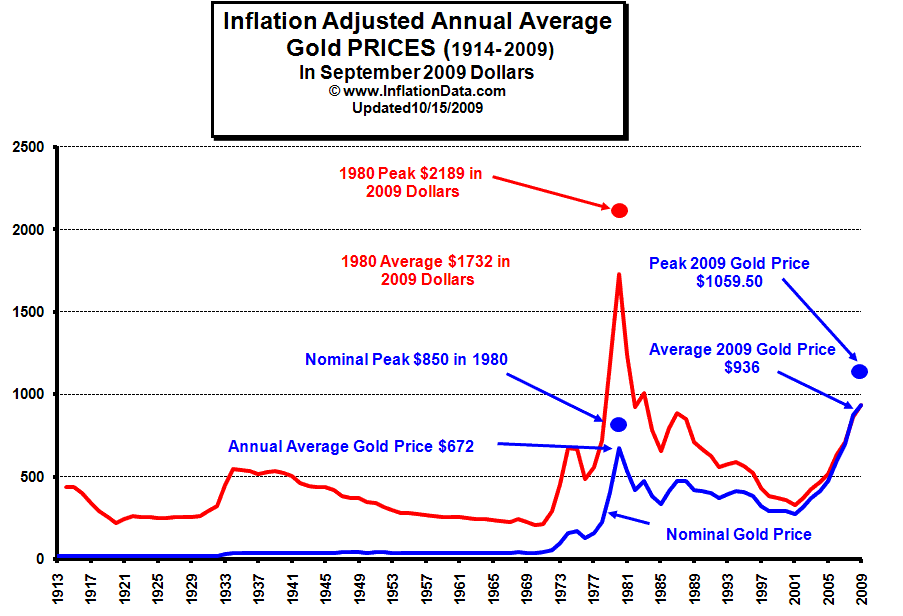 Remember just to reach the inflation adjusted price Gold reached at it’s peak in 1980 Gold will have to rise to over $2000. an ounce. And with the Chinese Government buying rather than selling it is quite possible that it will do even better than that. Some estimates are $2500-$3000. If Gold reaches $2520 that would be a 300% increase from the current $630 price. Taken over 10 years that would be an average of 30% per year. Not bad! But what if Gold only reaches its previous high (inflation adjusted) of $2000? That would still be a 217% increase or a 21.7% annual return.
But is it the only (or the best) hedge against inflation?
What other possible inflation hedges are there. How about inflation indexed bonds?
I-Bonds
Bonds as we know are paper financial instruments. And traditionally paper investments do poorly in times of high inflation. Bonds are especially bad because you invest high value dollars and get paid back in “cheaper” dollars that are worth less (worthless?).
To counteract this problem Governments have developed inflation indexed bonds. The basic premise is that the bonds will pay you a basic interest rate and then on top of that they will use an inflation adjuster to adjust your payment for the ravages of inflation.
Unfortunately, I-Bonds are adjusted according to the official inflation rate (which may or may not be the actual inflation rate) and can occasionally get caught in the fluctuations of the inflation rate. (See Why are my “I-Bonds” paying so little?) Also they are still only as good as the issuer behind them, when all is said and done they are still someone else’s debt. Physical commodities do not have that problem. But they do have other issues like storage and security and liquidity.
One of the major advantages of I-bonds is their liquidity. One phone call to your broker and you can have your cash. Whether they actually keep up with inflation or not is debatable. I would only rely on Inflation Indexed bonds for the portion of your portfolio that either must produce income or must be liquid.
Commodities
By definition Price Inflation is the increase in the costs of various commodities. (Although it is caused by an increase in the money supply (monetary inflation). See What is Inflation?) So by investing in various commodities you should be able to break even at least as they increase with the rate of inflation.
One commodity that generally performs well during times of inflation is Oil. It is needed by everyone no matter how bad the economy and it generally is a primary component of the increase in the consumer price index. So rather than being on the losing end as gasoline and heating oil costs rise… why not be on the gaining end as these stocks generate higher and higher revenues?
China has a huge trade surplus and is using it to modernize a woefully backward country. It needs absolutely everything and it is willing (and able) to pay whatever it takes to get it.
Once again it pays to follow the Chinese, as their demand for oil increases so does the price. Other commodities that China is developing insatiable demand for are also good candidates for “Inflation Protection” status. China wants to upgrade it’s infrastructure especially electricity and roads.
This will require vast quantities of Copper, Uranium, and Cement. China is in the process of locking up supplies on each of these. So the price has no where to go but up. Long term, companies producing these and other commodities will do well in this inflationary environment.


Leave a Reply