
There is a big difference between “Trading” and “Investing”. Investors research companies and then based on the fundamentals of the company they buy stocks for the longer term and expect the growth prospects of the company and the industry and the overall economy to take care of the growth of their portfolio. “Active trading” on the other hand is much more like a full time job. It requires watching your investments much closer and buying and selling more often. Thus the commissions you pay are much higher and so finding a broker with low fees is also critical.
Position Trading (Long Term)
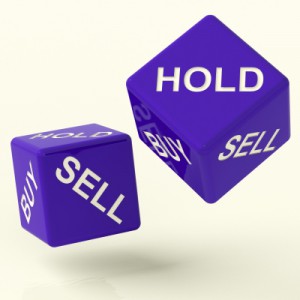 According to Investopedia “Many position traders will take a look at weekly or monthly charts to get a sense of where the asset is in a given trend. Position trading is the polar opposite of day trading because the goal is to profit from the move in the primary trend rather than the short-term fluctuations that occur day to day.”
You can take long positions and profit from increases in the market or take advantage of market corrections through short positions.
There are three basic strategies that active traders take and a primary difference is the length of time each one holds a position:
Day Trading (1 Day)
Day trading is probably one of the more popular forms of trading. It’s considered a pseudonym for active trading, as such. Day trading is the method of trading where you buy and sell securities within the same day. Positions are closed out with the same day and nothing is held overnight – hence the name.
Traditionally, this type of trading was done by professionals. However, newer electronic platforms make this type of trading practical for the non-professional investor.
For day trading to be effective, you need both an entry strategy and an exit strategy. Day traders use a variety of different systems to make predictions. But the overriding key is volatility and liquidity. Volatility means that the expected daily price range is quite large on a percentage basis. More volatility means greater potential profit or loss. Liquidity ensures that your order is filled quickly so you can exit the stock when you choose, at a good price, with a small spread between the bid and ask prices.
Some day traders find that trading indexes or ETFs provide even more liquidity and eliminate the risk of a “Black Swan” event happening to an individual company.
Swing Trading (Several Days)
Swing traders tend to hold a position for several days before selling. In this sense, they’re sort of like very short term fundamental traders. However, swing traders generally set trading rules based on technical analysis (i.e. chart patterns, etc) rather than fundamental analysis because rarely will the fundamentals of a stock effect a change in such a short period of time. While swing trading does involve using an algorithm, it doesn’t have to be an exact science to predict the peak or valley of a price move, it generally looks to follow an established short term trend.
Swing trading takes advantage of volatility that often occurs after a long-standing trend has been broken and a new trend is starting to develop. The best candidates for swing trades are actually the large-cap stocks – they’re some of the most actively traded stocks on major exchanges and they’re very liquid.
What swing traders hope for is a price more in one direction or another. Stocks that move sideways, are a risk for swing traders.
Scalping (Intra-day)
Scalping is a short-term trading strategy designed to make quick profits from the market. It’s one of the fastest strategies employed by active traders. This method involves exploiting various price gaps caused by bid/ask spreads and order flows. Traders try to get in and out of stocks quickly, taking advantage of non-volatile stocks and low volumes. Scalpers don’t want to exploit large moves in the market. Instead, they want to keep trading the same bid/ask spread for as long as it is profitable.
There are 3 Types of Scalping
The first type of scalping is called “market making,” whereby a scalper tries to capitalize on the spread by simultaneously posting a bid and an offer for a specific stock. This works for stocks with low liquidity and large spreads but is difficult to do because you must compete with exchange sanctioned market makers who have virtually no commission costs.
The second type of scalping is generally done by large institutions who purchase a large number of shares which they then sell for a small per share gain. This approach requires a large amount of capital and highly liquid stock to allow for entering and exiting large numbers of shares easily.
The third type of scalping is similar to traditional trading. A trader projects the direction the stock will move and then buys and sells based on very small price movements picking up small incremental profits along the way. Where scalpers make money is on repeated trades throughout the day. Because of the volume of trades, it’s a good idea to use sites like BrokerStance to find brokers with the lowest commissions, since those add up quickly.
Warning:
All forms of active trading are high risk activities. You are playing against professionals. You need a well tested system and should have considerable experience with “play money” before risking any real money.
You may also enjoy:
- How to Identify Turning Points in Your Charts Using Fibonacci
- How to Find Trading Opportunities in ANY Market
- Spot High-Confidence Trading Opportunities Using Moving Averages
- Risk Management In Trending Markets
 |
 |
 |
 |
| A Beginner’s Guide to Day Trading Online | How To Day Trade Stocks For Profit | Day Trading For Dummies | Trading for a Living: Psychology, Trading Tactics, Money Management |
Jarryd Harden has a passion for finance. He enjoys blogging about all things money management and smart investing.
Image courtesy of Stuart Miles / FreeDigitalPhotos.net

Leave a Reply