• Home
  • Related Sites
    • Financial Trend Forecaster
      • Moore Inflation Predictor
      • NYSE Rate of Change (ROC)
      • NASDAQ Rate of Change (ROC)
      • Crypto ROC- BTC & ETH
    • Unemployment Data
      • Historical Employment Data
      • Unemployment Rate Chart
      • Labor Force Participation Rate
    • Optio Money
    • Elliott Wave University
    • More Resources
  • Definitions
    • What is Inflation?
    • What is Core Inflation?
    • Inflation vs CPI
    • What is Deflation?
    • What is Disinflation?
    • What is Agflation?
    • What is Stagflation?
    • What is Hyperinflation?
    • What is Quantitative Easing?
    • What is Quantitative Tightening?
    • What is Velocity of Money?
    • What is Fiat Currency?
    • How Do I Calculate Inflation?
    • What are “Sticky Prices” and Why Do They Matter?
  • Featured Content
  • About Us
  • Feedback
    • Sitemap
  • Subscribe Now

InflationData.com

Your Place in Cyber Space for Inflation Data

CPIWidget-July26
  • Numerical Inflation Data
    • Current Inflation Rate
    • Monthly Inflation Rate (Moved)
    • Historical U.S. Inflation Rates
    • Historical CPI
  • Inflation Charts
    • Ann. Inf. Rate Chart
    • Long Term Inflation >
      • Ave. Inf. by Decade
      • Total Inf. by Decade
      • Inflation 1913-1919
      • Inflation 1920-1929
      • Inflation 1930-1939
      • Inflation 1940-1949
      • Inflation 1950-1959
      • Inflation 1960-1969
      • Inflation 1970-1979
    • Cumulative Inflation
    • FED Monetary Policy and Inflation
    • Inflation and Recession
    • Confederate Inflation (1861 – 1865)
    • Misery Index
    • The 3 Stages of Inflation
    • 15-Yr Inflation Trends Chart
  • Inflation Calculators
    • Cumulative Inf. Calc.
    • How Much Would it Cost
    • Historical Inflation Calculator since 1774
    • Salary Inf. Calc.
    • U.K. Inf. Calc.
    • Cost of Gas Calc.
    • Net Worth Calc.
    • Lifetime Earnings Calc.
    • Savings Goal Calc.
    • Financial Calculators
  • Inf. Adjusted Prices
    • Energy >
      • Inflation Adj. Gas Prices
      • Historical Oil Prices Chart
      • Crude Oil Price (Table)
      • Natural Gas Prices
      • Electricity Prices
      • Oil vs Gold
    • Gold >
      • Inflation Adjusted Annual Average Gold Prices
      • Gold is a “Crisis Hedge” not an  “Inflation Hedge”
      • Comparing Oil vs. Gold
    • Corn Prices
    • Education Inflation
    • Housing Prices
    • Mortgage Rates
    • NYSE Index
    • Inf. Indexed Bonds
    • Movie Revenues
    • Inflation-Adjusted Wages
  • Cost of Living
    • Calculate Cost of Living
    • Cost-of-living Adj. (COLA)
    • Consumer Price Index CPI
      • Historical CPI
      • Current CPI
      • CPI Release Dates
    • Gas Prices >
      • Cost of Gas
      • Cost of Gas Per Month
      • Gas vs. Oil Price Chart
    • Food Prices 1913 vs 2013
    • Health Insurance
  • Blog
    • Key Inflation Articles
    • International Inflation
    • Historical Inflation Rates for Japan (1971 to 2014)
You are here: Home » Blog » Economy » What if They Stop Buying Our Debt?

What if They Stop Buying Our Debt?

Published on June 25, 2009 Updated on September 20, 2017 by Casey Research Leave a Comment

By Doug Hornig, Senior Editor, Casey Research

“I have always depended on the kindness of strangers,” said Blanche DuBois, in the final words of the play “A Streetcar Named Desire.” Well, don’t we all.

Many citizens probably still cling to the old saw that public debt doesn’t matter because “we owe it to ourselves.” Wrong. Debt always matters. And as for whom we owe it to, it is a lot of kind (or, at least, not yet unkind) strangers.

As recently as 1970, foreign holders of U.S. debt were essentially non-existent. But their slice of our obligation pie has steadily increased, especially over the past two decades, until now foreign governments and international investors hold about 35% of Treasuries, as the following chart reveals. 
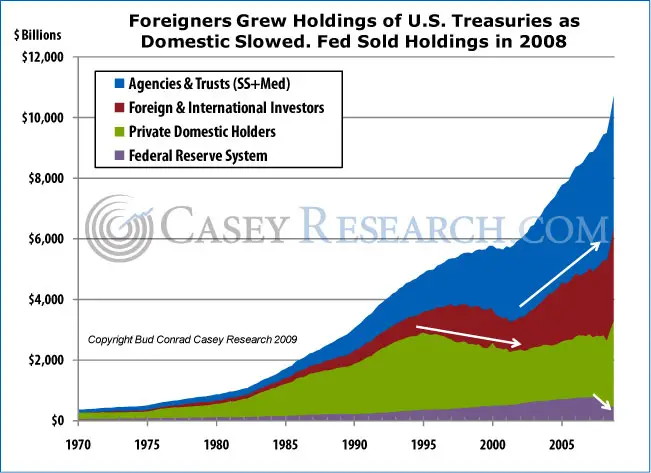
Foreigners Grew Holdings of US Treasuries as Domestic Slowed. Fed Sold Holdings in 2008

click for larger image

Of about $11 trillion in U.S. debt, foreigners have about $3.8 trillion, with China in the lead at nearly $1 trillion and Japan not far behind at around $750 billion.

Most likely, though, this trend has already leveled off. The Chinese, Japanese, Russians, and Indians have openly announced their decision to cut back on further purchases and existing holdings of U.S. government debt. Beyond that, the source of funds previously allocated to their purchases — trade surpluses — has declined sharply with the recession. As a consequence, going forward, foreign buying is more apt to shrink than increase.

While foreigners are continuing to show up for the record-sized Treasury auctions, it’s due to the dollar retaining its status (albeit shakily) as the world’s reserve currency. But they have become quite cautious, generally investing towards the front end of the yield curve, which is a vote of no confidence in the buck’s future. As the chart below illustrates, sales of long-term bonds to foreigners are way down.
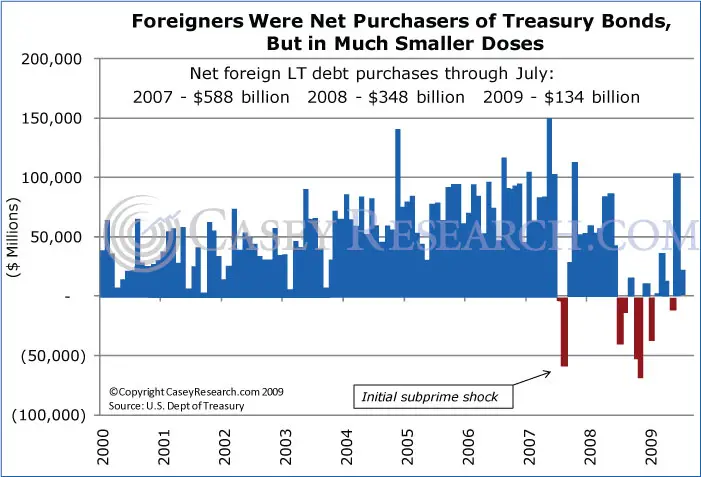
Foreigners were Net Purchasers of Treasury Bonds, but in smaller doses

Click for larger image

So what does all this mean?


It means that a big chunk of our prosperity during the past twenty years was due to a trade deficit that put billions of dollars into the hands of foreigners, who then turned around and bought Treasuries with them, helping the U.S. government finance its massive deficit spending. That’s over — and the unwinding process has just begun.


Yet federal deficit spending, far from reflecting this reality, has grown by leaps and bounds. But who will finance it? Let’s extend our first chart out a few years.
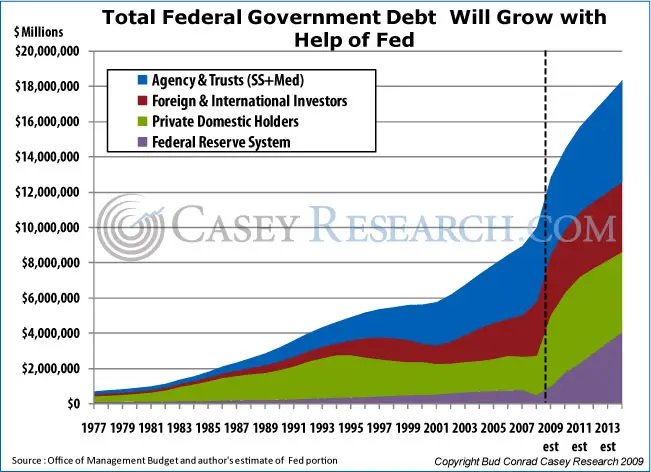
Total Federal Government Debt will grow with Help of FED

click for larger image

As you can see, we project that foreign participation has plateaued. U.S. private domestic investors can probably increase their holdings moderately, now that households are consuming less and saving more, and financial institutions have money to invest in Treasury paper. The agencies and trusts (like Social Security) are really not a part of the equation, but rather reflect programs on “auto-pilot” and quickly headed to the point where they will negatively impact, not help, the deficits.

Adding it all together, even under the most conservative of assumptions, there are simply not enough buyers to cover the accelerating federal deficits. That leaves the lender of last resort, the Federal Reserve, as the only remaining candidate to satisfy the government’s grotesque appetite for funding. There is no viable alternative.

The Fed will take up the slack in the only way open to it, by printing money out of thin air and exchanging it for promises from the Treasury. That means an escalation of monetary inflation and, somewhere down the road, serious price inflation as well. We don’t know exactly when that will happen, only that it must.

The editors of The Casey Report have been alerting subscribers to this very possible scenario for quite some time. If foreigners stop buying U.S. government debt, the whole house of cards will come crashing down. But if you would like to find out what you can do to protect yourself financially click here.

Has this article been helpful? We appreciate your feedback leave a comment below.

Filed Under: Economy Tagged With: foreign investors, U.S. debt

Leave a Reply Cancel reply

Your email address will not be published. Required fields are marked *

This site uses Akismet to reduce spam. Learn how your comment data is processed.

Recent Posts

  • June Inflation Down Sharply
  • How Explosive Growth in AI Triggers Inflation
  • Warsh’s First FOMC: No Dot, No Guidance, and No Dovish Pivot
  • May Inflation Up to 4.25%
  • May 2026: BLS April Inflation

Subscribe Now

eTrends Signup Form

A Message from Our Editor

Eliminate Debt

Post Archives

Sponsored:

As a Seasoned Investor I thought I'd seen everything... But recently I discovered TradingView which has really improved the information I have at my fingertips.~ Tim McMahon, editor

TradingView gives me an edge... including powerful charting tools, real-time market data, and a global community of traders—all in one easy to use platform. It has hundreds of indicators, and even custom scripts for more advanced users, and you don't need to change Brokers just use its seamless brokerage integration... TradingView isn't just a charting tool—it's your full trading command center.

Trade smarter. Trade faster. Check Out TradingView for free.

----------

The Best Place to Buy Your Crypto

Coinbase is the largest Crypto Trading platform in the U.S. and the easiest to use. ~Tim McMahon, editor

Check out Coinbase here

Home | Articles | Sitemap | Terms of Service | Privacy | Disclaimer | Advertise With Us

Copyright © 1996-2026 · Capital Professional Services, LLC · Maintained by Design Synergy Studio · Admin

Do Not Sell My Personal Information