Gold Is Going Nowhere…But Up
By Joshua Burnett
My father-in-law recently sent me an article from the Money section of CNN under the title: “Beware The 4 New Asset Bubbles,” written by Shawn Tully, senior editor at large at Fortune.
Mr. Tully contends that there are four new balloons in the economy: Treasuries, Oil, Gold, and Stocks. My father-in-law was primarily concerned with gold so let’s look at that.
The “Historic Average” of Gold
Mr. Tully makes several claims concerning gold. His first indirect statement address all four items: “They’ve already seen huge run-ups that put their prices far above their historic averages, and far above the levels justified by fundamentals.” Au contraire, monsieur.
Gold peaked at $850 in January of 1980; a simple adjustment for inflation puts that valuation at $2,193.25 in 2008 dollars (gold peaked at $1,212.50 in December of 2009 making it only 55% of its 1980 peak). The average price of gold in 1980 was $612.56, or $1,580.59 in 2008 dollars; 1981 saw an average of $460.03, or $1,076.17 in 2008 dollars. The “year of the all time high” in 2009 still only saw an annual average of $972.35 (two other years came to within $75 [inflation adjusted] of 2009’s average: 1979 [$898.15] & 1983 [$905.40]).
What I just listed proves two things: first, that gold has seen prices of double what we’re seeing now. Second, it shows that gold held averages for two years that exceed the current price of gold and two more years that rival its recent price. What these statistics don’t do is directly refute Mr. Tully’s argument that gold is priced “far above (its) historic average.” The reason for that is two-fold.
Gold’s “historic average” is a rather nebulous concept. As obvious as it sounds gold has only been valued in dollars since 1792, although it was used as a money metal for millennia before that. We can reasonably assume the historical averages Mr. Tully speaks of refer to history made since that time. The Coinage Act of 1792 defined the relative values of gold & silver; the dollar was legally bound to gold at the rate of $20.67 per ounce; something oft referred to as a “gold standard,” i.e. a concrete anchor of a fiat currency to a precious metal. I think it would also be prudent to assume that we can’t count these years into gold’s “historic average” since the dollar was tied to gold at a fixed rate. This lasted until 1933, when FDR revalued gold to $35.00 an ounce; he simultaneously made it illegal to own; this wasn’t repealed until December 31st, 1974, making 1975 the first year one could legally own gold which wasn’t tied to the dollar at a fixed rate (Nixon took us off the gold standard in 1971). So now we’ve narrowed the possibility of any “historical average” which Mr. Tully could be referring to from approximately 6,000 years of recorded human history to the last 34.
Gold has somewhat of an inverse relationship with the economy; because of its (rightly deserved) reputation as a stable store of value it traditionally doesn’t make for a great investment. An “investment,” by definition, is something you put money into to watch it grow at the risk of it being lost. A “store of value,” conversely, is something you put money into to keep it from being lost, knowing it probably won’t increase. Because of this anyone who put money in gold from 1975 until around 2000 either wasn’t a smart investor or they weren’t looking to invest at all. Gold is something people tend to turn to when inflation rears its ugly head; id est why gold peaked at its highest in 1979-1981 when inflation was in the double digits . These 34 years of history were some of the most prosperous in our nation’s history; the Dow went from 650 points in January 1975 to over 14,000 in 2007; an increase of approximately 2,150 percent.
The first reason that Mr. Tully can argue that gold is priced far above its historic average is that for the first 5,800 years of history it wasn’t valued in dollars, for the next 141 years the dollar was tied to gold at a set price of $20.67 per ounce, and for 41 years after that it was illegal to own (and therefore protected from American market fluctuation). This is to say that whenever you claim 6,000 years of history and only utilize 34 years of data it’s rather difficult to draw an accurate conclusion. The second reason for this claim is that gold simply wasn’t a good investment when the stock market was booming; who wants to put his money in a solid store of value when he can actually invest and make 10% and 12% per year on a conservative basis?
Fixed vs. Stable
The author discusses how investors are trending towards gold now because of the rotten macro economic fundamentals in the market that all point towards heavy increases in inflation; many (including myself) believe we’re on the verge of hyperinflation.
Bubble or no, that makes anything locked into dollars a bad investment (e.g. treasuries, outlined earlier in his article). Mr. Tully argues that the reason gold bugs so adamantly argue for the yellow metal is that “they claim (it) has a fixed supply.”
I’ve been interacting with gold bugs on a regular basis for a while now and I have yet to hear a single one make that claim.
I’ve been reading research and speculation that has been written over the past forty years and have yet to see that in writing until this article. What Mr. Tully has set up for his straw man is a misconstruction of the argument that the gold supply is stable, not fixed.
You see, unlike dollars, gold does have a fixed supply… on earth. There’s only so much of it in existence, and as alchemists proved by centuries of failure it cannot be re-created. Contrast this to fiat currencies which can be printed, or far more subtly now, be created with a few keystrokes. This makes dollars anything but stable, and gold the definition of it.
Gold supply is stable for many more reasons. One is that it typically takes between 7 and 10 years to open a new mine.
Another argument for stability of the yellow metal revolves around its primary uses. Gold has three:
- Investment (generally in bullion or coins)
- Industrial consumables
- Jewelry
Of these three only industrial uses tend to be consumed and most industries have recycling programs in place to re-utilize what they can of this used gold.
Because of its unique properties, manufacturers usually can’t turn to another metal when gold gets too pricey or another metal becomes relatively cheaper. So industrial demand tends to be consistent and fluctuates only with demand for the particular products made utilizing gold.
The Effect of Investor Demand
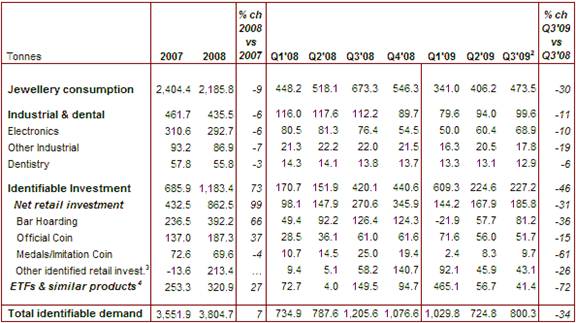
Jewelry demand tends to fluctuate with disposable cash; this is why we saw a 9% drop in gold jewelry demand from 2007 to 2008 and approximately 25% decrease from 2008 to 2009.
What occurred simultaneously was a 72.5% increase in gold investment demand from 2007 to 2008 as investors fled the stock market and sought refuge in gold. The next year experienced even more of the same as investment demand in the first 3 quarters of 2009 saw an increase of 30% over the same time period in 2008. A micro economist might want to stop here and claim that this increased demand accounted for the increased price of gold. Not so fast; let’s dig a bit further.
click to see larger image
Gold has been steadily on the rise since July of 2001; averaging 14.4% increase annually from 2001-2007, the seven years before we saw huge jumps of investors from the stock market to the gold market.
The 2007-2008 increases were 20.3% and 2008-2009 increases were 10.4% for a two year average of 15.35%. This means that even when the investment market more than doubled over the same two year period, all of this increased demand correlated to an increased price gain of less than 1%. The increase from 2004-2005 was 26.4% and five of the six years from 2001-2007 saw increases greater than those of 2008-2009.
So what does this mean? The gold market is moving independently of investment demand and industry supply.
The Threat of Private Gold Influx
This in and of itself is enough to disprove the claims that Mr. Tully makes in his article, but he’s got one more laughable arrow to let fly. After mentioning that gold mines “are investing heavily to increase production” he writes this: “The real threat: Prices are so high all over the world that people who once treasured their gold jewelry are now rushing to sell it. Swiss refiners are offering irresistible prices for bracelets and brooches, “cash-for-gold” stores are in Chicago malls, and suburbanites are hosting Tupperware-style parties where neighbors show up to hock their gold teeth.”
Yes, gold mining companies the world over are ramping up production to meet this incredible demand. And increased selling of gold could theoretically introduce a rather large resource pool into the investment market as it has traditionally accounted for approximately two/thirds of demand worldwide. This theory, however, has several problems. First, once gold is mined into jewelry it moves from the world of intrinsic value to that of abstract value. Much of the price of a piece of jewelry is its design & manufacture costs combined with profit markup; it’s possible that as little as a quarter of what you’re paying for is the actual value of the metal. This means that the price of gold would have to double to quadruple from when you bought your ring simply to recoup your costs. Add to that the fact that most gold jewelry is sentimental to some degree and few people have enough disposable gold to even bother with the hassle of selling it.
Gold & The Dollar
Gold is hardly in a bubble as it is moving independently of investors’ best efforts. Gold is merely moving in response to fiat monetary policies in ways that will only become completely apparent with the benefit of hindsight.
Gold is a concrete store of value with six millennia of proven track record as a monetary commodity behind it. The dollar, in its current configuration, has only been in existence for 39 years and is a fiat currency in a world where every fiat currency except for those currently in use has failed. Every single one.
Does the fact that the dollar is inflating tremendously mean that gold is overvalued? Of course not. As long as the dollar continues to display self-destructive trends gold will continue to be a safe place to be. It’s not going anywhere…except for up.


Leave a Reply