
By Ryan McMaken It is not uncommon to encounter political theorists and pundits who insist that political centralization is a boon to economic growth. In both cases, it is claimed the presence of a unifying central regime—whether in Brussels or in Washington, DC, for example—is essential in ensuring the efficient and free flow of goods throughout a large jurisdiction. This, we are told, will greatly accelerate economic growth. In many ways, the model is the United States, inside of which there are virtually no barriers to trade or migration at all between member states. In the EU, barriers have been falling in recent decades. The historical evidence, however, suggests that … [Read more...]
The Effects of Raising the Debt Ceiling
In this article, Professor Daniel Lacalle examines the relationship between Federal debt and crony capitalism. ~Tim McMahon, editor. Key Facts: Congress has raised the debt ceiling 78 times since 1960 US debt to GDP is 123.4% 8% of the budget goes to pay interest Discretionary spending is around 30% of the budget Fiscal year 2023 outlays = $5.9 trillion The United States budget is unsustainable More Federal Debt Means More Taxes, Less Growth, and Weaker Real Wages By Professor Daniel Lacalle Since 1960, Congress has raised the debt ceiling 78 times, according to Bloomberg. The process of increasing the debt limit has become so regular that markets barely worry … [Read more...]
Annual Inflation Virtually Unchanged in April
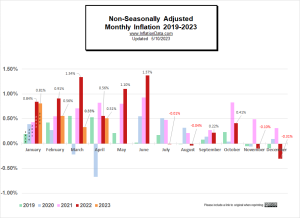
According to the Bureau of Labor Statistics CPI report released on May 10th, Annual Inflation declined by 0.1%... but according to our calculations, it was even less than that. The BLS reported a decline from 5% to 4.9%, but when carried to two decimals, it was virtually a rounding error difference. Monthly inflation was 0.51% for April 2023, compared to 0.56% in April 2022. April 2023 Inflation Summary: Annual Inflation fell from 4.98% to 4.93% CPI Index rose from 301.836 to 303.363 Monthly Inflation for April was 0.51% Next release June … [Read more...]
Central Banks Respond Differently to the Banking Crisis
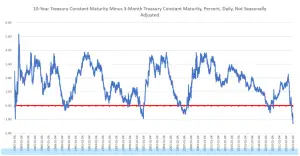
Central bankers don't like surprises, so they tend to communicate among themselves in order to coordinate their response to every new crisis. And this week there was a wave of responses to the combination banking crisis and still high inflation. The Cause Raising interest rates from near zero to over 4.5% in a short period of time puts stress on banks' liquidity as it causes an "inverted yield curve", i.e., short-term interest rates are higher than the locked-in long-term rates. Thus banks are paying out more (on short-term deposits) than they are receiving (on long-term mortgages). The Effect So you would think the Central Bankers would be prepared to deal with the … [Read more...]
Is The Fed Flashing Signs It’s Done Raising Rates?
The Federal Reserve’s Federal Open Market Committee (FOMC) on Wednesday raised the target policy interest rate (the federal funds rate) to 4.75 percent, an increase of 25 basis points. With this latest increase, the target has increased by 4.5 percent since February 2022, although this latest increase of 25 basis points is the smallest increase since March of last year. Indeed, the FOMC has slowed its rate of increase over the past three months. After four 75 basis point increases in 2022, the committee approved a 50-point increase in December, followed by the 25-point increase this week. In other words, the FOMC has been slowed down in its monetary tightening. The committee was … [Read more...]
Why the Fed Is Bankrupt and Why That Means More Inflation
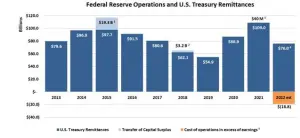
In 2011, the Federal Reserve invented new accounting methods for itself so that it could never legally go bankrupt. As explained by Robert Murphy, the Federal Reserve redefined its losses so as to ensure its balance sheet never shows insolvency. As Bank of America’s Priya Misra put it at the time: As a result, any future losses the Fed may incur will now show up as a negative liability (negative interest due to Treasury) as opposed to a reduction in Fed capital, thereby making a negative capital situation technically impossible. That was twelve years ago, and it was all academic at the time. But in 2023, the Fed really is insolvent, although its fake post-2011 account doesn’t show this. … [Read more...]
November FED Announcement Rocks Stock Market
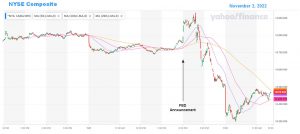
The FED Giveth and the FED Taketh Away On Wednesday, November 2nd, the FED held its "Federal Open Market Committee meeting" and made the announcement the market has been breathlessly awaiting. As expected, Chairman Jerome Powell announced a hike of 75 basis points in the fed funds rate. Along with the announcement, the market was hoping for some indication of a "pivot", i.e., that the FED would give some indication that it was going to be slackening off on its rapid rate increases. And in this respect, the November FED Announcement did throw the market a bone. It added the new phrase “Cumulative Tightening” to the standard announcement. So, going forward, the FED will take the fact … [Read more...]
September 2022 Inflation Virtually Unchanged
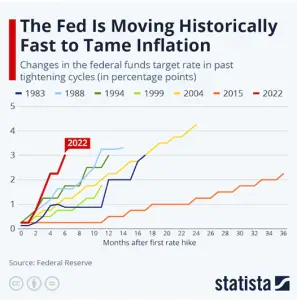
The Bureau of Labor Statistics reported that for September 2022, Annual Inflation fell from 8.26% to 8.20% Inflation Summary: Annual Inflation fell from 8.26% to 8.20% CPI Index rose from 296.171 to 296.808 Monthly Inflation for September was 0.22% Seasonally Adjusted Monthly Inflation was 0.4% Next release November 10th September Annual Inflation was 8.20%. Jan. 2021 -- 1.40% | Jan. 2022 -- 7.48% | Feb. 2022 -- 7.87% | March 8.54% | Apr. 2022 --8.26% May 2022 -- 8.58% | June 2022 -- 9.06% | July 2022 -- 8.56%% | August 2022 -- 8.26% | September -- 8.20% BLS Inflation Report: The BLS Commissioner reported, "The Consumer Price Index for All Urban Consumers (CPI-U) … [Read more...]
Jerome Powell “Channels” His Inner Paul Volcker
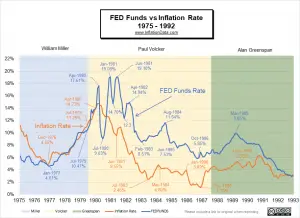
Federal Reserve Chairman Jerome Powell is sounding more and more like former FED Chairman Paul Volcker, who served as the chairman of the Federal Reserve from August 1979 to August 1987. Volcker is best known for his historic fight to vanquish inflation in the early 1980s. Before Volcker took over as the head of the FED, Inflation had risen from a low of 4.65% in December 1976 to 11.26% in July 1979. During that time, FED chairman William Miller raised the FED funds rate from 4.61% to 10.47% in July of 1979. During Miller's time, the FED funds rate pretty much tracked the inflation rate, with a couple of month lag. Prior to Volcker, the prevailing monetary theory was that the FED … [Read more...]
Surprise, Surprise, The FED Raises Rates by .75%
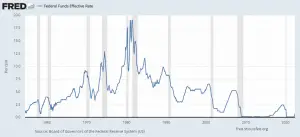
At its June 15th meeting, the FED announced that it will be raising rates by ¾%. Up until last week, this would have been a big shock to the market. But despite the imposed FED silent period leading up to their Wednesday meeting "somehow" journalists from all the major financial publications published remarkably similar articles predicting a 0.75% increase in the FED funds rate. Prior to this leaked guidance, the consensus was that the FED would increase rates by ½% but last week's higher-than-expected inflation report threw a wrench into the works. Everyone is making a big deal out of the fact that this is the first raise of that magnitude since 1994. And that it will double the FED … [Read more...]

