By David
Galland, Managing Editor,
The Casey Report
While everyone else has been focused on the banks’ stress tests and
how much government is spending to bail out troubled “too big to
fails,” a disturbing trend on the other side of the equation is now
emerging: how much (or rather, how little) the U.S. government is
receiving in tax revenues.
After combing through the past 25 editions of the “Monthly Treasury
Statement of Receipts and Outlays of the United States Government,”
which is compiled and published by the Treasury Department’s
Financial Management Service, we created the following chart.
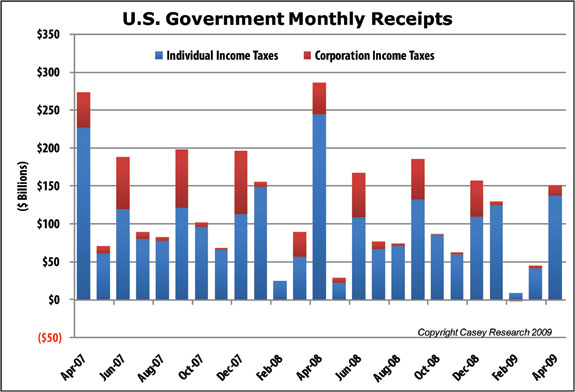
Here’s what’s
going on:
- In 2007 and 2008, government tax revenues
averaged about $633.15 billion per quarter. For the first
quarter of 2009, however, the numbers just in tell us that tax
receipts totaled only about $442.39 billion -- a decline of 30%.
- Looking to confirm the trend, we compared
the data for April – the big kahuna of tax collection months –
to the 2007-2008 average, and found that individual income taxes
this year were down more than 40%. The situation is even worse
for corporate income taxes, which were down a stunning 67%!
- When you add in all revenue from all
sources (including Social Security revenue, government fees,
etc.), the fiscal year-to-date – October through April – revenue
shortfall comes to 19%, vs. the 14.6% projected in Obama’s
budget. If, however, the accelerating shortfall apparent
year-to-date, and in April in particular, continues, the spread
between projected and actual tax receipts will widen
considerably.
Tellingly, for the first time since 1983, the U.S. government posted
a deficit in April. That’s a big swing in the wrong
direction, as the bump in personal tax collections in April
historically results in a big surplus -- on average about $68
billion.
What are the implications of this tanking tax revenue?
For starters, it means the federal government deficit is going be as
bad or worse than the $2.5 trillion Bud Conrad, chief economist of
Casey Research, projected it to be last year.
If the shortfall in individual and corporate tax revenue persists --
and we expect it will -- then the deep hole the government is
already digging for itself will be that much deeper.
Using the government’s own expense projections, the revenue
shortfall, even if it doesn’t worsen further, would push the fiscal
2009 budget deficit up to about $1.958 trillion. For reasons we’ve
discussed at some length in
The Casey Report, those
expense projections are likely to be significantly understated.

Case in point, in January the government projected a $1.2 trillion
deficit for fiscal year 2009… in March, just three months later,
they upped the projection to $1.8 trillion. That $600 billion
“adjustment” alone totaled more than any full-year budget deficit in
the nation’s history.

Yet, the real fly in the ointment is that the
actual borrowing by the Treasury is likely to be at least half a
trillion dollars more than the deficit.
That’s because the Treasury is buying toxic paper (mortgage, credit
card loans, etc.) and putting them on the books with a higher value
than the market is willing to assign. While that makes the budget
deficit appear smaller, it doesn’t negate the fact that the
government still must borrow the money needed to buy the toxic paper
in the first place. The additional revenue shortfall means they have
to raise that much more money. Based on the struggle they had
pushing the $14 billion in long-term notes at the latest auction, it
becomes increasingly apparent that when push comes to shove, the
only way the government is going to come up with the money needed to
meet its aggressive spending is to print it up.
In other words, events are rolling out almost exactly as we have
been anticipating. Below, for example, are some useful excerpts from
an April 3 article titled “Widening
Deficits” by Casey Research CEO Olivier Garret. To quote…
In the midst of the Great Depression, the
1931 federal tax revenues had fallen by 52% from their 1929 highs.
While we do not expect anything that dramatic in 2009, it would not
be unrealistic to see a 20% to 25% reduction in cash flow from tax
collections this tax season. Such a drop would pose significant
challenges given that spending commitments are off the charts and
climbing.
Later in that same article, Olivier continued,
In the absence of sizeable increases in tax
revenues, it is quite clear that the lion’s share of the planned
sales of Treasuries in 2009 cannot be met by demand from the market.
Either the Treasury will have to raise interest rates significantly,
or the Fed will need to step in very aggressively to support the
planned auctions. Our expectation is that both will happen. Auctions
will fail and the Fed will step in. The market will react to more
printing by anticipating inflation and demanding higher interest
rates. Once the cycle starts, it will be very hard to pull interest
rates back.
We continue to stand by our December forecast that the 2009 budget
deficit is more likely to widen to levels between $2.5 and $3
trillion rather than the CBO’s $1.8 trillion forecast. We also
believe that inflation could start setting in as early as Q3 of 2009
and will accelerate sharply by 2010. Treasury Rates will start
climbing and the era of cheap money will end, making it harder for
overleveraged consumers, businesses, and governments to service
their debt.
Olivier’s forecast of failed auctions and rising interest rates on
Treasuries proved more prophetic as a May 7th story from Bloomberg
reported:
Treasury 30-year bonds fell the most in four
months as investors demanded higher-than-forecasted yields at
today’s auction of $14 billion of the securities with the U.S.
slated to sell a record amount of debt this year.
“This is a problem,” said Chris Ahrens, head interest-rate
strategist at UBS AG in Stamford, Connecticut, one of 16 primary
dealers required to bid in Treasury auctions. “The market required a
fairly significant discount to buy the bonds.”
Thirty-year bonds have lost investors 20.9 percent this year,
Merrill Lynch & Co. indexes show, as the Treasury increases
securities sales to help fund a swelling budget deficit. Yields
climbed to a six-month high today as the auction drew a yield of
4.288 percent, higher than the 4.192 percent average forecast in a
Bloomberg News survey of seven primary dealers. Demand was below
average, judging by total bids.
The benchmark 30-year bond yield climbed 23 basis points, or 0.23
percentage points, the most since Jan. 5, to 4.316 percent, at 5:25
p.m. in New York, according to BGCantor Market data. It was the
highest yield since Nov. 14. The 3.5 percent security due in
February 2039 dropped 3 15/32, or $34.69 per $1,000 face amount, to
86 3/8.
The 10-year note yield increased 16 basis points to 3.345 percent,
the highest since Nov. 24.
Two-year notes yielded 1 percent for the first time since March 18,
while the rate on the three-month Treasury bill was 0.18 percent.
So, what does all this mean?
The rock-and-the-hard-place scenario we have
been predicting is unfolding before our eyes. At this point, other
than sharply changing course and letting the free market cope with
the crisis through a brutal “survival of the fittest” scenario, the
government is left with no other option than to accelerate its
buying up of its own debt.
Which is to say, it must push even harder on the levers of its
printing presses, further setting the stage for the massive
period of inflation we continue to see as inevitable… and for
the stunning rise in interest rates we are now positioning ourselves
for in
The Casey Report .
Editor's Note~ The Casey Report could
become your most valuable tool for protecting yourself from the
ravages of inflation. For more information on how to get your
copy of this important information check out
The Casey Report .
