By Andrew Gordon
The stimulus package has come and gone. And retail sales are once again feeling the pinch.
So, should the government put together a second package for exhausted consumers? After all, if the government can afford to throw $300 billion at Freddie and Fannie, certainly the government can spend another $145 billion to boost spending going into the holidays, right?
But with gas prices going down, maybe we don’t need another stimulus package. I was asked yesterday by CNBC if lower gas prices would help spending and boost the economy. I said it wouldn’t help much.
A quick look at the numbers might suggest otherwise. After all, every penny increase for a gallon of gas equals more than $1 billion in consumer spending over a year (according to Citigroup).
But let’s break down the numbers a little more.
On June 1st, American households were spending an average of $83 a week for gas. Gas peaked around mid-July along with crude’s peak. American households were spending $86.50 per week for gas. Since then the price of gas has dropped roughly 12 percent to $76. So families are now saving $10 per week from the peak in mid-July.
But gas is still falling. And it’ll continue to fall as crude bursts under the $100 per barrel barrier. Gas is right now averaging $3.65 a gallon. I believe it’ll easily go below $3.50 by the end of the year. That’s another four percent drop. But let’s be conservative and raise gas savings by two percent. So families will be saving $12 per week from now until the end of the year.
There are 12 more weeks to go before the holiday season begins. The savings for families before they hit the stores on “Black Friday”? It’s a grand total of $144.
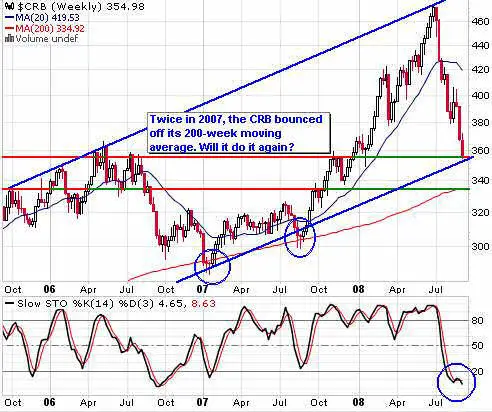
And, mind you, this is not a check you get in the mail. The savings will accrue gradually. People will hardly notice the savings. Of course, they might notice that they’re still paying high prices for food and other goods – despite a drop in commodity prices. Take a look at the CRB commodity index…
Commodity prices are down an average of 25 percent from their peak in June. They’re hitting a support level right now and are oversold (according to the Slow Stochastics).
But with the rest of the planet following the U.S. economy down the toilet, prices could easily continue to fall. The real test will come when (and if) prices fall to the 200-week moving average support at about 340.
They haven’t fallen below that level since mid-2002 when the economy was just coming out of a recession. Of course, back in 2002, you didn’t have trillions of dollars of hedge fund and other institutional money fleeing the commodity markets, either, like you do today. So the drop in commodity prices is happening much earlier in the economic cycle.
These falling prices, however, will take a while to reach the stores. You see, manufacturers have been swallowing the bulk of input price hikes over the past few months when these prices were surging. Now that they’ve fallen back, these companies have a chance to build their profit margins back up.
We’re seeing the same thing with gas prices. Margins for gas refiners have tripled since September 1st.
As much as the Fed likes to see these lower prices (because they help keep a lid on inflation), they do not help the economy grow.
Rather, it’s a sign of no growth or slowing growth. It may feel good to our wallets, but the fact is, when the economy is growing strong, we can afford higher prices. And when it’s going badly – like it is these days – lower prices don’t help much.
With de-leveraging and global growth fading fast, commodities should fall much further. When they find a true bottom, it will be a sign that the worst is behind us. We have a ways to go.
As I’ve said before, a smart move would be to buy more precious metals. They’ve been part of the rundown in prices recently. But as global economic problems deepen, gold should once again be in heavy demand.
Invest well,
Andrew Gordon


Leave a Reply